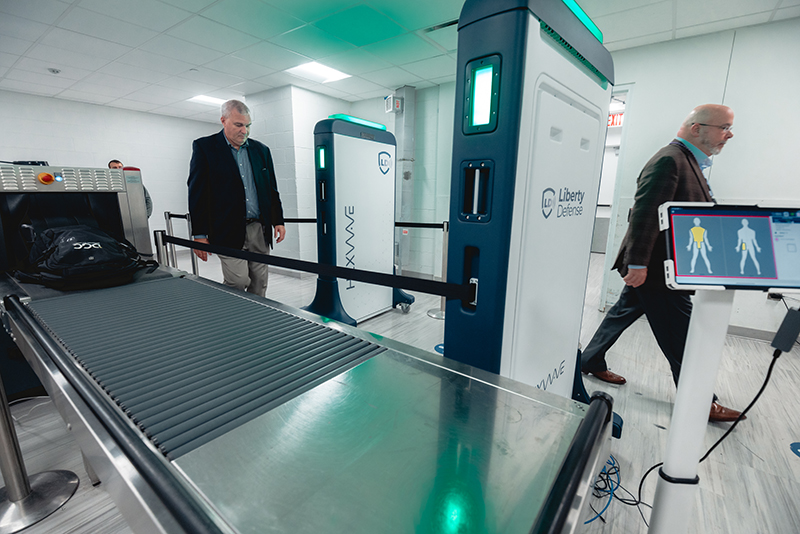
Liberty Defense Holdings Ltd. (CVE: SCAN) (OTCMRKTS: LDDFF) (FSE: E30) has joined the NVIDIA Connect Program to enhance its AI-driven security technology, the company announced. This collaboration aims to bolster Liberty’s development of advanced detection systems designed to identify concealed weapons and other potential threats. The partnership is expected to provide Liberty with access to cutting-edge hardware, expert training, and co-development opportunities, fostering a quicker pace of innovation.
Through this collaboration, Liberty anticipates improvements in automated threat detection capabilities across its existing platform, which features High-Definition Advanced Imaging Technology, Open Architecture systems, and its HEXWAVE scanner. The firm plans to broaden its threat detection scope and accelerate identification speed, while also leveraging the program to develop new AI functionalities that could enhance real-time decision-making processes.
Access to NVIDIA engineers will enable Liberty to refine its coding models, a critical step that could facilitate wider commercial deployment of its technology. The company aims to strengthen its AI processing capabilities to improve the accuracy of threat identification. Liberty anticipates that this initiative will assist in scaling its products for applications in airports, stadiums, schools, and other public venues.
Bill Frain, CEO of Liberty Defense, characterized the acceptance into the NVIDIA Connect Program as a significant milestone for the company. “We’re highly encouraged by the early progress we’ve made utilizing NVIDIA’s tools in edge-AI deployment for standalone HEXWAVE units, which we believe will support seamless integration into existing security infrastructures,” Frain stated.
The partnership is also seen as a strategic move to enhance Liberty’s readiness against emerging threats. The company aims to utilize improved processing speeds to mitigate bottlenecks in high-traffic environments, while more capable AI models are expected to support “future-proofing” against new risks.
HEXWAVE, Liberty’s screening portal, employs low-power radar and millimeter-wave imaging, integrated with artificial intelligence to analyze individuals in real time. This system constructs three-dimensional data, enabling the software to flag concealed metallic and non-metallic threats concealed in bags or underneath clothing. The contactless screening process eliminates the need for physical searches, thereby facilitating quicker movement through security checkpoints and allowing for more flexible layouts.
Over the past year, Palm Springs International Airport in California has deployed HEXWAVE for aviation worker screening. Additionally, Liberty has secured contracts for HEXWAVE units at the New Terminal One at JFK International Airport in New York, specifically for aviation worker screening checkpoints. One of the largest international airports in the United States has also ordered multiple systems for staff checkpoints, as facilities run pilot installations to comply with new worker screening mandates from the Transportation Security Administration.
Liberty Defense views its partnership with NVIDIA as an opportunity to deepen its long-term AI strategy. It expects this collaboration to spur broader innovation resulting from shared development efforts with NVIDIA scientists. This initiative reflects Liberty’s commitment to developing more efficient security screening systems that can adapt to evolving security demands.
As the landscape of security threats continues to evolve, Liberty’s advancements in AI technology through this partnership could play a crucial role in enhancing public safety across various sectors.
See also AI-Driven Cyberattacks Employ Polymorphic Malware, Transforming Threat Dynamics
 Google AI Security Expert Reveals Top 4 Tips to Protect Your Data with Chatbots
 Edgebase Invests in Cybersecurity, Expands AI Solutions Amid Rising Threats in Nigeria
 AI Enhances Ransomware Defense with Early Detection and Automated Response Strategies
 Google Cloud Reveals 2026 Cybersecurity Forecast: AI to Amplify Threats and Defenses