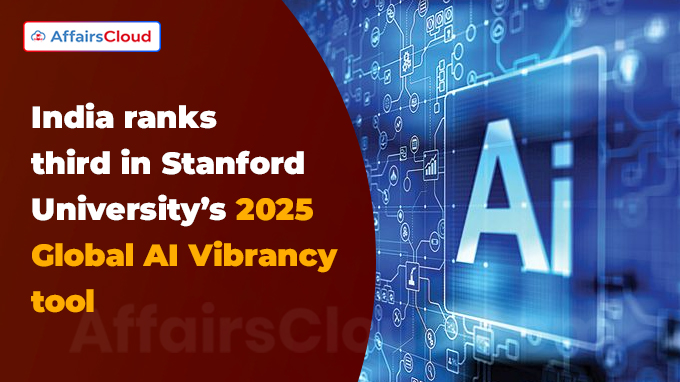
In December 2025, the Stanford Institute for Human-Centered Artificial Intelligence (HAI) unveiled its latest findings through the Global AI Vibrancy Tool (GVT) 2025. This development highlights India’s ascent in the global artificial intelligence landscape, as the country achieved a third-place ranking in the 2024 Global Vibrancy Index with a score of 21.59. This marks a notable improvement from its previous ranking of seventh in 2023. The United States continues to lead the index with a commanding score of 78.6, followed by China, which ranks second with 36.95.
The GVT serves as a data-driven benchmarking tool, developed by Stanford University, aimed at evaluating and visualizing the vibrancy of national AI ecosystems. The latest iteration provides updates on AI activity across various countries, capturing data up to 2024. Notably, the tool measures AI ecosystems through seven pillars: Research and Development (R&D), Talent, Economy and Investment, Policy and Governance, Infrastructure, Responsible AI practices, and Public Opinion.
The 2025 update has streamlined the assessment criteria, reducing the overall number of indicators from 42 to 23. This revision reflects a consolidation of the former Education and Diversity pillars into a single Talent category, indicating a sharper focus on the core aspects of AI development.
South Korea and the United Kingdom follow India in the rankings, securing the fourth and fifth positions with scores of 17.24 and 16.64, respectively. Singapore, Spain, the United Arab Emirates, Japan, and Canada round out the top ten, further illustrating the global competition in AI advancements.
The performance of the United States across all measured categories remains unparalleled, with the country retaining the top spot in R&D, Responsible AI, Economy, Talent, Policy and Governance, Public Opinion, and Infrastructure. China consistently occupies the second position in these areas, underscoring its ongoing commitment to AI development.
India’s rise in the rankings can be attributed significantly to the expansion within the Talent and Workforce pillar. The country’s growing pool of AI-skilled professionals, coupled with an increase in AI-related activities in its software and technology sectors, has contributed to this upward trajectory. Moreover, the country has witnessed a rise in scientific publications, patents, and global collaborations in AI, bolstering its R&D capabilities.
The impact of these developments is multifaceted. As India continues to enhance its standing in the global AI ecosystem, it positions itself as a key player in shaping the future of technology. This progress reflects not only a growing national commitment to innovation but also an increased recognition of the importance of fostering a robust and responsible AI landscape.
The GVT 2025 provides a comprehensive view of AI vibrancy worldwide, offering insights into how different nations are progressing in this critical field. The implications of these findings extend beyond mere rankings; they serve as a barometer for the global AI race, highlighting the competitive landscape among nations aiming to lead in technological innovation.
As countries strive to enhance their AI ecosystems, the insights provided by the Global AI Vibrancy Tool will be crucial for policymakers, industry leaders, and researchers alike. The ongoing evolution of AI technology remains a pivotal aspect of national agendas, with the potential to drive economic growth, improve societal well-being, and shape the future of work. The outcomes of this competitive environment will not only influence technological advancement but also impact global economic dynamics as nations navigate the complexities of AI integration.
For detailed insights and further information, refer to the official Stanford HAI website at Stanford HAI.
See also Thales Partners with Cohere to Develop AI Solutions for Canada’s Navy
 AI-Driven Dental Imaging Market to Surge from $351.1M to $2.3B by 2034, Transforming Diagnostics
 Peloton’s Holiday Sale and AI Strategy: Key Insights on Valuation Risks and Opportunities
 EU Opens Antitrust Investigation into Meta’s WhatsApp AI Restrictions for Businesses
 OpenAI, Apple, Amazon Join $200K US Tech Force to Boost Government AI and Cybersecurity