






















































AI Revolutionizes Antibody Discovery Amid Rapid Market Growth
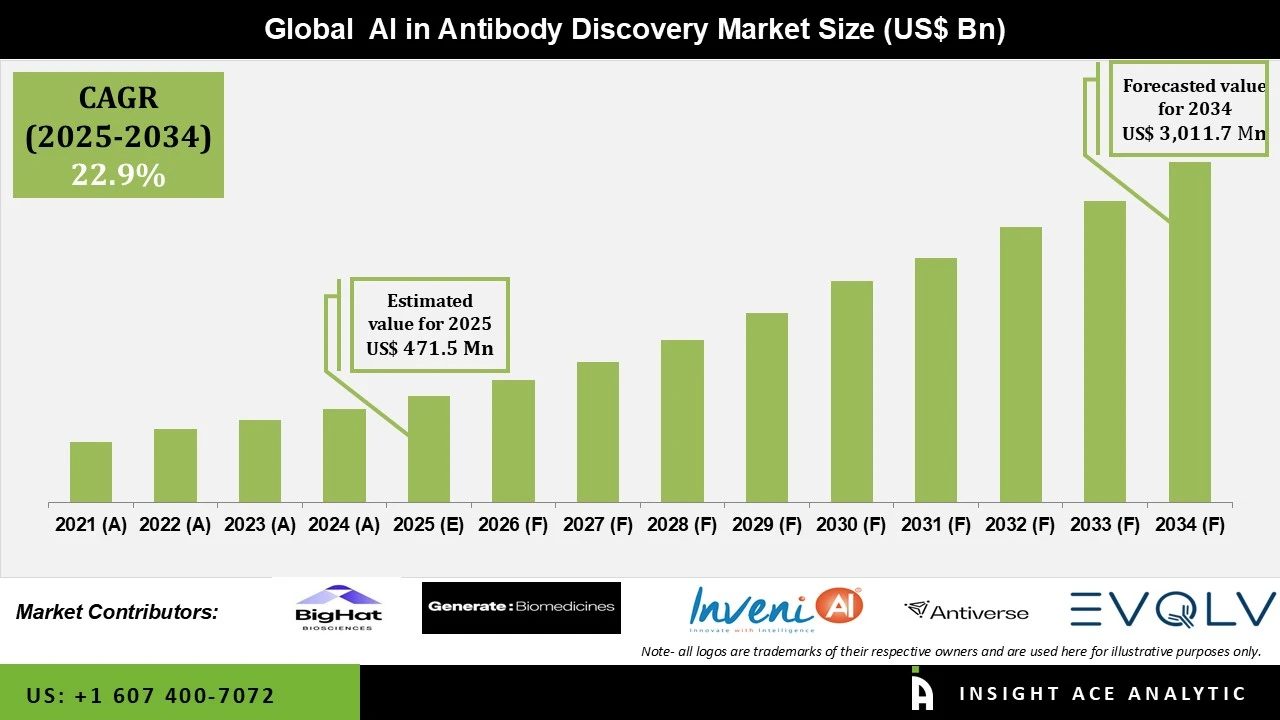
The global market for AI in antibody discovery is projected to grow significantly, with expectations to increase from a valuation of USD 471.5 million in 2024 to approximately USD 3,011.7 million by 2034, reflecting a robust compound annual growth rate (CAGR) of 22.9% during the period spanning 2025 to 2034. This remarkable growth is driven by advances in artificial intelligence (AI) and machine learning (ML) that enhance the efficiency and effectiveness of therapeutic antibody identification, design, and optimization.
AI technologies are transforming the antibody discovery landscape by enabling researchers to analyze vast biological datasets, including protein structures and genetic sequences, to predict antibody binding affinity, specificity, stability, and immunogenicity. By leveraging these capabilities, pharmaceutical companies can swiftly screen millions of antibody candidates, design novel sequences, and refine lead molecules before proceeding to costly laboratory investigations. Market expansion is fueled by increased scientific breakthroughs, the rising demand for targeted therapies, and the prevalence of chronic diseases like cancer and autoimmune disorders.
Recent trends indicate that high-throughput screening, combined with AI, is not only accelerating discovery processes but also enhancing productivity while reducing costs. The collaboration between pharmaceutical companies and academic institutions further propels innovation in this domain. Additionally, the emphasis on producing biosimilars and monoclonal antibodies, alongside the growing trends of personalized medicine, is fostering investments into AI technologies for antibody discovery, leading to improved therapeutic options.
Despite the promising outlook, challenges remain. Significant hurdles include the substantial initial investments required for AI implementation, the need for specialized personnel, and various regulatory complexities surrounding AI-generated drug candidates. However, ongoing advancements in deep learning, machine learning, and natural language processing are continuously addressing these limitations.
The structure prediction segment is expected to dominate the AI in antibody discovery market, given its critical role in accurately modeling antibody stability and 3D structures. Enhanced precision in structural predictions allows pharmaceutical and biotechnology companies to expedite the development of effective antibodies, thus shortening experimental timelines. Recent improvements in deep learning architectures have further accelerated these capabilities, driven by the increasing availability of high-quality structural resources.
In 2024, the pharmaceutical, biotechnology, and platform-developing companies segment is anticipated to achieve the highest growth rate in the AI in antibody discovery market. These entities possess significant infrastructure and investment power, allowing them to navigate the intricate regulatory landscape while driving continuous innovation in antibody therapies.
North America is set to lead the AI in antibody discovery market, primarily due to its robust healthcare system, advanced technological infrastructure, and considerable investments in pharmaceutical research and development. The United States, in particular, is home to numerous AI-driven drug development initiatives led by major corporations such as IBM Watson Health and Tempus. Government support in the form of funding for AI research and regulatory initiatives further bolsters the region’s leadership.
Key developments in this dynamic market are evident. In May 2025, Danaher Corporation announced a strategic partnership aimed at enhancing precision medicine through digital and computational pathology solutions, integrating AI-assisted algorithms to improve patient targeting for antibody-drug conjugates. In March 2025, Nona Biosciences unveiled the Hu-mAtrlx, an AI-assisted drug discovery engine designed to accelerate antibody discovery across various therapeutic areas, while also strengthening its international collaborations with companies such as Visterra and Atossa Therapeutics.
As the AI in antibody discovery market continues to evolve, the potential for innovative therapeutic solutions becomes increasingly apparent, signifying a paradigm shift within the biotech and pharmaceutical industries. The ongoing integration of AI technologies promises not only to enhance the efficiency of antibody discovery processes but also to pave the way for next-generation biologic drug development, ultimately transforming how complex diseases are treated.
See also Corporate America Faces 1.17M Job Cuts in 2025, Eroding Human Capital Amid AI Push
 OpenAI Negotiates $10B Amazon Investment Amid $500B Valuation Talks
 NVIDIA Partners with DOE to Revolutionize U.S. AI Infrastructure and Scientific Discovery
 AMD Stock Rebounds 3.4% Amid AI Funding Concerns; Piper Sandler Maintains $280 Target
 Interconnects Doubles Audience to 40K in 2025 Amid Surge in Open Model Discussions















