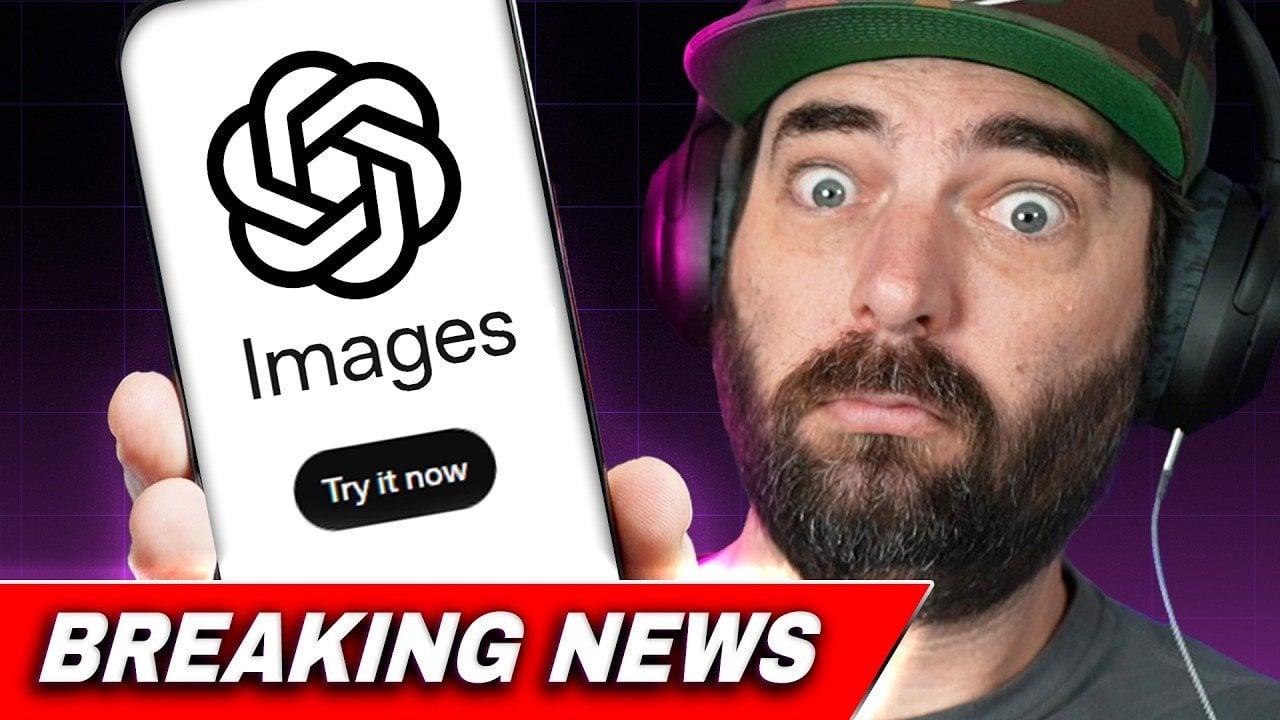
OpenAI has launched ChatGPT Image 1.5, a revolutionary update that significantly enhances its image generation capabilities, positioning it as a formidable challenger to Google’s Nano Banana Pro. This update boasts four times faster image generation speeds coupled with a 20% reduction in costs, suggesting not only an incremental improvement but a potential shift in the competitive landscape of AI image generation. The innovative features and performance upgrades of ChatGPT Image 1.5 could redefine user expectations and workflows just as Nano Banana Pro has long dominated the space.
In his analysis, Matt Wolfe delves into the disruptive elements of ChatGPT Image 1.5, highlighting creative breakthroughs such as multi-step editing and likeness retention, alongside improved technical precision for handling complex layouts and text rendering. While Nano Banana Pro has built a strong reputation for consistency and reliability, the advancements offered by OpenAI raise questions about whether it can maintain its standing amid this new wave of innovation.
Key improvements in GPT Image 1.5 include substantial increases in speed and cost efficiency, making it a practical option for users across various sectors. The model’s ability to generate images up to four times faster than its predecessor allows for quicker turnaround times, crucial in scenarios where efficiency is essential. Furthermore, the reduction in API costs enhances its accessibility for both businesses and individual users.
The introduction of new features aimed at fostering creativity further distinguishes GPT Image 1.5. A dedicated “Images” tab provides users with preset styles to explore diverse aesthetics, while the likeness retention feature ensures that characters or elements maintain consistent appearances across multiple images. Additionally, a discovery feature highlights trending use cases, encouraging users to experiment and broaden their creative horizons.
In terms of technical capabilities, GPT Image 1.5 enhances multi-step editing, allowing users to refine images with greater precision. Improved spatial reasoning helps the model adhere to complex designs, making it suitable for detailed projects like architectural renderings. Enhanced text rendering facilitates the handling of intricate textual elements, while advanced capabilities for rendering faces, logos, and other challenging elements bolster its appeal for commercial applications.
Despite these advancements, the comparison with Google’s Nano Banana Pro reveals a nuanced rivalry. While GPT Image 1.5 excels in creative flexibility and adaptability, Nano Banana Pro maintains a stronger record of consistency in preserving original elements during edits. Users may find GPT Image 1.5 advantageous for projects requiring innovative and iterative editing processes, whereas Nano Banana Pro could be preferred for tasks demanding strict adherence to initial designs.
However, users must also consider the limitations of GPT Image 1.5. The model may encounter challenges with highly detailed layouts, occasionally straying from user prompts. Moreover, as a creative tool, its outputs can be interpretative, which may not suit projects that require strict factual accuracy. Understanding these limitations can help users set realistic expectations about the model’s capabilities.
OpenAI emphasizes accessibility by making GPT Image 1.5 immediately available to all ChatGPT users, both free and paid, without a waitlist. The user-friendly interface, designed to cater to both technical and non-technical users, simplifies the image generation process, broadening the user base that can harness this advanced AI technology.
As GPT Image 1.5 sets a new benchmark in AI image generation, it reflects a significant evolution in how these tools can meet diverse user needs. While the competition with Google’s Nano Banana Pro remains intense, the combination of speed, affordability, and innovative features in GPT Image 1.5 suggests it is not merely an enhancement but a potential game changer in the realm of AI-driven creativity. This development augurs a new era for users seeking advanced capabilities in image generation, pushing the boundaries of what is possible in creative expression.
See also Receptor.AI Integrates LLMs to Accelerate Protein Binding Pocket Identification
 Skyra Launches Groundbreaking ViF-CoT-4K Dataset for Enhanced AI Video Detection and Explainability
 DuckDuckGo Launches Privacy-Focused AI Image Generator with OpenAI Technology
 Actor Neil Newbon Critiques Generative AI in Gaming: “It Sounds Dull as Hell”
 New Diffusion Model Achieves Advanced Mural Restoration with Guided Residuals and Enhanced Noise Reduction