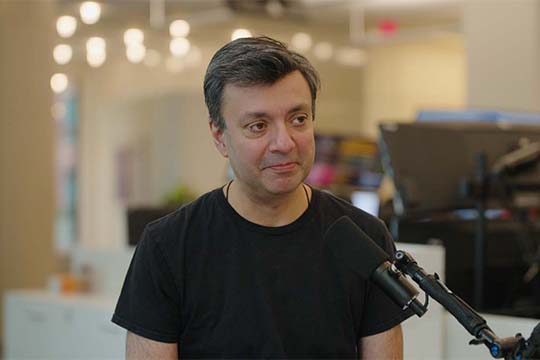
Chris Hussey: This is The Markets. I’m Chris Hussey and today is Thursday, April 30th. I’m here on the trading floor with Anshul Sehgal, global co-head of fixed income, currency, and commodities within Global Banking & Markets. Anshul, thanks so much for joining us here on The Markets.
Anshul Sehgal: Thank you for having me.
Chris Hussey: We’re coming right in the wake of the Fed that came in yesterday afternoon. A little hawkish tilt, maybe. Powell said he’s going to stick around. Rates shrug. What do you make of it all?
Anshul Sehgal: There’s a bit of a divided committee. After the prior meeting, the Fed was signaling one cut this year, largely due to expectations that labor markets would remain weak. However, recent labor market data has been unexpectedly strong, indicating that the US consumer is in better shape than projected. The ongoing war adds inflationary pressure, creating a supply-side shock that the Fed lacks tools to address. They are keen to prevent inflation expectations from becoming entrenched.
Looking at pricing for the ECB, which just held its meeting, they are pricing in three to three and a half hikes this year. They are more sensitive to energy prices since they import all their energy, unlike the United States. Nevertheless, central banks need a more nuanced approach. The recent Fed meeting noted four dissents: one for a cut this meeting and three advocating for a more balanced stance. Essentially, the Fed is not pre-committing to a cut as the next move, which is a minor change that won’t affect policy significantly for the next few months but will shape future debates.
In summary, the committee remains divided. The labor economists still lean towards a cut as the next move, while others like Beth Hammack, Lorie Logan, and Neel Kashkari take a more balanced view.
Chris Hussey: Of course, Powell ended the meeting by saying, “You won’t see me later,” which implies we’ll see Warsh later.
Anshul Sehgal: Right, he was confirmed, so that adds an interesting layer. Warsh has a history of voicing his long-term views, especially regarding the Fed’s balance sheet. He seeks to consider the implications of Fed and Treasury actions, aiming for a smaller balance sheet. However, this will be a slow process. If approached aggressively, it could challenge the financial system. He’s aware of that.
Moreover, Warsh’s stance on inflation versus growth is crucial. We’re currently experiencing a stagflationary shock with rising energy prices, leading to reduced discretionary spending. This situation doesn’t bode well for economic growth if the war continues.
We perceive Warsh as slightly less dovish than Powell, which will influence the policy landscape in the intermediate term. However, we expect no significant changes in Fed policy over the next three to six months. The market is pricing in no hikes or cuts through mid-next year, suggesting a bimodal distribution by mid-2027 regarding Fed actions, averaging to no moves.
Chris Hussey: That highlights the tension between growth and inflation, especially given the Fed’s dual mandates. Switching gears, how do you interpret the current dynamics across fixed income, currency, and commodities markets? With oil prices still elevated and rates moderately higher, equities and credit seem indifferent. How does that reconcile?
Anshul Sehgal: That’s an insightful question. Since the Great Financial Crisis, balance sheets across the economy have been less leveraged compared to pre-crisis levels. The pandemic-induced global fiscal expansion has maintained this trend. In an inflationary environment, less leverage on private balance sheets means that the economy isn’t as frothy as it was in 2008.
Consequently, credit markets have become somewhat detached from macroeconomic concerns. With debt servicing costs manageable despite inflation rates projected between 2% to 4%, the outlook for credit remains stable. Private balance sheets have the capacity to absorb shocks.
Equities, too, are disentangled from traditional economic indicators. The rise of emergent technologies is pivotal, especially as demographics shift with a shrinking labor force due to retiring boomers and decreased immigration. The healthcare sector has driven significant job growth, suggesting resilience and ongoing demand for technological integration.
We now navigate a multifaceted economic landscape, contrasting with the previous decade dominated by deleveraging. The promise of new technologies coexists with entrenched inflation, while improved household balance sheets influence market dynamics.
Chris Hussey: That’s a crucial observation about leverage, which seems to have shifted to the government side. How does this affect the sentiment in fixed income markets?
Anshul Sehgal: Indeed, it has shifted globally, particularly in the United States, which concerns fixed income markets. Current bond yields are elevated, reflecting this dynamic. In the near term, the U.S. government can service its debt, maintaining credibility, though future downturns may test this capacity. Countries like Japan, with higher debt-to-GDP ratios, show how market reactions can become volatile under fiscal expansions.
There’s uncertainty ahead. If AI fulfills its potential, we could witness substantial GDP growth, effectively changing debt-to-GDP dynamics. However, that remains speculative, and the fixed income market appears cautious.
Chris Hussey: We recently saw updates from major companies, especially in the tech sector. How do their results reflect the ongoing AI narrative?
Anshul Sehgal: The earnings reports have been intriguing. Despite geopolitical tensions and inflation, the equity market has remained largely unaffected, particularly as hyper-scalers now comprise over 25% of the domestic market. Investors reacted positively to earnings, particularly since these companies are not ramping up AI capital expenditures heavily in the near term.
Demand for cloud computing has surged due to increased token usage, which is a promising sign for the hyper-scalers. The market’s concerns about AI CAPEX recoupment seem alleviated, with companies showing a clear understanding of AI’s operational costs compared to human labor.
This transformative shift signals potential growth not only for hyper-scalers but also new business models yet to emerge. Anticipated advancements in world models set to launch later this year could further boost token usage and interaction capabilities.
Chris Hussey: This rebound over April has been remarkable, akin to post-GFC and post-COVID recoveries. Do you view this rebound as sustainable or should investors be cautious?
Anshul Sehgal: Our broader thesis remains unchanged. We’re witnessing a credit expansion, which differs from fiscal expansion, as lenders remain cautious about returns on capital. Historical context shows that wars tend to be inflationary, prompting spending that typically favors tech firms. While April was strong, March was less favorable. We initially entered this period with a seven-out-of-ten rating, planning to increase it if valuations improved, but we hesitated. Now, with the rebound, we are back to a seven, wanting to ride the wave but still seeking better entry points.
Chris Hussey: What’s your strategy moving into May?
Anshul Sehgal: May will center on inflation. Labor markets are holding steady, and consumer spending continues, albeit at the expense of savings. How discretionary spending trends will play out in May will be crucial for forward-looking insights. With summer travel season on the horizon, rising airline ticket prices could lead consumers to reduce travel, potentially impacting growth. May’s leading indicators will provide valuable insights into the direction of the market.
Chris Hussey: Thank you for your insights, Anshul.
Anshul Sehgal: Thank you for having me.
Chris Hussey: That concludes this week’s episode of The Markets. I’m Chris Hussey. Thanks for listening.
To hear another perspective on how Kevin Warsh could shape Fed policy, listen to our most recent episode of Exchanges with Rob Kaplan.
See also Kamiwaza Launches 1.0 with Secure AI Orchestration for Regulated Industries
 Iren’s 1.6GW Oklahoma Site Boosts AI Potential, But Nebius Secures $27B in New Deals
 Jensen Huang Critiques AI Doom Predictions, Calls for Fact-Based Discussions
 Cognizant Announces Layoffs Amid AI-Driven Workforce Restructuring, Sees 6,000 New Hires
 Red Hat Reveals Small Language Models as Key to Scaling Enterprise AI Agents