A coalition of prominent American media organizations filed a legal brief supporting Amazon in its dispute with Perplexity AI, emphasizing the need for a preliminary injunction against Perplexity’s Comet AI agent accessing Amazon’s password-protected systems without authorization. The brief, submitted on April 29, 2026, by Digital Content Next (DCN), represents a collective voice from publishers with a combined reach of 259 million unique visitors, covering 95 percent of the U.S. online population.
This submission pertains to Case No. 26-1444, currently before the United States Court of Appeals for the Ninth Circuit. The appeal by Perplexity AI, Inc. challenges a district court ruling favoring Amazon.com Services LLC. The underlying case, No. 3:25-cv-09514, is presided over by Judge Maxine M. Chesney in the Northern District of California. DCN is represented by Huth Reynolds LLP, a law firm based in Huntington, New York.
Founded in 2001, DCN serves as a trade organization for digital content companies, uniting well-established broadcast names and digital-native outlets. Its membership includes major players like the Associated Press, BBC Studios, Bloomberg, The New York Times, and dozens of others. The brief underscores that these members invest substantial resources in journalism, reliant on advertising and subscription revenues to sustain their operations.
The involvement of DCN as an amicus curiae—a friend of the court—signals that the publisher community perceives the case as a test with far-reaching implications beyond Amazon’s e-commerce platform. The brief posits that unauthorized access by AI agents to publisher systems poses a significant threat to the economic structure that underpins journalism.
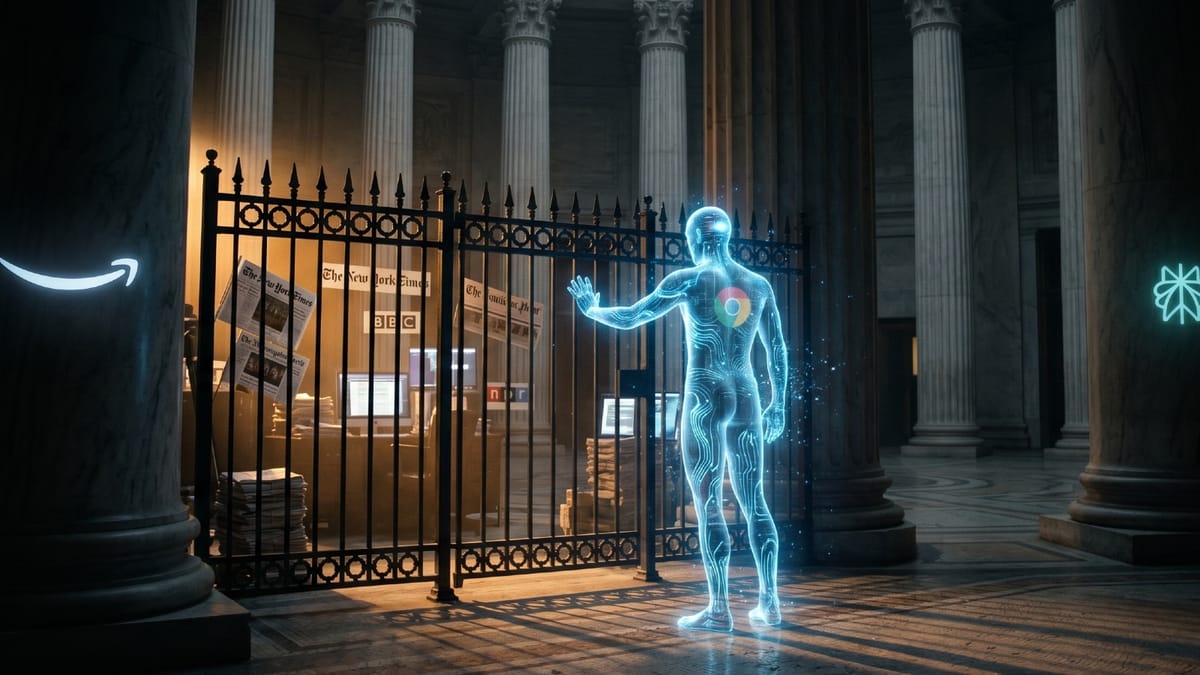
The legal contention centers on Perplexity’s Comet browser, particularly the user-agent spoofing allegations. The dispute began in November 2024 when Amazon raised concerns about Perplexity’s “Buy with Pro” feature, which enabled users to utilize Amazon Prime accounts through Perplexity’s systems. Amazon subsequently filed a lawsuit on November 4, 2025, asserting that Comet was impersonating human users by transmitting the same user-agent string as Google Chrome, blurring the lines between human and automated activity. Following a forensic analysis, Amazon determined that Comet’s browsing behavior was distinct from ordinary customer traffic.
After notifying Perplexity’s CEO Aravind Srinivas on two occasions in September 2025 about the unauthorized nature of Comet’s activities, and receiving no denial, Perplexity made the Comet browser available to the public on October 2, 2025. Amazon issued a cease-and-desist letter on October 31, 2025, and filed its lawsuit shortly thereafter. A preliminary injunction was granted in March 2026, restricting Comet’s access to Amazon’s locked content areas, applying both the Computer Fraud and Abuse Act (CFAA) and California’s Comprehensive Computer Data Access and Fraud Act (CDAFA). Perplexity filed an appeal on April 1, 2026, asserting that the CFAA was misapplied and that the law was not intended to regulate AI shopping assistants functioning on user devices.
DCN’s brief elaborates on the broader implications of unregulated AI access to protected publisher systems. It asserts that AI agent spoofing injures publishers in three key ways: distorting advertising metrics, undermining subscription models, and extracting commercially valuable data used for training large-language models. The advertising concern is particularly acute; advertisers pay for visibility to human audiences, but if AI agents access publisher content while masquerading as human users, the accuracy of audience measurements suffers. DCN cites the experience of the digital publisher Salon, which reportedly lost advertising business due to rising concerns over general invalid traffic.
According to a study commissioned by the Association of National Advertisers, invalid traffic across all media channels stands at 8.5 percent, equating to $63 billion in annual losses—a figure anticipated to escalate as AI agents proliferate. Notably, a report from DoubleVerify indicated an 86 percent year-over-year increase in general invalid traffic during the second half of 2024, with monthly volumes surpassing two billion requests for the first time.
At the heart of Amazon’s complaint is the technical behavior of Perplexity’s Comet browser. Rather than using a unique browser identifier, Comet employs the same user-agent string as Google Chrome, thereby obscuring its automated activities. This decision has prompted Amazon to revise its Business Solutions Agreement, establishing an Agent Policy requiring AI agents to disclose their automated identity and comply with new access regulations.
DCN’s brief contrasts Comet with Amazon’s own “Buy for Me” AI agent, which clearly identifies itself as automated and follows established protocols. This suggests that Perplexity had the technical capability to implement transparency but opted against it. Moreover, Perplexity admits in its brief that Comet captures and transmits content to its servers, which can hinder publishers’ ability to manage their proprietary information over time.
Beyond advertising concerns, DCN warns that Perplexity’s Comet could threaten subscription revenue streams. An AI agent using a single subscriber’s credentials could potentially extract all accessible content, leading to repackaging and redistribution without proper attribution, undermining the very subscriptions that sustain publishers.
As the Ninth Circuit deliberates, the implications extend beyond Amazon and Perplexity. A ruling in favor of Perplexity could destabilize the foundations of digital advertising and subscription models, prompting a need for publishers to invest heavily in detection technology to counteract AI agents. Such financial strain could detract from resources allocated to journalism itself, underscoring the case’s critical significance for the future of the industry.
See also Perplexity Unveils Mac-Native ‘Personal Computer’ Platform with $2.8B in Labor Savings
 BBC Studios Launches Live AI Avatar for Morning Live, Revolutionizing Broadcast TV
 Mistral Launches Medium 3.5, Enabling Cloud-Based Remote Coding Agents in Vibe and Le Chat
 Apple, Google, and Amazon Shine Post-Earnings as AI Demand Reshapes Tech Landscape
 DeepSeek Launches V4 Open-Source Model, Underpricing GPT-5.5 and Claude Opus 4.7