






















































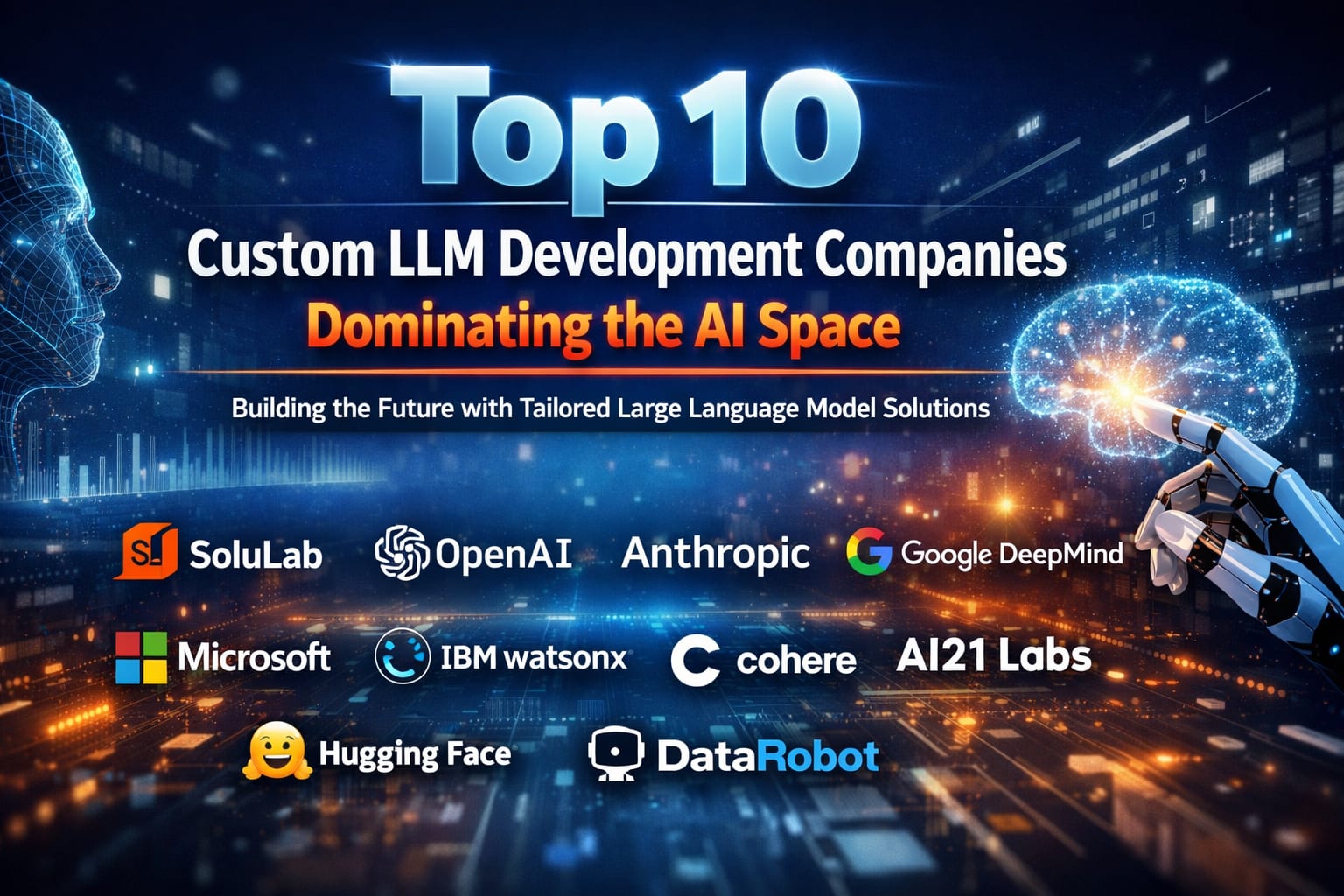
The rapid advancement of Large Language Models (LLMs) is fundamentally transforming the landscape of artificial intelligence, enabling businesses to automate processes, refine customer interactions, and derive profound insights from data. Applications of LLMs are becoming essential across various sectors, ranging from chatbots and virtual assistants to content generation and enterprise automation. However, effectively building and deploying these sophisticated solutions necessitates significant technical expertise and tailored strategies. This is where leading LLM development companies are making substantial contributions.
Among the top players in this arena is SoluLab, which has quickly established itself as a premier provider of custom AI and LLM development services. The company specializes in scalable, business-specific solutions that cater to the unique operational requirements of its clients. Offering end-to-end services from ideation through deployment, SoluLab’s focus on innovation and client-centric approaches positions it as an ideal choice for both startups and large enterprises.
OpenAI, renowned for its pioneering GPT models, continues to set industry standards in natural language understanding and generation. Businesses utilize OpenAI’s APIs to create intelligent applications that automate workflows and elevate user engagement. The company’s ecosystem is designed to facilitate rapid development while ensuring high performance and scalability, making it a cornerstone in the AI landscape.
Another notable contender is Anthropic, which emphasizes safety and reliability in its AI systems. The company’s Claude models are developed with a focus on ethical considerations and alignment, making them particularly appealing to organizations that prioritize responsible AI use. This commitment to safety differentiates Anthropic in a crowded market.
Google DeepMind merges cutting-edge AI research with real-world applications. With the backing of Google’s expansive infrastructure, it harnesses powerful AI capabilities that can be seamlessly integrated into enterprise environments. This integration supports advanced analytics, automation, and informed decision-making, which are critical for organizations looking to enhance their operational efficiency.
Microsoft has also carved out a significant niche in the enterprise AI market through its Azure platform, which provides access to advanced LLMs. The company is recognized for its strong focus on security, compliance, and scalability, allowing organizations to incorporate AI functionalities into their existing systems without disruptions.
Meanwhile, IBM continues to be a trusted name in business transformation through its Watson platform, which emphasizes explainable AI and industry-specific solutions, especially in sectors such as healthcare and finance. IBM’s LLM offerings are designed to ensure reliability and adherence to regulatory standards, which is crucial for enterprises navigating complex compliance landscapes.
Cohere specializes in delivering customizable natural language processing models tailored to the needs of businesses. Its solutions optimize various tasks, including search, summarization, and text generation, thereby assisting companies in creating effective AI-powered applications that enhance productivity.
AI21 Labs, recognized for its Jurassic models, excels in text generation and comprehension. The company aims to boost human productivity by providing intelligent writing and reading tools that improve workflow efficiency. This focus on enhancing user capabilities places AI21 Labs among the most innovative companies in the LLM sector.
Open-source AI leadership is embodied by Hugging Face, which has become a vital hub for open-source AI development. Its extensive library of pre-trained models and tools supports developers in building, customizing, and deploying LLMs with both flexibility and efficiency. This appeal has made Hugging Face particularly popular among startups and research teams looking for adaptable solutions.
Lastly, DataRobot offers a comprehensive AI platform that combines LLM capabilities with automation and MLOps. This integration allows businesses to accelerate the development and deployment of AI solutions while maintaining oversight and governance, ensuring that they can scale effectively while adhering to best practices.
The demand for custom LLM solutions is escalating as organizations strive to remain competitive in an AI-driven marketplace. Each of the companies highlighted brings unique strengths to the table, from cutting-edge research and enterprise scalability to open-source flexibility and tailored development services. Selecting the appropriate partner hinges on specific needs, such as desired customization level, budget constraints, scalability, and industry focus.
As AI technology continues to evolve, investing in the right LLM development partner can streamline operations and unlock new avenues for innovation and growth, solidifying their roles as indispensable players in the future of artificial intelligence.
See also ALGD Framework Enhances Safety in Reinforcement Learning with Stable Diffusion Models
 DEV.co Unites Automation and Private AI to Streamline Enterprise AI Adoption
 Microsoft Launches Copilot for Effortless AI Image Creation and Editing with Text Prompts
 WIT Studio Resolves AI Controversy by Updating Ascendance of a Bookworm Season 4 Opening
 71% of Companies Use AI, Yet Only 11% Achieve Reliable Production Scale















