
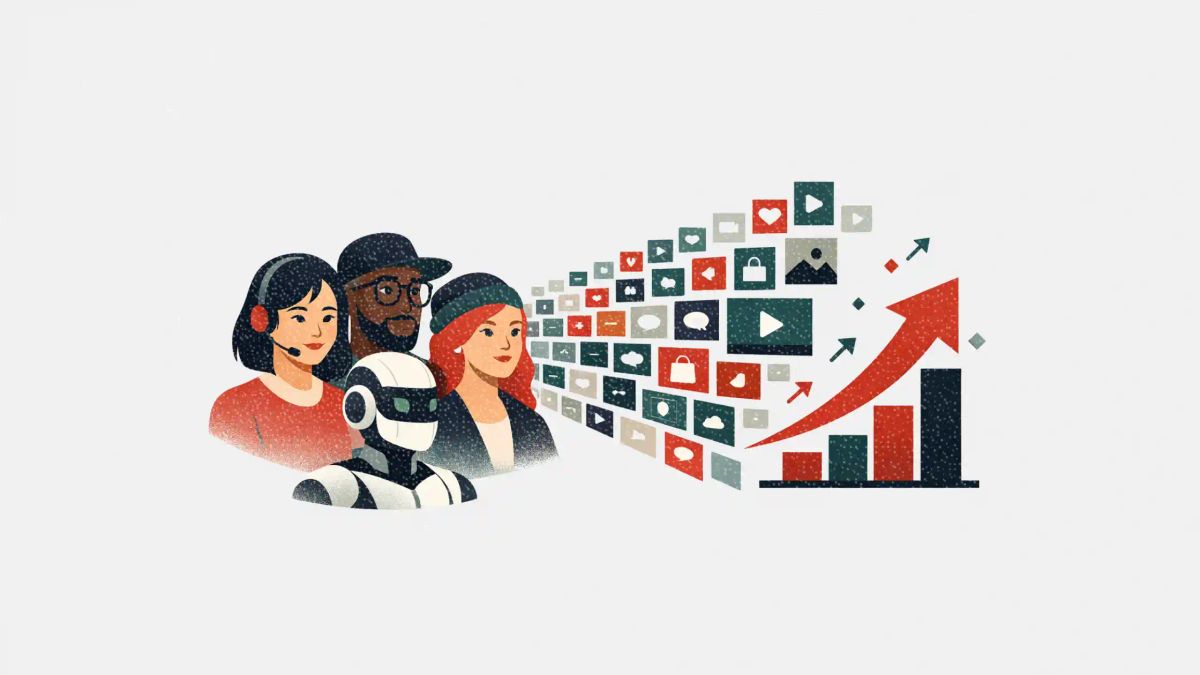
The creator economy is experiencing a significant transformation as AI-generated creators emerge as powerful content producers, outpacing their human counterparts. Recent data from Humanz indicates that these AI creators are not merely a novelty but are reshaping marketing dynamics by producing content at a scale previously unattainable.
According to Humanz, a platform focused on the creator economy, the output of AI creators is staggering. A typical partnership with a human creator yields between 5 and 20 creative variations. In contrast, just four AI creator accounts generated 169 creatives in a similar setup. This dramatic difference not only enhances efficiency but also allows for unprecedented levels of experimentation, enabling marketers to test a multitude of formats and audience segments simultaneously.
This shift away from traditional content production methods marks a crucial evolution for marketers. The content landscape is moving from a resource-intensive model to one that is increasingly automated and scalable. As AI systems continue to refine their capabilities, the creative process is becoming less of a bottleneck and more of a performance lever, offering brands the agility to adapt to rapidly changing consumer preferences.
The data also reveals that creator-style ads, whether crafted by humans or AI, far surpass traditional brand messaging in terms of engagement, achieving three to five times higher interaction rates. As audiences gravitate towards content that feels authentic and relatable, brands are beginning to recognize the value of native advertising that integrates seamlessly into user feeds. AI creators not only replicate this engaging style but also facilitate the generation of hundreds of tailored variations for specific audience segments, fundamentally altering campaign strategies.
Liran Liberman, CEO of Humanz, emphasizes that the future of advertising will be characterized by hyper-personalization. He predicts that AI-driven campaigns could scale exponentially, with projections suggesting potential increases up to 24 times by 2026, and even 80 times with broader adoption. Each piece of content can be crafted to resonate with individual consumers, creating a uniquely tailored experience.
This personalized approach redefines social media marketing, pushing brands to develop continuous streams of content tailored for distinct micro-audiences rather than relying on a limited number of high-performing creatives. Liberman notes that AI creators are already outperforming existing paid strategies, including traditional influencer partnerships, and that this trend is accelerating at an unexpected pace.
As marketers navigate this evolving landscape, they must consider key shifts in their strategies. Creative production is transforming into an ongoing system rather than a one-time asset, necessitating pipelines that continuously generate, test, and iterate on content. Additionally, personalization is fast becoming the default expectation; messages that fail to engage individual interests may struggle to compete in a marketplace saturated with tailored AI-generated content.
The speed of content creation through AI will also challenge established workflows, compelling brands to rethink approval processes and production timelines. Integration with platforms like Google’s ad ecosystem will be critical for maximizing the reach and efficiency of these AI-driven campaigns. Moreover, the shrinking relevance window indicates that brands failing to adopt scalable, personalized strategies risk losing visibility and impact in the near future.
The rise of AI creators signifies a fundamental shift in marketing dynamics, moving away from the ability to execute singular campaigns towards building effective content systems. The competitive edge is increasingly found in how swiftly and effectively brands can adapt to a reality where scale and personalization are not trade-offs but essential expectations. As the landscape continues to evolve, the question remains not if AI will play a role in creator marketing, but rather how rapidly teams can adjust to these emerging norms.
See also Viral Nation Reveals AI Tools Transforming Social Media Marketing with 1.4M Video Hours
 Ideally Launches Canvas in U.S. with $10M Series A Funding to Transform Market Research
 AI Marketing Automation Tools Drive 13.2% Growth, Boosting Conversions and Engagement
 Semrush Reveals Content Marketing Jobs Split: 376% Surge in Senior Roles
 AI in B2B Sales Boosts Efficiency but Risks Eroding Buyer Trust, Study Finds