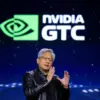
Jensen Huang, CEO of NVIDIA (NasdaqGS:NVDA), recently reflected on the company’s early investment missteps in firms like OpenAI and Anthropic, while simultaneously highlighting NVIDIA’s significant financial commitments in these and other artificial intelligence (AI) companies. With NVIDIA shares trading at $201.68, the company has seen substantial returns over the past year, with an impressive 98.8% increase. This backdrop makes Huang’s insights into capital allocation particularly significant for both current and prospective shareholders.
Huang outlined an “AI foundation portfolio” strategy, suggesting that instead of concentrating resources on a single leading enterprise, NVIDIA will diversify its investments across a range of AI startups. This approach not only mitigates potential risks but also positions NVIDIA to leverage various growth opportunities in the burgeoning AI landscape. In addition to investing in software firms, Huang emphasized NVIDIA’s multimillion-dollar stakes in suppliers such as Marvell, Lumentum, and Coherent, underscoring the company’s strategy to fortify its hardware and software franchises.
During his remarks, Huang also addressed the critical intersection of AI development and geopolitical factors, particularly U.S.-China relations. His public stance against stringent U.S. export controls, which have led to inventory challenges and reduced revenue projections from China-based data centers, illustrates how intertwined NVIDIA’s operational strategy is with regulatory dynamics. For shareholders, these disclosures signal that capital allocation, geopolitical risks, and supply chain security are essential components of NVIDIA’s overarching AI strategy rather than ancillary concerns.
Investors tracking NVIDIA’s performance will need to consider how Huang’s diversified investment strategy and his commentary on U.S.-China AI policies may influence the company’s future growth trajectory. Huang’s acknowledgment of missed investment opportunities, followed by significant investments totaling around $40 billion across leading AI firms, reveals a management philosophy focused on both mitigating regret and maximizing upside potential.
This diversified investment strategy reflects a growing narrative that places NVIDIA at the core of AI infrastructure, from manufacturing chips to partnering with model providers and cloud services. However, the large equity positions in third-party AI companies raise questions about NVIDIA’s traditional growth story, which primarily revolves around selling its own hardware and software. As relationships with these partners deepen, returns will increasingly depend on their performance and regulatory environments.
Moreover, while the current narrative emphasizes U.S.-China export controls and the customization of silicon for customers, it has yet to fully account for how substantial stakes in AI firms and suppliers could amplify both potential gains and risks if market conditions change. Analysts are already cautioning about high levels of non-cash earnings, further complicating NVIDIA’s financial outlook.
Huang’s strategy of constructing an AI foundation portfolio may help the company capitalize on widespread sector growth, even as competition intensifies from established players like AMD and Intel. However, concentrating billions in select AI companies and key suppliers also introduces additional risk, particularly if regulatory pressures mount or if competition from custom application-specific integrated circuit (ASIC) vendors intensifies.
As NVIDIA moves forward, it will be crucial to monitor how management navigates its investments in AI and supplier equities, especially as these positions grow in importance relative to total assets. Shareholders should pay close attention to any shifts in U.S.-China export regulations and how frequently management references geopolitical considerations in future guidance. Additionally, observing the responses of competitors, including potential shifts toward alternative supply chains aimed at reducing reliance on NVIDIA, will be key in assessing the competitive landscape.
Staying informed on NVIDIA’s evolving narrative is essential for stakeholders. The company’s future will depend not only on its ability to innovate within the AI sector but also on how it manages the intricate interplay of supply chain dynamics and geopolitical risks. With Huang’s strategic vision positioned at the forefront, investors have a lot to watch as NVIDIA continues to shape the future of AI technology.
See also BioPhorum Reveals Four Layers of Technical Assurance Essential for AI Trust in Pharma
 Maverick Payments Enhances AI Governance to Boost Decision-Making and Reduce Risks
 Sai Prashanth Pathi Debuts Explainable AI Solutions for Credit Risk Management
 Indonesia Positions Itself as Key Partner in Global AI Governance, Aiming for 8.35% ICT Growth by 2025
 OpenAI Faces Scrutiny After Mass Shooting Linked to User Behavior and AI Interaction