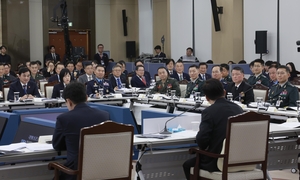
The South Korean Defense Ministry is set to revive the post of assistant minister for the first time in 20 years, focusing on the integration and development of artificial intelligence (AI) in defense planning. This announcement comes as part of a broader organizational reshuffle aimed at enhancing military capabilities and restoring inter-Korean dialogue. The changes were outlined during a policy briefing on December 18, 2025, at the Defense Ministry in Seoul, where President Lee Jae Myung addressed military leaders.
The ministry’s proposal includes reinstating its North Korea Policy Division, previously known as the North Korea Strategy Division, to strengthen its legitimacy in implementing North Korea policies and facilitating inter-Korean military discussions. This shift marks a departure from the division’s recent focus on sanctions-related tasks, a change initiated in July 2024 under the Yoon Suk Yeol administration. The North Korea Strategy Division had relinquished its responsibility to uphold the Comprehensive Military Agreement, which had been effectively suspended by North Korea since November 2023.
In a concerted effort to rebuild confidence and cooperation on the peninsula, the Defense Ministry aims to gradually restore the military agreement established in September 2018. The ministry emphasized its commitment to peace on the Korean Peninsula during its recent policy briefing, outlining plans to revitalize its approach to inter-Korean relations.
The revival of the assistant minister role is notable, as it was abolished in 2006 under the administration of Roh Moo-hyun. However, discussions around reinstating the position have been ongoing since the current administration took office. Under the proposed changes, the new assistant minister will support Defense Minister Ahn Gyu-baek and Vice Defense Minister Lee Doo-hee in overseeing critical areas such as defense AI planning, force development policy, and logistics management.
Furthermore, the ministry’s restructuring plans include the establishment of a new Defense AI Planning Bureau, which will be separated from the current Military Force Policy Bureau. This new bureau is tasked with enhancing the formulation and coordination of defense AI policy, effectively positioning South Korea to address emerging technologies in warfare.
As part of these reforms, a new division is set to be established within the Defense AI Planning Bureau, bolstering its workforce with seven additional staff members. The Manned-Unmanned Teaming Division, initially created as a temporary unit, will be formalized into a permanent organization. This adjustment is aimed at ensuring the effective integration of manned and unmanned combat systems, reflecting a significant shift in modern military strategy.
The legislative notice regarding these organizational changes was issued on December 19, 2025, and the public comment period is expected to conclude soon. The ministry aims for these changes to take effect early next year, aligning with its broader strategy to adapt to the evolving landscape of defense and security.
This restructuring effort highlights South Korea’s commitment to enhancing its military preparedness in response to regional threats, particularly from North Korea, while also embracing advanced technologies that promise to transform defense capabilities. By reinstating the assistant minister position focused on AI and advanced technologies, the Defense Ministry is positioning itself at the forefront of modern military strategy, ensuring that it can effectively navigate the complexities of contemporary warfare.
See also Colorado Lawmakers Defy Trump’s AI Order, Push for New Regulations to Prevent Discrimination
 Canada’s AI Policy Shift: Minister Solomon to Introduce New Privacy Bill Amid Global Trends
 Sedgwick Reveals Workforce Transformation Amid AI-Driven Leadership Changes
 Missouri Lawmakers Announce AI Regulation Bills Ahead of January 7 Session
 Europe’s Far-Right Parties Leverage Unlabelled AI to Secure 37 MEP Seats Despite Ethics Violations