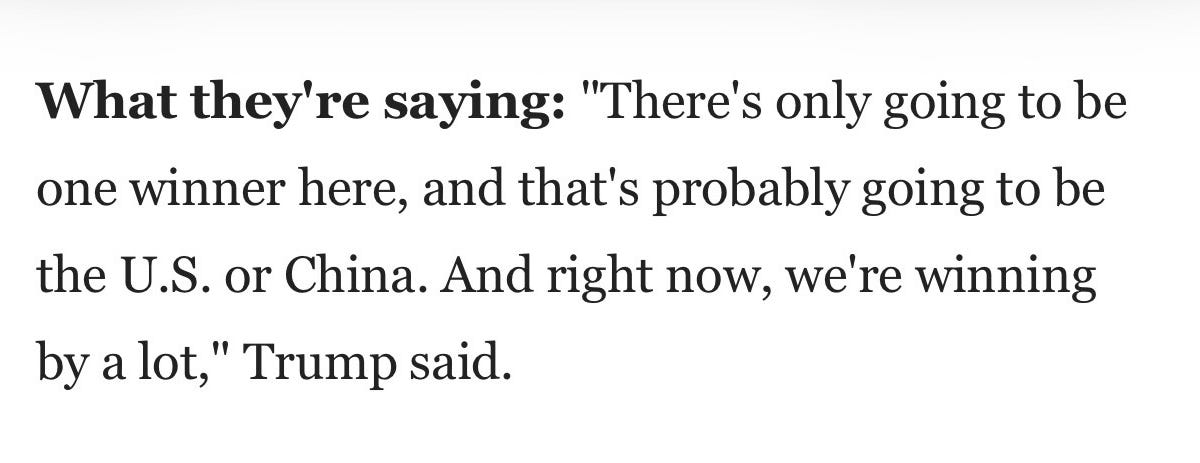
President Donald Trump is facing scrutiny as he moves forward with an Executive Order on artificial intelligence (AI) that has been largely met with skepticism, even within his own party. During the signing ceremony on Thursday, Trump indicated his belief that the generative AI landscape is a “winner-take-all race,” a perspective shaped, perhaps, by influences from Silicon Valley investors. This assertion has underpinned his controversial decision to pursue legal action against states attempting to impose regulations on AI, which he argues are essential for protecting citizens.
Critics contend that this notion of a winner-take-all dynamic is fundamentally flawed. They argue that the generative AI race will not resemble the fierce competition seen between established brands like Coca-Cola and Pepsi, where one could dominate the market. Instead, evidence suggests that both the United States and China will maintain significant shares in the AI sector, with no definitive victor emerging.
China excels in various domains, paralleling U.S. capabilities: both nations manufacture cars, construct highways, and develop software. Each country has carved out its respective space in the global market, illustrating that outright dominance is unlikely in the generative AI competition. Analysts suggest that neither nation will emerge as a clear winner, particularly given the shared technical foundations and open-source innovations that both sides utilize.
The competitive landscape further complicates any assertions of dominance. Despite Trump’s claims, experts argue that the AI race is essentially tied, with both the U.S. and China leveraging large language models (LLMs) to serve their respective customer bases. The reality is that China is only a few months behind the U.S. in terms of AI advancements, and the lead is expected to oscillate between the two. For instance, major American firms like Google, Microsoft, and Amazon are well-positioned to deliver generative AI via cloud services, while Chinese companies are similarly equipped in their domestic market.
Technical advantages have become increasingly blurred, as both countries follow a similar playbook relying on vast data and massive servers to develop large language models. The narrative that one nation will decisively defeat the other in this arena is seen as misguided. Instead, the focus should shift to the infrastructures both countries are building. Over-investment in generative AI capabilities could lead to significant economic implications, especially given the rapid depreciation of key components like GPUs.
The outcome of this race may hinge on which country avoids overextending itself financially in pursuit of success in an area that lacks a clear path to victory. If LLMs turn out to be less impactful than anticipated, or if they are supplanted by more efficient systems requiring less infrastructure, the stakes could shift dramatically. The real winner might simply be the nation that can navigate the complexities of the race without succumbing to financial ruin.
In recent interviews, discussions around the current state of AI have reflected a growing concern about the lack of regulation. Trump’s vision of a “Wild West” approach to AI raises questions about the potential for unforeseen risks that may arise from unregulated advancements. As these conversations develop, the broader implications of the generative AI landscape on international relations and economic stability remain to be explored.
The changing dynamics of the AI sector underscore the need for a nuanced understanding of the ongoing competition. With both nations investing heavily in AI infrastructure, the immediate future will likely see a proliferation of generative AI solutions, making it crucial for policymakers to take a measured approach in navigating this complex terrain.
See also Trump’s AI Executive Order Faces State Resistance and Legal Challenges Ahead of 2026
 Trump Signs AI Executive Order to Centralize Regulation Amid Industry Debate
 QUALCOMM Introduces Governance Changes Amid AI Chip Expansion, Boosting Investor Influence
 Trump Administration Unveils Federal AI Regulations, Challenging Arizona’s Local Authority
 AI Ethics: 5 Key Concerns Impacting Accountability, Bias, and Job Security