






















































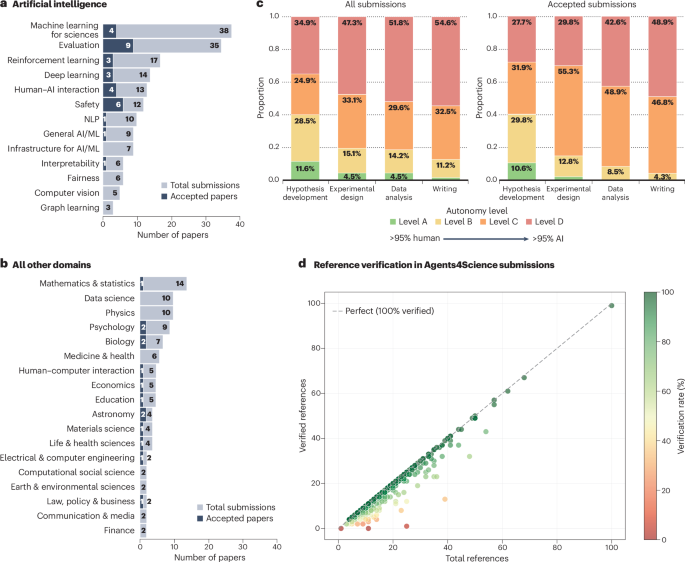
Artificial intelligence (AI) agents are evolving beyond their traditional role as mere tools for science, emerging as ‘co-scientists’ that engage in various stages of research design and analysis. This shift has become particularly pronounced over the past year, as researchers increasingly harness AI capabilities for a wider array of scientific tasks, including hypothesis generation, experimental design, and even the drafting of academic papers. This transformation is driven by advancements in autonomous AI systems, which are built on large language models (LLMs) that not only perform specific tasks but can also utilize external databases and sift through extensive scientific literature.
Historically, scientific inquiry often begins with a narrowly defined question, such as predicting protein structures from amino acid sequences. Researchers would then employ AI tools, like AlphaFold, to address these specific challenges. However, the integration of AI as an active participant in the research process marks a significant shift in the scientific landscape. AI co-scientists have successfully designed nanobodies and formulated experimentally validated hypotheses, although this area remains largely experimental and not fully mainstream.
Despite these promising developments, fundamental questions linger regarding the creative potential of AI scientist agents and the nature of human collaboration with these systems. The limitations of current practices are evident; many scientific journals and conferences continue to prohibit AI co-authors and restrict the use of AI systems as reviewers. This creates a barrier to further understanding AI’s capabilities within the academic community. Researchers often remain reticent about the extent to which they employ AI in their work, complicating attempts to gauge the technology’s impact on scientific productivity and creativity.
The ongoing evolution of AI co-scientists reveals both opportunities and challenges. On one hand, the ability of AI to assist in generating hypotheses and designing experiments could expedite the pace of scientific discovery. On the other hand, researchers must navigate the ethical and practical implications of using AI in research contexts. As AI continues to interweave with scientific investigation, establishing frameworks for collaboration will be essential to fully realize its potential and mitigate risks associated with its deployment.
As the role of AI in scientific research expands, the implications for the future of academia and industry are profound. Institutions and researchers will need to consider how to integrate AI more effectively while addressing concerns over transparency and accountability. The conversation surrounding AI’s contributions to scientific inquiry will likely intensify, calling for a re-evaluation of existing norms and practices in the research community. Ultimately, the journey toward collaborative human-AI research is just beginning, and its trajectory could reshape the future of science as we know it.
See also Harvard Study Reveals AI Boosts Individual Productivity but Favors Team Collaboration
 Machine Learning Study Reveals Electrolyte Imbalances Significantly Predict Mortality Risks
 China Advances EUV Lithography, Threatening ASML and NVIDIA with Lower-Cost Chips
 NASA’s OSIRIS-REx Reveals Life’s Building Blocks in Asteroid Sample, Challenges Biology Detection
 UCSD’s Hao AI Lab Acquires NVIDIA DGX B200, Boosts Low-Latency LLM Performance















