The “AI Index 2026,” released on April 13, 2026, by Stanford University’s Human-Centered AI Research Institute (HAI), has positioned South Korea third globally in the “AI Model” category, trailing only the United States and China. This ranking highlights the significant advancement of Korea’s domestic AI industry. However, it also underscores the emerging necessity for robust regulatory frameworks governing data used for AI training, as countries adopt varying approaches.
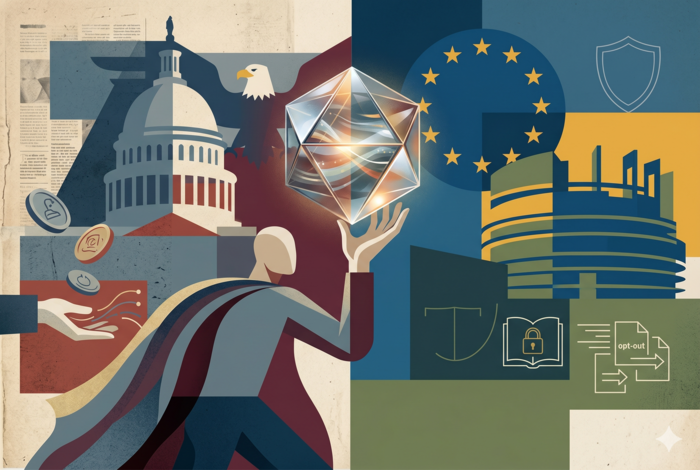
In the United States, the “National Policy Framework for Artificial Intelligence Legacy Recommendations,” announced by the Trump administration on March 20, 2026, offers a detailed set of legislative recommendations at the federal level. The administration contended that employing AI for learning in creative works does not infringe upon federal copyright laws. However, it left the interpretation of fair use under federal copyright law to the judiciary. Additionally, Congress has recommended the establishment of a licensing system permitting rights holders and AI companies to negotiate collectively without the constraints of antitrust laws, fostering a market-driven resolution.
Contrasting with the U.S. approach, the ‘EU AI Act,’ scheduled for full implementation in August 2026, emphasizes a preemptive regulatory strategy. The EU acknowledges the opt-out rights of copyright holders, except for scientific research, per the existing Copyright Directive in the digital single market. It imposes obligations on general-purpose AI model operators to disclose summaries of their learning content, embodying a proactive regulatory stance. In essence, while the U.S. opts for “post-responsibility,” the EU is pursuing “pre-duty” measures for AI governance.
In South Korea, the “Basic Act on Artificial Intelligence,” effective January 2026, defines learning data within a legal framework and mandates explanatory obligations for high-impact AI operators, reflecting a regulatory approach similar to that of the EU. Nevertheless, the “Fair Use Guide,” released by the Ministry of Culture, Sports, and Tourism in February 2026, indicated that commercial crawling is not exempt from fair use provisions. This opens the door for a case-by-case evaluation of fair use, blending elements of U.S.-style ex post responsibility with EU-like prior obligations.
As the regulatory landscape becomes increasingly complex, it is crucial for companies to adopt strategic preemptive measures. First, companies must consider entering into licensing agreements with copyright holders if their work is included. To assert fair use, they should conduct thorough assessments of applicable criteria. Furthermore, businesses targeting the EU market are required to verify whether their data sources are registered under opt-out provisions. For high-impact AI operators, establishing an internal governance system to systematically manage the type, source, and scale of learning data is imperative. Additionally, if personal information is involved in the learning data, firms must ensure compliance with the Personal Information Protection Act and evaluate the legitimacy of processing data beyond its initial purpose.
Ultimately, the competitive edge of AI technologies will likely hinge not merely on the volume of data available but on the ability to legally and reliably articulate the sources of that data. This necessitates a data governance framework that integrates legal, compliance, personal information, security, development, and business sectors. Such comprehensive collaboration will be vital for navigating the multifaceted challenges posed by evolving regulatory requirements.
In this context, lawyers from Barun Corporate Law Group, including attorney Lee Eui-gyu, are addressing compliance issues essential for corporate governance. Lee Eui-gyu, who has previously worked in compliance and governance roles at Samsung, now focuses on corporate risk management, the construction of compliance frameworks, and navigating AI and data regulations.
See also Neel Somani: Why AI Labs Offer Better Long-Term Prospects Than Quant Finance
 AI Dependency May Impair Cognitive Abilities, Warns Neuroscientist Vivienne Ming
 Machine Learning Model Achieves 95% Accuracy in Identifying Cancer Origins via DNA Methylation
 Chinese Researchers Unveil ASI-Evolve: AI Model Self-Improves, Accelerates Scientific Discovery
 Microsoft Study Reveals 41% of Health Queries to AI Chatbots Seek Information and Education