Super Micro Computer (SMCI) has reported a significant expansion in its operational capacity as it seeks to meet rising demand for its products that support artificial intelligence (AI) and high-performance computing (HPC) workloads. In its first-quarter fiscal 2026, the company announced that it has scaled up to an internal power capacity of 52 megawatts and aims to increase its rack capacity to 6,000 racks per month, including 3,000 racks equipped with direct liquid cooling. This initiative underscores the growing need for advanced computing infrastructure tailored for AI applications.
SMCI’s rack-scale compute architecture is designed for various high-demand applications, including large-scale AI training, enterprise AI inference, content delivery, and virtualization at the AI edge. The company’s offerings include NVIDIA HGX B200 8-GPU systems, NVIDIA GB200 Grace Blackwell SuperChip, and multiple variants of NVIDIA H100 and H200 GPUs, among others. This diverse range of products positions SMCI as a key player in the AI and HPC markets.
To enhance its production capabilities, SMCI is developing new facilities in the United States, Taiwan, Malaysia, the Netherlands, and the Middle East, specifically for rack-level production rather than mere server assembly. The introduction of rack-scale plug-and-play servers is a crucial aspect of SMCI’s broader data center building block strategy, which aims to streamline the deployment of computing resources.
Despite these advancements, the transition to rack-scale deployment is presenting challenges for the company. SMCI has encountered higher costs and lower margins as it scales its new GB300 optimized rack platform. Additionally, the company experienced a revenue decline in the first quarter of fiscal 2026, primarily due to shipment delays resulting from upgrades to a custom rack platform. Nevertheless, there is a clear upward trajectory in demand for SMCI’s products, with the company’s revenues having nearly tripled over the past two years. The Zacks Consensus Estimate for SMCI’s revenues in fiscal 2026 is set at $36.5 billion, reflecting a year-over-year increase of 66%.
In the competitive landscape, SMCI faces stiff competition from major players such as Dell Technologies (DELL) and Hewlett Packard Enterprise (HPE) in the AI and data center markets. Both Dell and HPE supply a variety of servers and storage systems to a diverse customer base, including enterprises and cloud providers. In terms of rack-scale server solutions, Dell offers the Integrated Rack 5000 Series, which maximizes GPU density and features advanced thermal management, alongside the Integrated Rack 7000 Series, designed to accommodate multiple generations of CPUs and GPUs. HPE counters with its ProLiant series, known for its comprehensive performance capabilities.
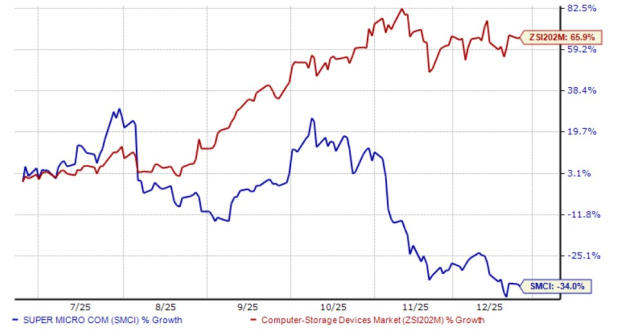
In terms of market performance, shares of SMCI have declined by 34% over the past six months, a stark contrast to the Zacks Computer – Storage Devices industry, which has seen growth of 65.9% during the same period. From a valuation perspective, SMCI is trading at a forward price-to-sales ratio of 0.46, substantially lower than the industry average of 1.81, suggesting potential undervaluation.
The Zacks Consensus Estimate for Super Micro Computer’s earnings in fiscal 2026 suggests a year-over-year increase of approximately 3.58%, with an even more pronounced growth of 41.5% anticipated for fiscal 2027. However, estimates for fiscal 2026 earnings have seen downward revisions over the past month, reflecting some caution in market forecasts.
Currently, Super Micro Computer holds a Zacks Rank #3 (Hold). As the company navigates its growth trajectory amid competitive pressures, its ability to effectively scale operations while managing costs will be critical. Investors remain attentive to the evolving landscape of the AI and HPC markets, where demand for high-performance computing solutions is expected to continue its upward trend through 2026 and beyond.
See also AI inside Inc. Stock Falls 4.37% to JPY 2582; Future Forecasts Signal Mixed Outlook
 NVIDIA GPUs Drive AI Boom as Data Center Sales Surge, Stock Hits New Highs
 Bernie Sanders Calls for AI Moratorium, Warns of Economic Impact on American Workers
 Broadcom Hits $352.13 as AI Demand Soars, Yet Margins Face Pressure Ahead of Q1
 PowerBank Launches DeStarlink Genesis-1, Pioneering Orbital Cloud Infrastructure