Carson Easterling, an electrical engineering senior at Auburn University, is preparing to specialize in control theory as he transitions to graduate school this fall. In pursuit of additional preparation, he enrolled in an interdisciplinary course titled Applied Statistics and Machine Learning (ELEC 5970 6970 600), which aims to equip students with foundational and advanced machine learning skills through hands-on projects.
Easterling emphasized the course’s value, stating, “It’s invaluable to have an understanding of the foundations of artificial intelligence (AI) models and deeper knowledge of why they do certain things. From an electrical engineering perspective, machine learning is a nice way to create models of very complex things when you have the data.”
The course, co-directed by Yin Sun, the Godbold Associate Professor in the Department of Electrical and Computer Engineering, and Rui Chen, a Research Extension Assistant Professor at Tuskegee University, is in its fourth iteration. This semester, it serves 23 Auburn students and nine from Tuskegee.
During the course, students explored a variety of machine learning algorithms, including K nearest neighbor, support vector machines, decision trees, and neural networks. Sun noted that the class covers both convolutional neural networks, used primarily for computer vision, and transformer neural networks, which are fundamental to applications like ChatGPT. “Simple machine learning algorithms are typically good for small dataset problems, while more cutting-edge deep learning algorithms excel with big data,” Sun explained, highlighting the diverse backgrounds of the students from engineering and agriculture.
Sun believes the course challenges students and faculty to broaden their thinking about AI applications. “AI itself is interdisciplinary, and all industries and private businesses in Alabama will need it,” he remarked. He anticipates a growing importance of AI across various fields and noted ongoing projects involving AI for agriculture, education, 6G wireless, and robotics in collaboration with NVIDIA and faculty at Auburn and Tuskegee.
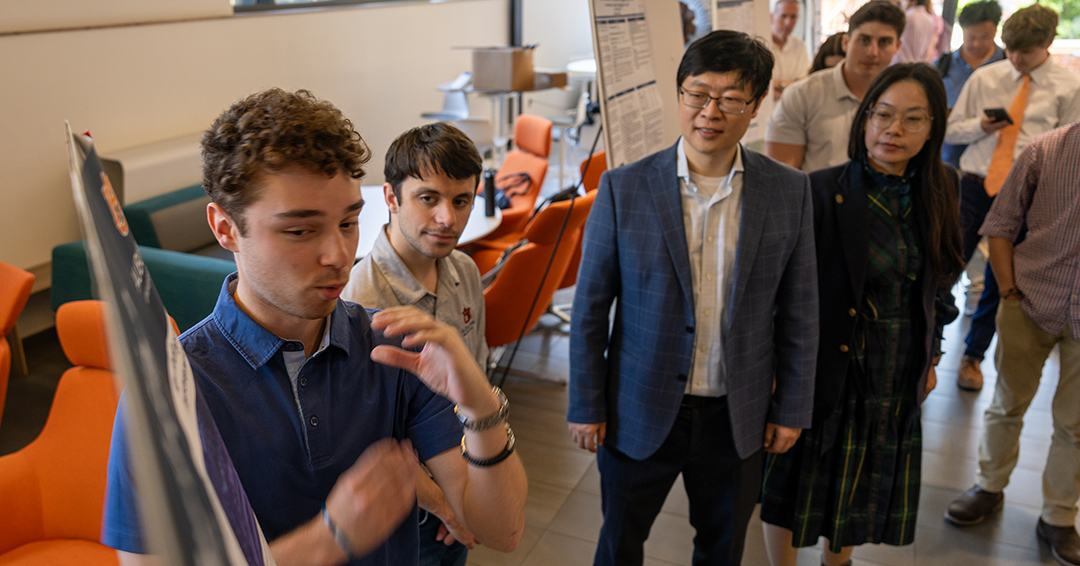
The course culminated in a series of poster presentations held on April 22 at Broun Hall, showcasing complex projects such as temporally consistent real-time video captioning, interactive large language model tokenization analyzers, and automatic video highlight detection for long-form footage.
“The poster presentations make the project formal and get the students excited,” Sun said. “Auburn engineering students are very capable. When they are serious about a course project, the project outcomes are very good. These presentations are great experiential learning activities for the students, and they are now prepared for the new AI-based engineering career.”
Students echoed similar sentiments about the course’s hands-on learning component. Sam Chamoun, a teaching and research assistant set to receive his master’s degree in electrical engineering in May, expressed gratitude for the course, stating, “It allowed me to learn machine learning while immediately applying it to a real-world project. The collaborative structure was especially valuable. It taught me how to effectively manage and split up technical tasks for a major coding project, which is a practical skill I haven’t had the chance to develop in other courses.”
Easterling reiterated the critical importance of hands-on learning, particularly in fields like robotics and simulation, where theoretical models are translated into practical applications. “When you are in the classroom, you are looking at the linear algebra on the whiteboard and you are like, ‘What is going on?’ But once you get into code and you start using data and seeing the outputs, you start really putting the theory into practice, and that internalizes it for you. That’s where this class stands out,” he remarked.
This focus on experiential learning is not just beneficial for students but also aligns with the increasing demand for skilled professionals in AI and machine learning. As industries evolve, the foundational knowledge and hands-on experience gained from courses like this are likely to play a significant role in shaping the future workforce.
See also AI Transforms Health Care Workflows, Elevating Patient Care and Outcomes
 Tamil Nadu’s Anbil Mahesh Seeks Exemption for In-Service Teachers from TET Requirements
 Top AI Note-Taking Apps of 2026: Boost Productivity with 95% Accurate Transcriptions
 Machine Learning Tools Transform Materials Discovery, Enhancing Semiconductor Efficiency