






















































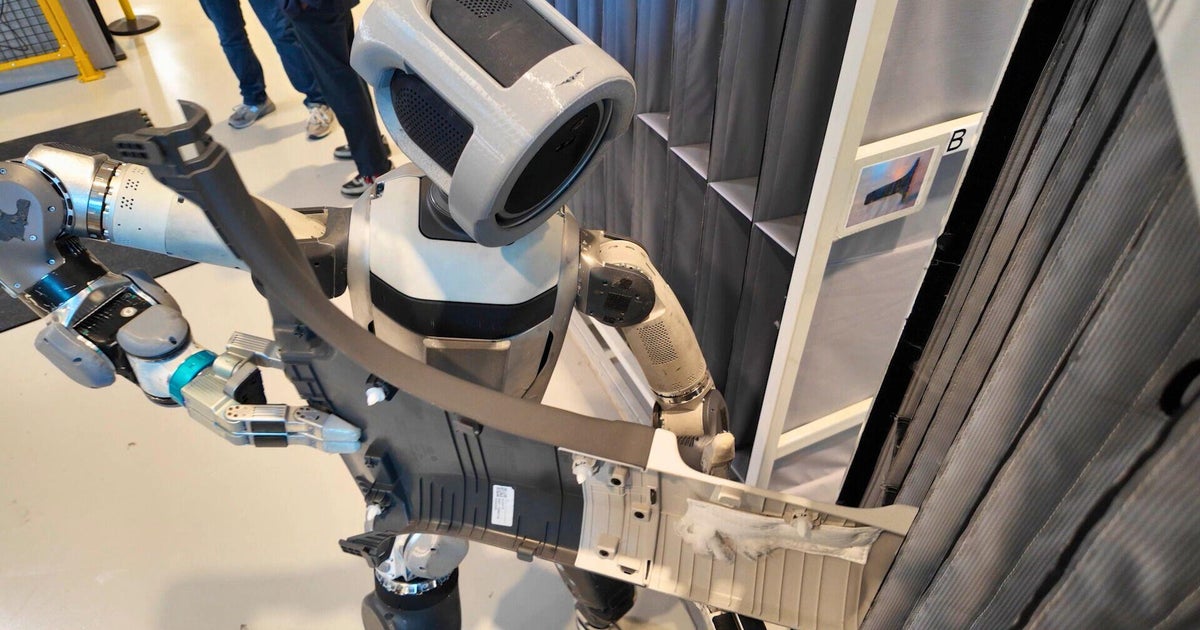
Amidst rapid advances in artificial intelligence, the race to create humanoid robots is intensifying, with companies like Boston Dynamics leading the way. Supported by South Korean automotive giant Hyundai, which holds an 88% stake in the company, Boston Dynamics is testing the latest iteration of its humanoid robot, Atlas, at Hyundai’s new factory in Georgia. This 5-foot-9-inch, 200-pound robot recently showcased its abilities by autonomously sorting roof racks on the assembly line.
Scott Kuindersma, head of robotics research at Boston Dynamics, noted that today’s AI-powered humanoids are capable of movements once deemed too complex for machines. “A lot of this has to do with how we’re going about programming these robots now, where it’s more about teaching, and demonstrations, and machine learning than manual programming,” he explained.
Atlas has evolved significantly since its previous bulky, hydraulic version. Now featuring an all-electric body and powered by advanced microchips from Nvidia, the robot is trained through innovative techniques. Machine learning scientist Kevin Bergamin demonstrated a method of supervised learning by wearing a virtual reality headset to guide Atlas’s movements until it successfully completed tasks autonomously.
Kuindersma elaborated, “That generates data that we can use to train the robot’s AI models to then later do that task autonomously.” Another training technique employs a motion capture suit, which allows human movements to be replicated by Atlas. During a demonstration, 60 Minutes correspondent Bill Whitaker performed jumping jacks, and the data collected was used to train Atlas to mimic these movements accurately.
Over 4,000 digital Atlases trained for six hours in simulation, encountering challenges like slippery floors and stiff joints. This extensive training allowed Atlas to execute jumping jacks almost identically to Whitaker. The robot has also learned to run, crawl, skip, and dance, although Kuindersma acknowledged limitations. “There are no humanoids that do that nearly as well as a person,” he said, noting that Atlas is not yet adept at many routine tasks like pouring a cup of coffee. However, he sees a promising path forward.
Boston Dynamics CEO Robert Playter has been instrumental in advancing the company’s humanoid initiatives. He remarked on the growing excitement in the industry regarding the potential for robots that can perform a wide range of tasks. Goldman Sachs has projected that the market for humanoid robots could reach $38 billion within the next decade, with U.S. manufacturers like Boston Dynamics competing against state-supported Chinese companies in this race.
“The Chinese government has a mission to win the robotics race,” Playter stated, while asserting that the U.S. still leads technologically. Nonetheless, he cautioned about the threat posed by the scale of investment in China.
As concerns mount regarding potential job displacement from AI, companies like Boston Dynamics are preparing humanoid robots to undertake tasks currently performed by human workers, such as those at Hyundai’s plant. Playter anticipates that it may take years before Atlas functions as a full-time worker, yet he believes humanoids will ultimately transform labor by taking over repetitive, strenuous jobs.
“The really repetitive, really backbreaking labor is really going to end up being done by robots,” he said, though he emphasized that these robots will still require management, training, and maintenance. Playter envisions a future where robots can exceed human capabilities in strength and endurance, operating in dangerous environments where humans cannot.
Despite the advancements, Playter reassured that there is no immediate cause for concern regarding sentient robots. “If you saw how hard we have to work to get the robots to just do some of the straightforward tasks we want them to do, that would dispel that worry about sentience and rogue robots,” he asserted.
See also Top 3 AI Stocks Poised for Growth Amid Tech Disruption: Invest Now for Future Gains
 Meta Acquires Manus for $2 Billion, Accelerates AI Ad Strategy Across Platforms
 Western Digital’s Stock Soars 7% on AI-Driven Storage Demand Amid Valuation Reassessment
 Transforming Police Leadership: Embracing AI Governance for Community Trust by 2026















