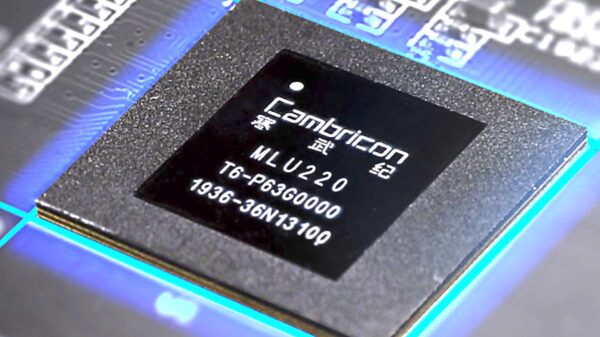
While US AI companies continue to dominate headlines with unprecedented valuations, savvy investors are increasingly turning their attention to China’s burgeoning AI sector. The growth of firms like DeepSeek and other native large language models (LLMs) has made this sector a focal point, particularly in light of recent developments stemming from China’s 15th five-year plan.
Grace Tam, chief investment adviser at BNP Paribas (BNPP) Hong Kong, highlighted that the “nourishing policies” for AI and digital consumption adopted during the National Congress, held from October 20-23, 2023, further signal China’s commitment to advancing its AI capabilities. The minister of science and technology, Yin Hejun, announced increased investment in basic technological research aimed at enhancing cross-industry applications of AI, emphasizing the importance of computing power and advanced chip production alongside legal frameworks and international cooperation.
“We see robust secular growth opportunities in China’s AI sector,” Tam noted, pointing to the market’s valuation of over US$97.5 billion as of mid-2025. The favorable policies and ecosystem are designed to foster scale, with government coordination and capital strength driving the transformation of this dynamic sector. Tam emphasized the goals of enriching digital consumption, supporting research and development, and ensuring balanced supply and demand.
In addition, Tam mentioned that China’s State Council has unveiled an AI+ Action Plan and an AI+ International Cooperation Initiative to expedite the integration of artificial intelligence into various societal and economic facets.
However, she urged investors to look beyond LLMs and explore sectors where China may hold a competitive edge over the US, particularly in manufacturing real-world appliances through advanced AI integration. Opportunities exist in AI-native devices such as smartphones, robots, wearable tech, desktop 3D printers, household appliances, network-connected vehicles, digital education, AI healthcare, digital entertainment, and e-commerce.
Despite the exuberance surrounding AI, Tam noted that valuations of Chinese AI companies remain “somewhat reasonable” compared to the multi-trillion dollar valuations of their US counterparts, which some experts are increasingly wary of, citing potential bubble-like conditions. Investors are encouraged to approach this market with caution.
She advises that key indicators to watch include earnings growth and the emergence of innovative products or services that can surprise the market. “Overall, we always recommend that investors have a diversified multi-asset portfolio to weather all kinds of market scenarios,” Tam said. She advocates for a portfolio approach using funds, ETFs, and structured products that can limit downside risk while capturing upside potential during favorable conditions.
Jeanne Lim, founder of BeingAI and former CEO of Hanson Robotics, also expressed optimism about the trajectory of China’s AI sector, labeling it a national strategic priority. Lim pointed out that China’s AI plan channels capital into six crucial areas: science and technology, industrial development, consumption quality, well-being, governance capacity, and global cooperation. “Compelling opportunities are stratified across the entire AI technology stack,” she stated.
While substantial capital is flowing into foundational layers of AI—such as domestic chips, cloud infrastructure, and model development—Lim sees robust potential in the application layer. “As AI adoption accelerates,” she explained, “companies that successfully integrate AI to solve real-world problems in key sectors are poised for exponential growth.” These companies, particularly those moving past initial subsidized phases to establish profitable business models, offer considerable upside potential.
Lim critiques the inflated valuations within the US AI industry, likening the environment to the late 1990s dot-com bubble, driven by a “seemingly unstoppable surge of capital” pursuing the latest AI trends without clear proof of sustainable use cases.
The most important indicators are earnings growth … and whether any innovative products or services surprise the market.
Lim outlines a critical distinction for China’s AI sector: the central role of the state, with valuations closely tied to a company’s utility in achieving national objectives. This relationship allows for accelerated adoption curves through government policy. For wealth professionals, Lim advises constructing a resilient, multilayered portfolio balancing growth and risk across the AI value chain.
She recommends including foundational companies in cloud services, data centers, and semiconductors that benefit from widespread adoption and robust policy support, alongside established leaders in sectors like healthcare and finance that harness AI for significant efficiency gains. There is also merit in exploring pure-play AI startups or venture funds directing capital toward breakthrough areas like foundational models and robotics.
To manage risk effectively, investors should align their portfolios with national priorities such as industrial AI and domestic hardware, while minimizing exposure to politically sensitive areas like consumer data and content platforms. Lim concludes that diversification across the AI stack mitigates technological and geopolitical shocks while maintaining disciplined portfolio management. Investors are encouraged to dollar-cost average their core holdings and set profit-taking triggers during speculative surges to capitalize on corrections.
See also OpenAI Blames ‘Misuse’ of ChatGPT in Teen Suicide Case Amid Growing Legal Challenges
 AI’s Governance Challenge: Bridging the Gap Between Production Volume and Understanding in Finance
 Japan Proposes 40% Tax Credits to Boost AI, Semiconductors, and Strategic Tech Investments
 Google Cloud’s PanyaThAI Initiative Targets 15 Thai Firms, Aims for $21B AI Impact by 2030
 Cyber Resilience and AI Integration: Key Trends Shaping IT Strategies for 2026