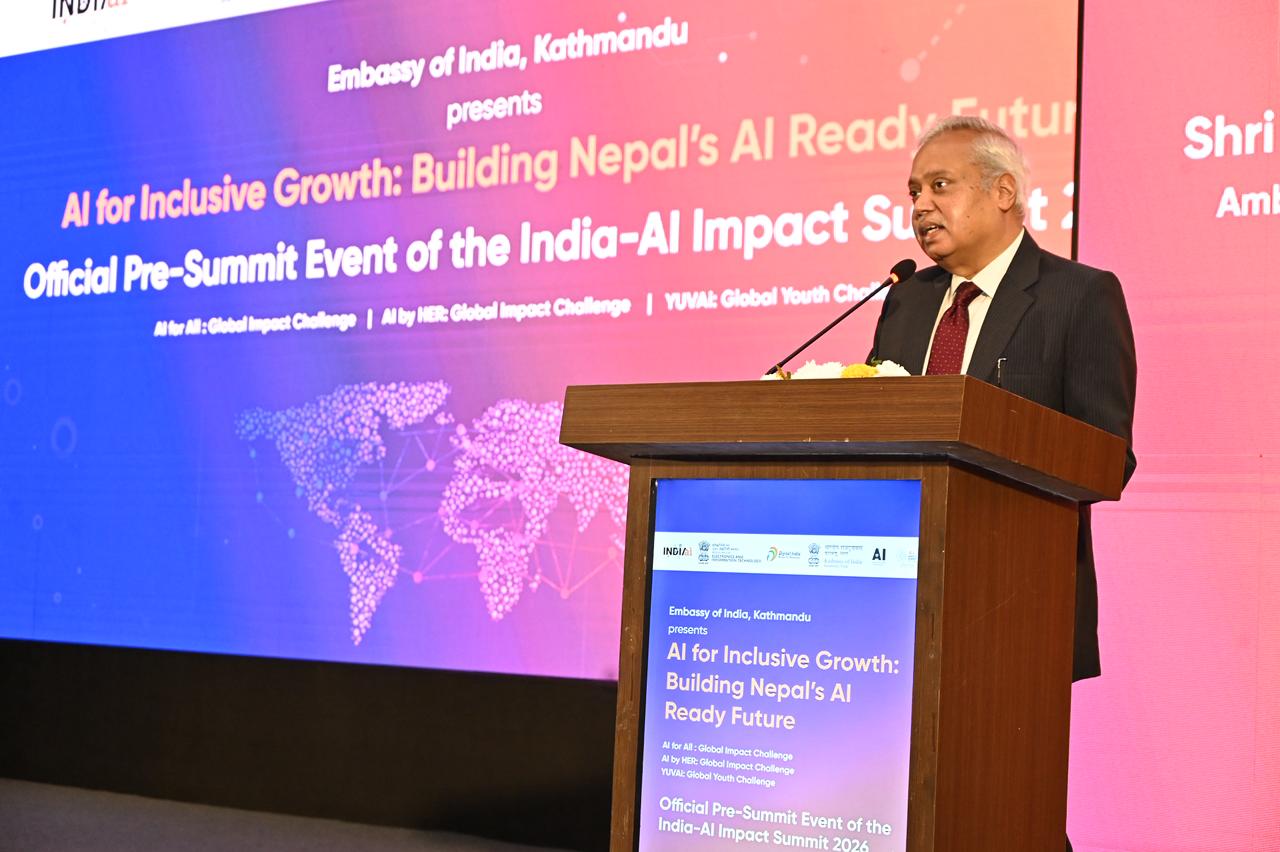
The Embassy of India in Kathmandu hosted an event titled “AI for Inclusive Growth: Building Nepal’s AI Ready Future” on November 21, 2025, in collaboration with the AI Association of Nepal. This gathering has been designated as an official pre-Summit event for the upcoming AI Impact Summit, set to take place in New Delhi on February 19-20, 2026.
Discussions at the event centered on recent advancements in artificial intelligence, as well as the goals of the AI Impact Summit. More than 400 attendees, comprising representatives from startups, government bodies, Chambers of Commerce and Industry, the Robotics Association of Nepal, NAS IT, the Fintech Alliance, academic institutions, think tanks, and media organizations, participated in the event.
Chief Guest Mr. Jagdish Kharel, Hon’ble Minister for Communication and Information Technology of Nepal, addressed the audience, highlighting the government’s AI initiatives and potential areas for collaboration in this evolving field.
During the Plenary Session, Ambassador Naveen Srivastava elaborated on India’s principle of “AI for ALL,” stressing the need to shift the global conversation towards the tangible impacts of AI across various aspects of life and its prospective future. He also urged Nepali youth to actively engage in various AI challenges, including AI for ALL, AI for HER, and YUVAi.
Mr. Amitabh Nag, CEO of the Digital India Bhashini Division, delivered a keynote presentation showcasing Bhashini’s transformative role in enhancing public services in India, aligning with the “AI for ALL” ethos. He provided several use cases illustrating Bhashini’s contributions to development. Mr. Anirban Sarma, Director of the Digital Societies Initiative at the Observer Research Foundation, introduced attendees to the objectives of the AI Impact Summit.
The event progressed to a panel discussion titled “Leveraging AI for Nepal’s Growth,” moderated by Dr. Suresh Pokharel, Vice President of the AI Association of Nepal. Mr. Adesh Khadka, Joint Secretary of the Government of Nepal, discussed strategies for formulating AI policy in the country. Er. Bikash Gurung, President of the Robotics Association of Nepal, elaborated on initiatives aimed at promoting robotics and AI adoption among Nepali youth. Mr. Sixit Bhatta, Founder of Vriddhi Sanjal, argued that AI could play a crucial role in establishing a digital public infrastructure framework for Nepal. Mr. Amitabh Nag and Mr. Anirban Sarma contributed insights based on their experiences in India’s AI sector during this discussion.
The event concluded with a workshop focusing on AI tools and architecture, led by Mr. Ram Sharma Bhattarai and Mr. Darshan Parajuli from the AI Association of Nepal. This session included industrial case studies demonstrating the application of Bhashini AI in India. Ms. Radhika Aryal, Secretary of the Ministry of Communication and Information Technology of Nepal, also attended the event as a Special Guest.
Looking ahead, the AI Impact Summit in February 2026 will feature three global challenges and a Research Symposium, for which applications can be submitted online via https://impact.indiaai.gov.in. This pre-Summit event signifies a growing recognition of the importance of AI in fostering inclusive growth and collaborative efforts between India and Nepal in the tech sector.
See also Japan Announces $6.34 Billion Support for Home-Grown AI Development Starting 2026
 Japan Allocates $6.3 Billion to Boost Private AI Development Over Five Years
 IIT Madras Launches National AI Training Program for Government Officials with Google Collaboration
 Japan Adopts First AI Basic Plan to Enhance Development and Address Safety Concerns