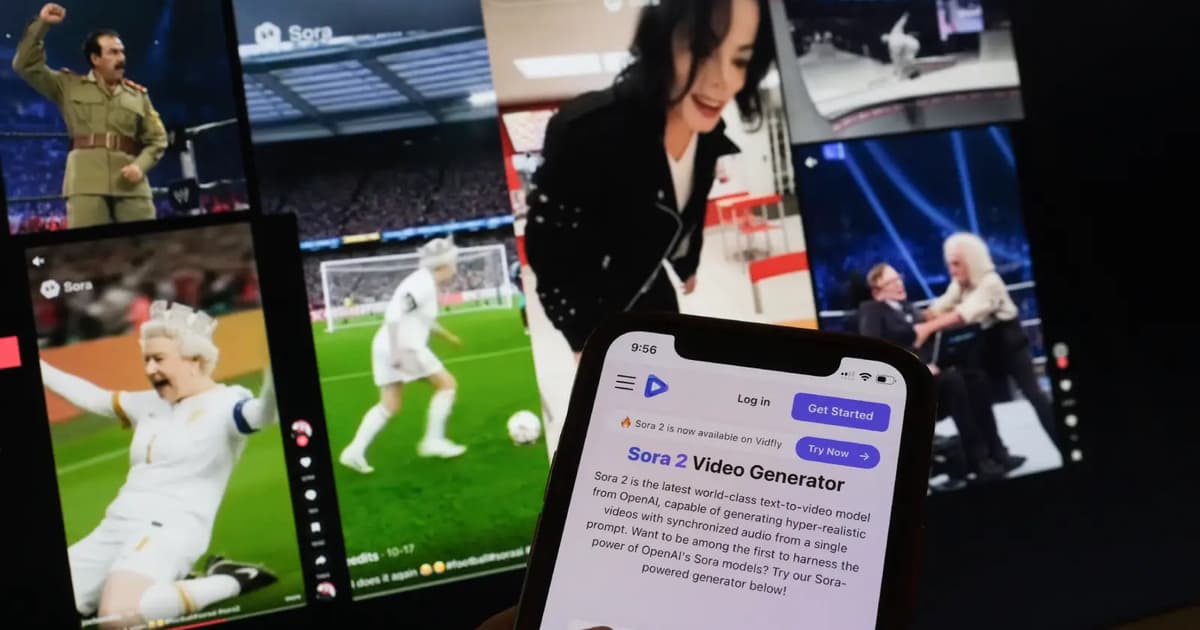
OpenAI’s new app, widely dubbed a “deepfake machine,” is generating hyper-realistic videos of deceased public figures, including Queen Elizabeth II and Michael Jackson, sparking significant debate over the ethical implications of using the likenesses of the dead. Launched in September, the app, known as Sora, has rapidly gained traction online, showcasing a variety of bizarre and unsettling clips that depict historical icons in whimsical scenarios.
In one viral TikTok video, Queen Elizabeth II is humorously shown arriving at a wrestling match on a scooter, while another features her extolling the virtues of “delightfully orange” cheese puffs in a supermarket. Other notable figures, such as Winston Churchill and Elvis Presley, have also been featured in similarly absurd contexts. However, not all content produced by the app has been received positively.
Following complaints from the estate of Martin Luther King Jr., OpenAI took steps to block the creation of videos featuring the civil rights leader after some users produced disrespectful depictions, including altered renditions of his iconic “I Have a Dream” speech. Such instances highlight the potential for misuse of AI-generated content to misrepresent or degrade the legacies of important figures.
Critics argue that the technology, while advancing free expression, poses a significant risk to the integrity of individuals’ likenesses. “We’re getting into the ‘uncanny valley’,” noted Constance de Saint Laurent, a professor at Ireland’s Maynooth University. She emphasized the emotional toll such content could have, particularly if loved ones are depicted in distressing or inappropriate ways. The children of late entertainers like Robin Williams and George Carlin have echoed similar sentiments, condemning the unauthorized use of their fathers’ images and voices in AI-generated videos.
Zelda Williams, Robin’s daughter, recently expressed her frustration on Instagram, pleading with people to “stop sending me AI videos of dad,” characterizing the material as “maddening.” An OpenAI spokesperson acknowledged the balance between free speech and the rights of families to control the likenesses of deceased individuals. The company has stated that for “recently deceased” figures, authorized representatives can request that their likeness not be used in Sora.
However, experts warn that the limitations OpenAI has imposed may not be sufficient to curtail potential abuses. Hany Farid, co-founder of GetReal Security and a professor at the University of California, Berkeley, criticized OpenAI’s measures, arguing that while some safeguards exist, they do not prevent the co-opting of identities of many other celebrities. “Even with OpenAI putting some safeguards to protect MLK Jr., there will be another AI model that does not,” he stated, predicting that the issue will likely worsen.
The recent appropriation of likenesses extends beyond well-known public figures. As AI tools become increasingly sophisticated, the potential for deceased non-celebrities to be similarly manipulated raises additional ethical concerns. Researchers have cautioned against the proliferation of synthetic content, which has been dubbed “AI slop,” warning that unchecked use could lead to a significant distrust in media among users.
“The issue with misinformation in general is not so much that people believe it. A lot of people don’t,” Saint Laurent noted. “The issue is that they see real news and they don’t trust it anymore. And this (Sora) is going to massively increase that.” As the landscape of digital media continues to evolve, the implications of AI-generated content pose challenging questions about consent, representation, and the preservation of public figures’ legacies.
See also Artists Seek Alternatives as AI Image Generators Enforce Stricter Content Restrictions
 ROSOrin Launches Versatile Multimodal Platform for Advanced Robotics Education and AI Integration
 Google Reveals AI Chatbots Struggle with Accuracy, Gemini 3 Pro at 68.8%
 Apple Unveils DarkDiff AI Model to Enhance Low-Light Photography, Boosting Details and Reducing Noise