The U.S. Department of Energy (DOE) has launched the “Genesis Mission,” a significant initiative aimed at establishing an integrated artificial intelligence (AI) platform across its 17 national laboratories. Announced on November 24, 2025, by President Trump, the mission seeks to “accelerate scientific discovery, strengthen national security, secure energy dominance, enhance workforce productivity, and multiply the return on taxpayer investment into research and development,” as outlined by The White House. Less than a month later, on December 18, the DOE revealed collaborations with 24 organizations to further this ambitious mission.
One of the primary ambitions of the Genesis Mission is to “double the productivity and impact of American science and engineering within a decade.” U.S. Secretary of Energy Chris Wright emphasized the scale and urgency of this goal, comparing it to historical efforts like the Manhattan Project and the Apollo mission. “Today, the United States is calling on them once again,” Wright stated during the mission’s launch.
Central to the Genesis Mission is the American Science and Security Platform, a sophisticated infrastructure designed to connect the DOE’s national laboratories, supercomputing resources, AI systems, and scientific instruments into a potentially unprecedented scientific tool. This platform aims to harness the expertise of approximately 40,000 DOE scientists, engineers, and technical staff, along with private sector partners, to provide essential resources including high-performance computing, AI modeling frameworks, domain-specific foundation models, and secure access to extensive federal scientific datasets.
The executive order mandates a 270-day timeline for demonstrating initial operational capabilities for at least one national science and technology challenge. The mission focuses on three major areas: American Energy Dominance, Advancing Discovery Science, and Ensuring National Security. In the energy sector, the initiative plans to apply AI for accelerating developments in advanced nuclear power and grid modernization technologies, thereby aiming to ensure affordable and secure energy while decreasing reliance on foreign sources.
In advancing discovery science, the DOE intends to foster a “quantum ecosystem” that will lead to significant innovations across various fields, including advanced manufacturing, biotechnology, and semiconductors. For national security, advanced AI technologies will be developed to ensure the safety and reliability of the U.S. nuclear stockpile while also enhancing the production of defense-ready materials.
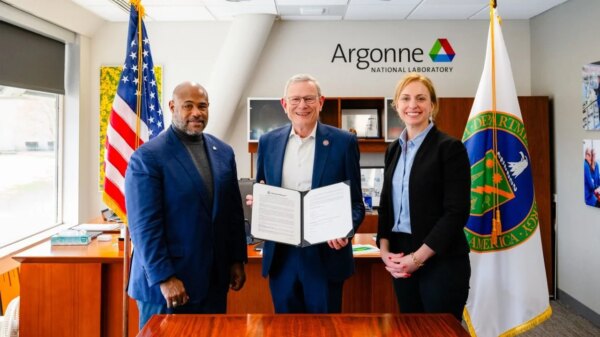
The formal announcement on December 18 established memorandums of understanding with key industry players, including Amazon Web Services (AWS), Google, Microsoft, NVIDIA, OpenAI, and IBM, among others. Michael Kratsios, assistant to the President and director of The White House’s Office of Science and Technology Policy, remarked that this partnership framework is just the beginning, underscoring a commitment to involve the entire scientific community, including academia and nonprofits.
Dr. Darío Gil, DOE Under Secretary for Science and director of the Genesis Mission, highlighted the platform’s goal of uplifting the entire U.S. research and development ecosystem. With a background in technology leadership at IBM and significant governmental advisory experience, Gil aims to ensure that products developed under the Genesis Mission are “architecture-agnostic,” avoiding dependency on any single technology provider.
Early implementations of the Genesis Mission are already underway. For instance, a collaboration between Idaho National Laboratory (INL) and AWS initiated in July 2025 focuses on using AI and digital twin technology for advancing nuclear energy solutions. According to David Appel, AWS VP for Global Government, INL has created an initial prototype of an “AI-Powered Nuclear Reactor Design & Analysis Platform,” which integrates AI agents to assist in complex nuclear engineering tasks, thereby accelerating design processes significantly.
Governance for the Genesis Mission will fall under the Secretary of Energy, with coordination overseen by the Assistant to the President for Science and Technology through the National Science and Technology Council. Crucial milestones outlined in the executive order include identifying key science and technology challenges, assessing available federal resources, and reviewing capabilities at national laboratories. The timeline emphasizes the urgency of demonstrating initial operating capacities within 270 days of the order’s signing.
The Genesis Mission is positioned within a broader policy context, building upon previous Trump administration initiatives aimed at maintaining U.S. leadership in AI. Officials emphasize the mission as a critical step to ensure the nation remains competitive in the rapidly evolving landscape of technology. “The Genesis Mission represents the next great chapter and an unparalleled opportunity for America’s scientific and national security leadership,” stated Brandon Williams, administrator of the National Nuclear Security Administration. The DOE continues to seek industry participation through open requests for information aimed at fostering transformational AI models and capabilities for national security.
See also AI Researcher R. Xie Reveals Deep Learning’s Role in BRI Green Production Optimization
 AI Models in Economic Game Show Key Differences from Human Strategic Thinking
 OpenAI’s Sam Altman Predicts AI Breakthrough with Infinite Memory by 2026
 Microsoft Achieves $3.7 Trillion Valuation as AI Era Reshapes Tech Landscape