The Bureau of Economic Analysis (BEA) confirmed today that the U.S. economy grew at a robust annualized rate of 4.4% during the third quarter of 2025, a significant upward revision from the initial estimate of 4.3%. This marks a notable acceleration from the 3.8% growth observed in the second quarter, effectively quelling fears of a severe economic downturn. The revised figures suggest that the much-anticipated “hard landing” has been avoided, giving rise to an expansion fueled by advancements in artificial intelligence.
This revision carries substantial implications for monetary policy. With the economy exceeding the Federal Reserve’s neutral growth projections, the central bank has adopted a “hawkish hold” stance. For both the American public and global investors, this indicates that while borrowing costs are likely to remain high for an extended period, the U.S. economy—propelled by high-tech investments and a diverse consumer base—demonstrates remarkable resilience.
The journey to the 4.4% figure involved several data delays and unexpected fiscal stimuli. Following a significant upward adjustment to the second quarter’s growth—from 3.0% to 3.8%—analysts began to recognize a surge in business investments. However, a 43-day federal government shutdown in late 2025 delayed the finalization of the Q3 data, obscuring the full economic picture. Nonetheless, the data unveiled a “perfect storm” of growth drivers that countered the expected cooling effects of high interest rates.
Key to this economic acceleration was the “One Big Beautiful Bill” Act (OBBBA), enacted in the summer of 2025, which introduced retroactive tax relief and substantial incentives for domestic manufacturing. This legislation helped to reconcile pandemic-era savings with the burgeoning demand for industrial production. Notably, a 9.6% surge in exports, particularly in non-automotive capital goods, contributed to narrowing the trade deficit amidst ongoing global market volatility.
The Federal Reserve, under the leadership of Chair Jerome Powell, has responded cautiously yet affirmatively to these developments. Despite implementing three cuts of 25 basis points late last year to address a softening labor market, the strength of the GDP revision has halted further easing. As of late January 2026, the federal funds rate hovers between 3.50% and 3.75%, with indications that persistent economic strength and inflation near 2.9% may restrict the central bank to just one more rate cut throughout the year.
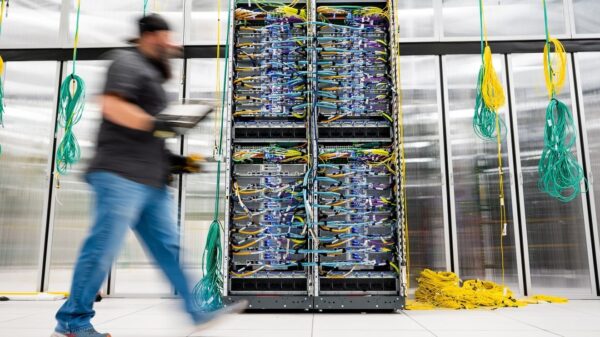
The primary beneficiaries of this revised economic landscape are the leaders of the “Intelligence Economy.” Companies like NVIDIA have emerged as significant contributors, with their hardware forming the backbone of AI infrastructure, accounting for nearly 14% of Q3 GDP growth. Cloud service giants such as Microsoft, Amazon, and Alphabet experienced notable increases in valuation, driven by a 46% rise in AI-related capital expenditures during the first nine months of 2025. Additionally, companies like Oracle and Intel have gained from the incentives provided by the OBBBA Act, aimed at bolstering domestic semiconductor and data center operations.
In the consumer market, the benefits have been less evenly distributed. While spending among high-income households on services and travel significantly boosted the 4.4% growth, lower-income consumers have increasingly gravitated toward value-oriented options. This trend has favored retailers like Walmart and Costco, which have captured market share from traditional department stores. Similarly, The TJX Companies reported record foot traffic as consumers sought “off-price” premium goods in response to rising tariffs on imported electronics and apparel.
Conversely, sectors sensitive to prolonged high interest rates have been adversely affected. Small-cap firms that depend on floating-rate debt have struggled, and the housing market remains stagnant. While industrial players such as GE Aerospace benefit from government-backed infrastructure projects, residential developers continue to face high financing costs, prolonging their challenges.
The broader implications of the summer 2025 revision highlight a structural shift in the U.S. economy towards an AI-driven productivity model. Unlike previous growth cycles that were fueled by cheap credit, this expansion is characterized by tangible investments in technology and “re-industrialization.” The 4.4% growth rate stands as a historical anomaly for a mature economy operating with interest rates above 3%, suggesting that the “neutral rate” of interest may be higher than previously estimated.
This situation not only sets a new standard for fiscal policy amidst monetary tightening but also exerts global pressure. The strength of the U.S. dollar, bolstered by a strong growth rate, poses challenges for emerging markets and European partners struggling with slower growth and unable to maintain high interest rates in line with the Federal Reserve.
Looking ahead to 2026, a critical question emerges: can this momentum be sustained, or are we merely “borrowing” growth from the future? In the short term, businesses are expected to maintain their aggressive pursuit of AI integration, yet the labor market poses uncertainties. With unemployment rising to 4.4% alongside GDP growth, a “jobless growth” scenario could exert political pressure for further rate reductions, irrespective of economic indicators.
In the long term, the U.S. must grapple with a substantial debt load exacerbated by the spending associated with the OBBBA Act. If inflation does not revert to the 2.0% target by mid-2026, the Federal Reserve may face a difficult choice between managing government borrowing costs and preserving its inflation-fighting credibility. Investors should prepare for a period of heightened scrutiny over economic data, as the upcoming employment and inflation reports will be critical in determining whether the summer 2025 growth represents a peak or a new plateau.
The upward revision of Q3 2025 GDP to 4.4% marks a pivotal moment in the post-pandemic era, revealing the U.S. economy’s surprising resilience driven by technological transformation and strategic fiscal interventions. The key takeaway is that the Federal Reserve has no immediate impetus to cut rates as the economy continues to demonstrate its capacity to thrive under tightened monetary conditions. Investors should remain vigilant of the productivity divide between the tech-savvy winners and the rest of the market, as this divergence, alongside a rising unemployment rate, suggests that the impressive growth figure conceals underlying vulnerabilities.
This content is intended for informational purposes only and is not financial advice.
See also Amazon Plans 16,000 Job Cuts While Investing $155 Billion in AI and AWS Expansion
 Barbell Portfolio Strategy Surges Amid AI Boom, Balancing Growth and Stability
 Tennessee CIO Kristin Darby Advances Agentic AI, Aiming for Exponential Government Transformation
 India AI Impact Summit 2026: Pioneering Inclusive Innovation for Global Development
 Fayetteville School Board Unveils Ambitious AI Strategy to Transform Education Standards