Microsoft has unveiled Rho-alpha (ρα), a groundbreaking robotics model that aims to redefine the capabilities of robots in less structured environments, echoing the transformative impact of generative models in language and vision processing. This new vision-language-action (VLA) model is designed to enhance the autonomy of robots, enabling them to perceive, reason, and act alongside humans more effectively, according to Ashley Llorens, Corporate Vice President and Managing Director at Microsoft Research Accelerator.
Rho-alpha is a significant advancement in the realm of physical AI, which integrates agentic AI with physical systems. The model translates natural language commands into control signals for robotic systems, facilitating bimanual manipulation tasks. It is classified as a VLA+ model, as it expands the perceptual and learning modalities beyond traditional VLA capabilities. Notably, Rho-alpha incorporates tactile sensing and aims to incorporate additional modalities, such as force, to enhance its adaptability and responsiveness to real-world scenarios.
Microsoft is actively inviting organizations to participate in the Rho-alpha Research Early Access Program, allowing them to evaluate the model for various use cases. It will also be made available through Microsoft Foundry later on. The company emphasizes that adaptability is central to intelligence, with the expectation that robots capable of adjusting to dynamic situations will be more beneficial and trustworthy in human environments.
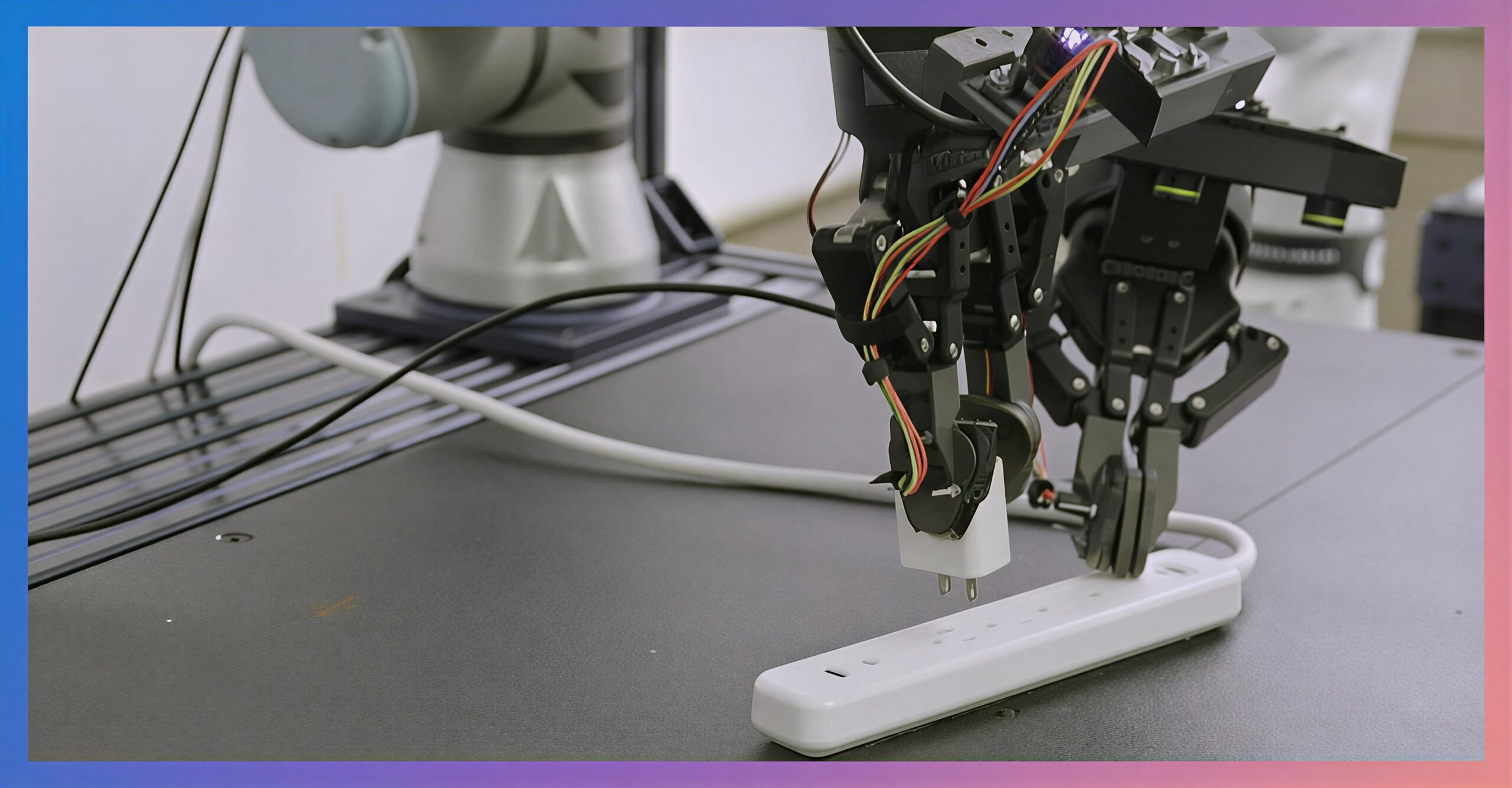
Demonstrations of Rho-alpha show its proficiency in executing tasks based on natural language prompts, as illustrated in a series of videos where the robot interacts with a physical benchmark called the BusyBox. For instance, in one video, prompts such as “Push the green button with the right gripper” showcase Rho-alpha’s real-time capabilities in manipulating physical objects. The footage illustrates the model’s ability to navigate complex tasks, from flipping switches to plugging in devices.
To enhance Rho-alpha’s operational efficiency, Microsoft is focusing on end-to-end optimizations of its training pipeline and data corpus. The model is currently being evaluated on dual-arm setups and humanoid robots, with a detailed technical description set to be published in the coming months. The training approach incorporates tactile-aware behaviors informed by vision-language understanding, achieved through co-training on trajectories from physical demonstrations and web-scale visual question-answering data.
In addressing the challenge of data scarcity in robotics, particularly in terms of diverse and real-world datasets, Microsoft is leveraging simulation technology. This enables the generation of synthetic data through a multistage process powered by reinforcement learning, using the NVIDIA Isaac Sim framework. This innovative approach allows the company to enrich pre-training datasets with varied synthetic demonstrations, which are essential for training versatile models like Rho-alpha.
Professor Abhishek Gupta of the University of Washington noted the practicality of Microsoft Research’s collaboration in generating enriched datasets, further underscoring the importance of simulation in overcoming data limitations. Deepu Talla, Vice President of Robotics and Edge AI at NVIDIA, emphasized the significance of utilizing physically accurate synthetic datasets to accelerate the development of models capable of mastering complex manipulation tasks.
Despite the advancements in perception capabilities, the potential for errors during operation remains a concern. Microsoft is working on tools and model adaptation techniques that would allow Rho-alpha to learn from corrective feedback provided by human operators in real-time, thereby improving its functionality and reliability.
The ongoing development of Rho-alpha reflects Microsoft’s commitment to empower robotics manufacturers, integrators, and end-users. By providing foundational technologies that facilitate the training, deployment, and continuous adaptation of cloud-hosted physical AI, Microsoft aims to foster innovation in various applications across industries. As the field of robotics continues to evolve, Rho-alpha represents a significant step forward in integrating AI with physical systems to create smarter, more adaptable machines.
Organizations interested in experimenting with Rho-alpha and contributing to its evolution are encouraged to express their interest in the Research Early Access Program, which promises to shape the future of physical AI technologies.
See also Vietnamese Researchers Utilize AI for Enhanced Autism Risk Stratification in Toddlers
 Deep Learning Enhances QSAR Models for Precise Developmental Neurotoxicity Predictions
 Multimodal Deep Learning Revolutionizes Chinese Medicine Diagnosis with AI-Driven Insights
 AI/ML Enhances Dark Energy Analysis at LSST, Boosting Cosmological Insights
 AI-Driven Innovations Propel Plastic Recycling Efficiency, Overcoming Major Challenges