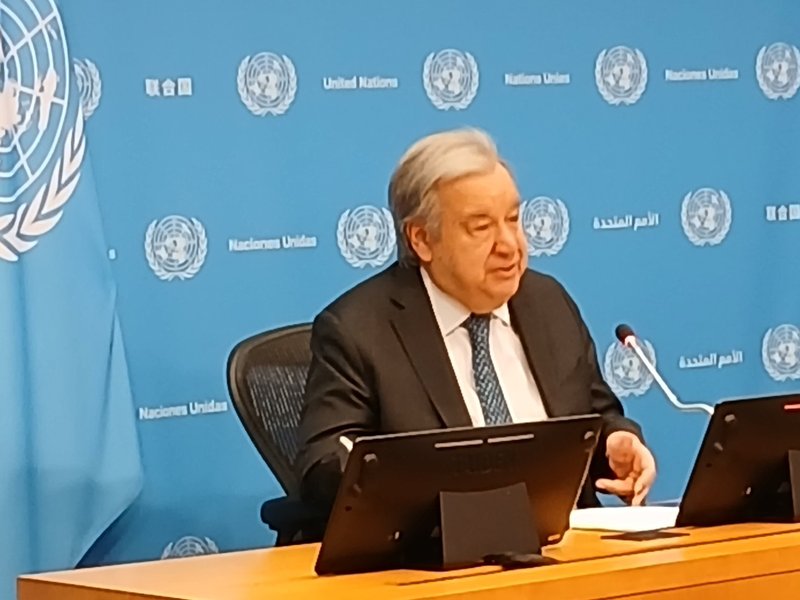
United Nations, Feb 5 (IANS) — United Nations Secretary-General Antonio Guterres has commended India for its leadership in addressing the challenges posed by artificial intelligence (AI), particularly through the upcoming India AI Impact Summit 2026. Scheduled to take place in New Delhi from February 16 to 20, the summit aims to foster international dialogue on AI’s implications and governance.
Speaking at a press conference, Guterres expressed his enthusiasm about participating in the summit, stating, “I do believe that AI is today, an absolutely crucial issue in international relations and one of the biggest challenges of all times.” He emphasized the necessity for nations to collaborate and engage with civil society in discussions regarding AI.
India’s Ministry of Electronics and Information Technology reported that over 35,000 individuals from more than 100 countries have registered for the event, indicating a significant international interest. Additionally, more than 500 start-ups are expected to participate, making this summit the largest of the four held thus far. The Ministry highlighted that this strong turnout reflects a growing global momentum towards responsible, inclusive, and impact-driven AI.
During the summit, Guterres plans to convey important messages to heads of state and other leaders, particularly on mobilizing international support for capacity building in developing countries. He noted, “I believe that for India as a developing country, even if with remarkable capacity already existing … this objective is the central objective of the summit.”
The summit will align with the conclusions of the Global Digital Compact, adopted by world leaders at the UN Summit of the Future in 2024. This compact establishes principles for cooperative efforts to ensure that digital advancements are beneficial to all, while addressing their effects on the environment, economy, and human rights.
In conjunction with the summit, the UN is forming an Independent International Scientific Panel on Artificial Intelligence to report on advancements in the field and promote global dialogue surrounding AI governance. Guterres has proposed 40 experts for this panel, who are anticipated to receive approval from the General Assembly. The selection process was thorough, drawing from over 2,600 nominations to ensure both global representation and diverse expertise, according to UN Under-Secretary-General Amandeep Singh Gill.
Among those nominated is Balaraman Ravindran from the Indian Institute of Technology (IIT) Madras, head of the Department of Data Science and Artificial Intelligence and the Centre for Responsible AI. Another notable expert is Vipin Kumar, an Indian-American computer scientist and regents’ professor at the University of Minnesota.
Guterres remarked that the panel “will be the first global, fully independent scientific body dedicated to helping close the AI knowledge gap and assess the real impacts of AI across economies and societies.” He added that it would serve as an authoritative reference point during a time when reliable and unbiased understanding of AI is crucial.
As the discourse around AI intensifies globally, the outcomes of the India AI Impact Summit 2026 and the establishment of the International Scientific Panel could play pivotal roles in shaping the future of AI governance and collaboration, particularly in developing regions. The summit highlights India’s growing influence as a leader in addressing the challenges and opportunities associated with AI technology.
See also EnFi Secures $15M to Enhance AI-Driven Credit Decisions for Smaller Banks
 SpaceX and Nvidia Lead $10B AI Investments, Highlighting Capital’s Role in Tech Growth
 Surge in AI and Auto Demand Positions Monolithic Power Systems for Major Earnings Upswing
 Dunkirk School District Cuts Chronic Absenteeism from 38% to 22% Using AI Attendance Program
 Alphabet Reports Q4 Revenue of $114B, Plans $175B AI Capital Expenditure Increase