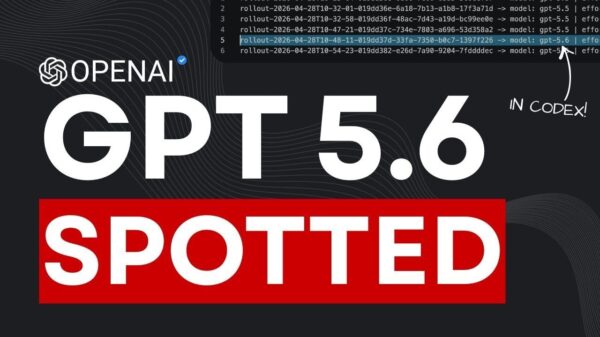
OpenAI has unveiled its latest AI coding model, GPT-5.3-Codex, marking a significant enhancement in its capabilities. The announcement was made on [date], with the model touted as the most advanced in OpenAI’s lineup. This iteration builds upon the performance of its predecessor, GPT-5.2-Codex, by combining superior coding abilities with enhanced reasoning skills.
The new model is described as being “25 percent faster” than GPT-5.2, allowing it to manage long-running tasks that require extensive research and tool usage. According to OpenAI, GPT-5.3-Codex can be directed and interacted with as it executes tasks, maintaining context and continuity during operation. This functionality aims to replicate the experience of working alongside a human colleague, facilitating smoother collaboration in software development.
In a remarkable development, GPT-5.3-Codex is the first model from OpenAI to have been utilized in its own creation. Early versions of the model were employed to debug the training process, oversee its deployment, and evaluate test outcomes. The team expressed astonishment at how effectively Codex could expedite its own advancement.
Beyond coding, GPT-5.3-Codex has broadened its utility to encompass various aspects of the software lifecycle. The model is capable of debugging, deploying, monitoring, and even writing product requirement documents (PRDs). Additional functions include editing copy, conducting user research, and analyzing metrics. This versatility extends to creating and managing presentations and spreadsheets, making it a multifunctional tool for professionals across diverse fields.
Currently, GPT-5.3-Codex is accessible to users with a paid ChatGPT plan and is compatible with the app, command-line interface (CLI), integrated development environment (IDE) extensions, and web platforms. OpenAI has indicated that API access will be made available shortly, further expanding its reach within the developer community.
The introduction of GPT-5.3-Codex comes at a time when the demand for sophisticated AI tools is surging, as businesses increasingly seek to integrate AI into their workflows. The evolution of such models not only highlights advancements in AI but also raises questions about the implications for the future of coding and software development.
As organizations continue to explore the potential of AI, GPT-5.3-Codex represents a significant step forward, offering enhanced capabilities that could reshape how tasks are approached in the tech industry. The implications of its self-creation process and multifunctional applications may signal a new era of AI-driven productivity.
See also DAS Technology Wins Best New Product at NADA 2026 for AI-Driven Power AI Search Solution
 Google Unveils Natively Adaptive Interfaces to Transform AI Accessibility for All Users
 Broadcom and TSMC Set to Dominate $100B AI Chip Market by 2027, Analysts Predict Major Gains
 Anthropic Launches Claude Opus 4.6, Set to Disrupt Software Market with Advanced AI Features
 OpenAI Begins Testing Ads in ChatGPT, While Anthropic’s Claude Stays Ad-Free