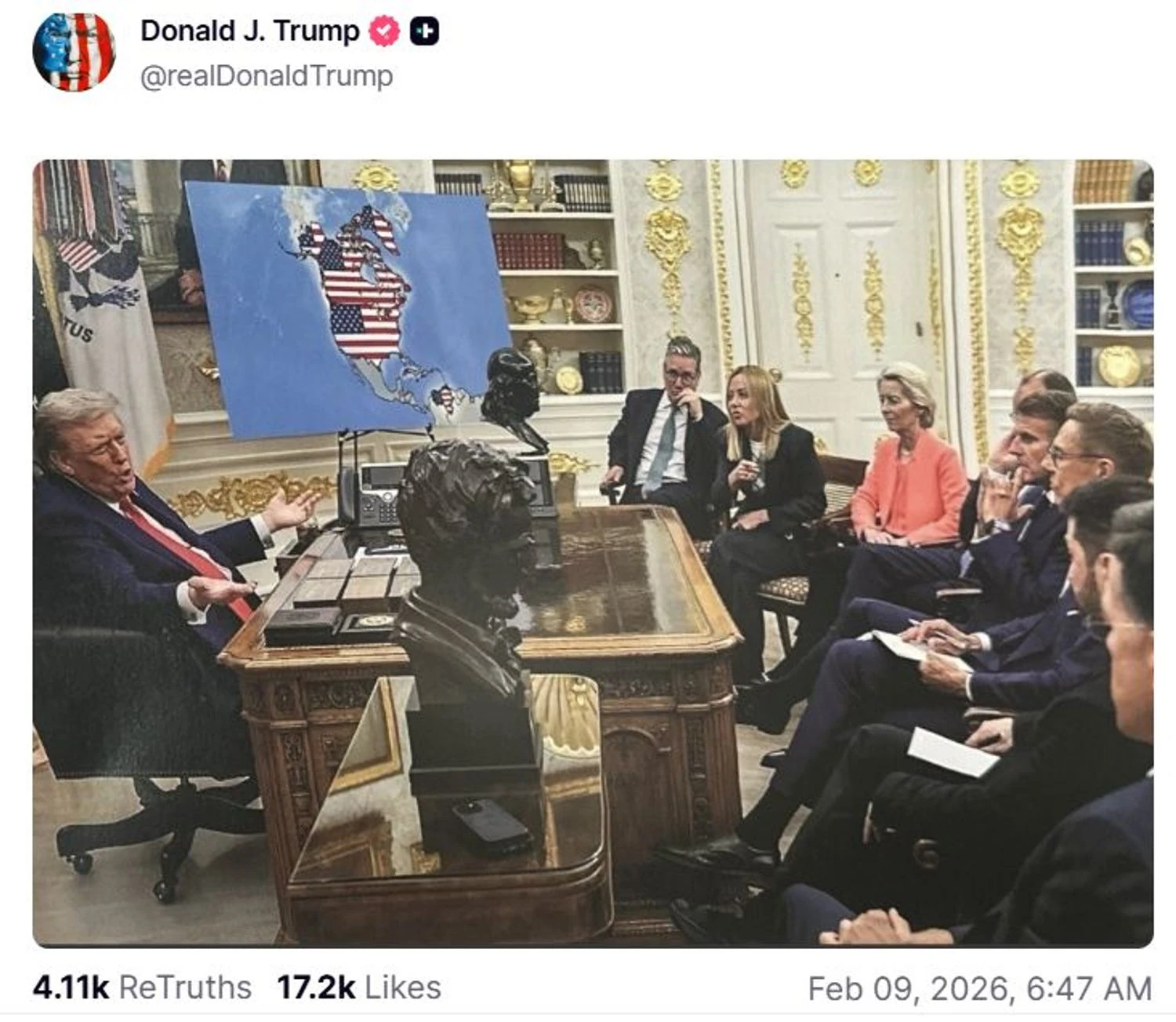
US President Donald Trump shared an AI-generated image on social media that has drawn attention for its radical alteration of the map of the American continent. The doctored image depicts territories of Canada, Greenland, and Venezuela as part of the United States. This incident was reported by UNN.
In the altered photograph, Trump is portrayed as a lecturer, pointing to the controversial map in front of a group of prominent Western leaders. Among those depicted are French President Emmanuel Macron, European Commission President Ursula von der Leyen, Italian Prime Minister Giorgia Meloni, NATO Secretary General Mark Rutte, and British Prime Minister Keir Starmer. The recognizable figure of Ukrainian President Volodymyr Zelenskyy is also present, albeit appearing with his back facing the camera.
The image has sparked discussions about the implications of using AI technology to manipulate visual information, particularly in political contexts. Experts warn that such alterations can contribute to misinformation, especially when shared by influential figures. AI-generated content challenges the boundaries of authenticity, raising questions about how digital media will be perceived in an age increasingly shaped by artificial intelligence.
This episode is reminiscent of previous comments made by Trump regarding the purchase of Greenland, which he humorously referred to as a potential future 51st state in February 2020. The prospect of acquiring Greenland was met with widespread skepticism and was ultimately dismissed by Danish officials, highlighting the complexities of geopolitical discussions.
The use of AI in generating images and videos has surged in popularity, driven by advancements in deep learning and computer vision. Companies like Nvidia and OpenAI are at the forefront of these developments, creating tools that can produce highly realistic outputs. However, the ethical ramifications of such technology are still being debated, particularly regarding its potential to mislead the public.
As the landscape of digital communication evolves, the ability to generate convincing yet fabricated imagery poses significant challenges for society. The possibility of manipulated visuals influencing public opinion remains a pressing concern among educators, policymakers, and technology developers alike. The need for media literacy is more crucial than ever to help individuals discern between authentic and altered content.
In the broader context, the blending of AI capabilities with political discourse could shape future interactions between leaders and their constituents. The ramifications of this incident highlight the necessity for transparency in the information shared by public figures, especially as misinformation could have far-reaching consequences, including undermining trust in democratic institutions.
As technology continues to advance, it will be essential for stakeholders in various sectors to collaborate on establishing guidelines that address the ethical use of AI. This includes fostering an environment where factual integrity is prioritized, ensuring that tools designed for creativity do not become weapons of misinformation.
In considering the implications of AI-generated content, it is clear that the intersection of technology and politics will require vigilant oversight. The public’s ability to navigate this terrain effectively will depend on a collective commitment to understanding the tools at their disposal and recognizing the potential for manipulation in an increasingly digital world.
See also US-China AI Dominance Threatens Middle Powers with Strategic Isolation and Economic Risks
 Perplexity Launches Model Council to Enhance AI Answer Accuracy with Multi-Model Comparison
 Axchip Technology’s Shares Drop 4.18% in Grey Market Amid Competitive AI Chip Risks
 U.S. AI Strategy Risks Global Leadership as Critics Cite Unsafe Practices and Regulation Gaps
 Cambridge Botanic Garden Launches AI-Enabled Plants for Interactive Visitor Experience