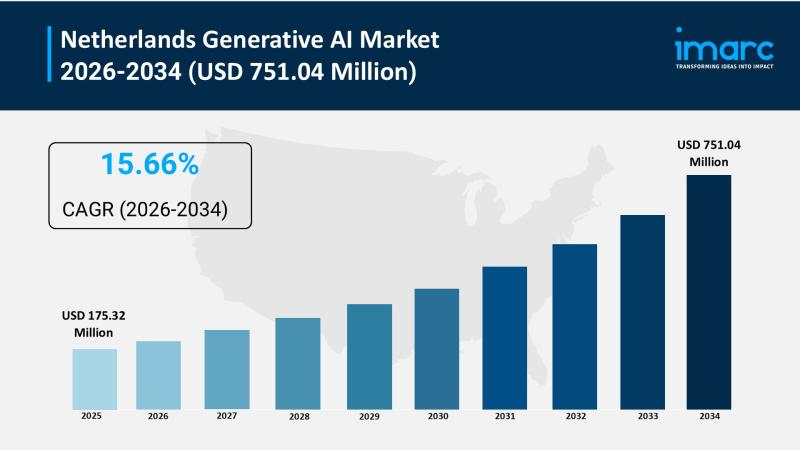
The Netherlands’ generative AI market is poised for remarkable growth, expanding from USD 175.32 million in 2025 to an anticipated USD 751.04 million by 2034. This translates to a compound annual growth rate (CAGR) of 15.66% from 2026 to 2034. Driven by a surge in automation demand and a quest for personalized experiences across various sectors, including healthcare, finance, and retail, the market’s trajectory is further supported by robust technology infrastructure and significant investments in AI research and development.
Central to this growth is the Dutch government’s commitment to fostering generative AI innovation. A recently unveiled vision allocates EUR 3.5 million (USD 15.53 million) to support the open-source GPT-NL model. Additionally, EUR 204.5 million (USD 235.18 million) has been earmarked from the National Growth Fund to enhance AI education and innovation initiatives. These efforts aim to create a balanced regulatory framework that emphasizes ethical AI use while promoting transparency, fairness, and accountability.
With generative AI startups rapidly emerging in cities such as Amsterdam, Eindhoven, and Rotterdam, the country is witnessing the formation of a vibrant tech ecosystem. This environment not only encourages innovation but also attracts both domestic and international venture capital, further solidifying the Netherlands as a hub for AI development. Industry reports suggest that generative AI could contribute approximately EUR 80-85 billion (USD 92-97 billion) to the national GDP, highlighting its potential impact on the country’s economic landscape.
The expanding applications of generative AI tools across sectors like healthcare, finance, and manufacturing are significant drivers of market growth. Companies are increasingly adopting AI technologies to enhance efficiency, reduce operational costs, and foster innovation. Recent collaborations illustrate this trend; for instance, Randstad is partnering with Song to establish generative AI-driven content studios, while Aircall has launched an AI-powered conversation intelligence platform. These initiatives showcase the tangible benefits of AI adoption, including improved productivity and customer engagement.
Government-backed campaigns and assessments by bodies like the Social and Economic Council are also playing crucial roles in evaluating the labor market impacts of AI adoption. The focus on responsible AI integration is expected to lead to broader workforce improvements, enhancing job prospects while ensuring ethical considerations remain at the forefront of technological advancements.
As the market continues to evolve, several key factors are shaping its future. The Dutch government’s proactive approach – from funding startups to supporting responsible AI deployment – is a cornerstone of the generative AI landscape. The significant investments in the GPT-NL model and the AINEd innovation program are crucial for establishing a secure yet innovative environment that promotes market expansion.
In particular, the establishment and growth of generative AI startups are redefining the competitive landscape. The dynamic tech scene in major cities fosters innovation and attracts substantial venture capital investments. This influx of funding empowers various sectors to utilize AI for productivity enhancements and opens avenues for new applications. As companies like Randstad and Aircall lead the way in leveraging AI technologies, the possibilities for growth and innovation are boundless.
Recent developments reflect this momentum. In May 2025, Randstad NV appointed Song as its global creative and content agency, aiming to leverage generative AI for improved content production and brand consistency across markets. Similarly, in December 2025, Aircall introduced its AI-powered platform in the Netherlands, which features real-time call transcription and analytics that could save sales and customer service teams up to 21 hours per week. These initiatives underscore a growing corporate investment in AI-driven marketing and operational efficiencies.
The Dutch government’s commitment to responsible AI growth is further evidenced by the launch of six action lines under its generative AI vision in January 2025. These initiatives include workplace impact assessments, the establishment of a national AI test facility, and the formation of AI validation teams, all supported by over EUR 235 million in funding. This comprehensive approach highlights the government’s dedication to advancing AI while addressing ethical concerns and societal impacts.
As the generative AI market in the Netherlands continues to expand, its implications for various sectors, including healthcare and finance, are profound. The government’s efforts, combined with a growing ecosystem of startups and corporate initiatives, are set to redefine how AI is integrated into everyday business practices. The future appears promising, with generative AI positioned to become a cornerstone of economic growth and innovation in the years ahead.
See also LLaDA2.1 Launches with 892 Tokens/Second, Revolutionizing Diffusion Language Models
 Zhipu AI Launches GLM-5, Surpassing OpenAI’s GPT-4o in Key Multimodal Benchmarks
 Sourceful Launches Riverflow 2.0 with Unmatched Photorealism for Commercial AI Imaging
 Flow AI Launches Integrated Video Generation Platform to Streamline Corporate Marketing
 KPMG’s Fabiana Clemente Reveals Key Insights on Synthetic Data’s Role in AI Systems