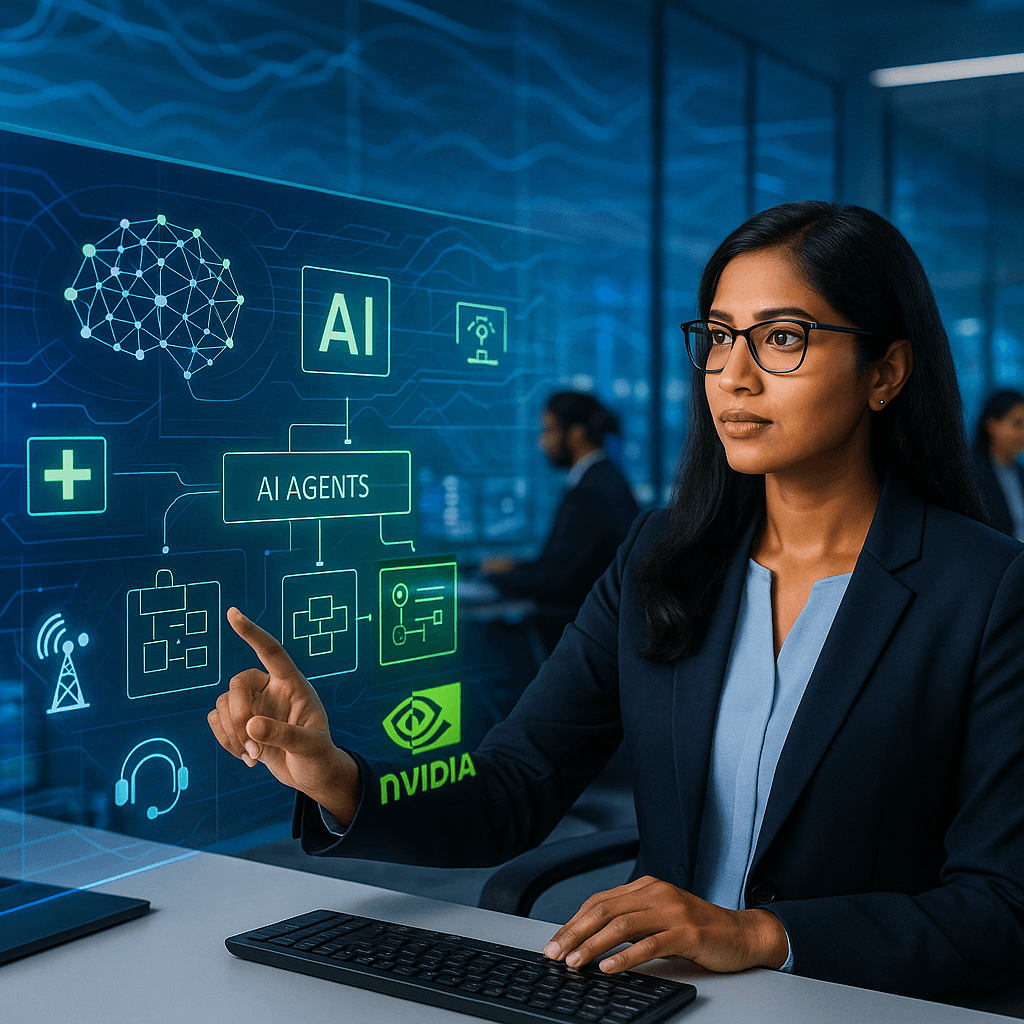
India’s leading systems integrators are positioning themselves at the forefront of artificial intelligence (AI) deployment, leveraging NVIDIA AI Enterprise software and Nemotron models to develop agentic AI solutions for enterprise clients. Companies such as Infosys, Wipro, Tech Mahindra, and Persistent Systems are focusing their efforts on automating workflows in sectors like call centers, telecommunications, and healthcare. This strategic shift marks a significant transition for India’s tech services industry, moving away from traditional outsourcing models toward AI-powered automation.
The urgency of this transition is apparent. While many enterprises spent 2024 and early 2025 testing chatbots and other generative AI tools, these Indian integrators are advancing directly to agentic AI systems. These systems are designed to handle complex multi-step tasks with minimal human intervention. According to a blog announcement from NVIDIA, the primary areas of focus will include call center operations, telecommunications infrastructure, healthcare administration, and back-office processing—all sectors where India’s robust $250 billion IT services industry has long excelled.
This shift is particularly noteworthy given that these companies built their success on labor arbitrage, employing millions to perform the very tasks that AI is now poised to automate. The transition underscores a critical realization among India’s tech leaders: to safeguard their market position, they must evolve from being providers of low-cost labor to becoming automation leaders. Infosys, in particular, has taken an aggressive stance by forging partnerships with multiple AI vendors and simultaneously training thousands of employees in agentic workflows.
The deployment of AI agents represents what could be the next wave of productivity gains, following initial experiments with generative AI. These enterprise AI agents are capable of streamlining operations, thereby enhancing efficiency and reducing costs for businesses that adopt them. As companies navigate a competitive landscape increasingly influenced by technological advancement, implementing such AI solutions could provide a significant edge.
With the rapid evolution of AI technology, firms like Wipro and Tech Mahindra are betting that the ability to automate complex workflows will not only sustain their business models but also attract new clients looking for efficiency and reliability in their operations. In recent years, the focus on enhancing customer experience has become paramount, as more organizations recognize the value of deploying AI to improve service delivery and operational efficiency.
As these Indian tech giants harness the capabilities of NVIDIA’s AI tools, they are reshaping the global outlook on AI deployment. This transition may very well serve as a blueprint for tech industries in other regions to follow. The emphasis on agentic AI could spur a wider acceptance of automation technologies across various sectors, further driving digital transformation initiatives.
Looking ahead, the implications of this pivot are profound. If these enterprises succeed in deploying AI-powered solutions effectively, they may not only redefine their own business models but also influence the adoption of similar technologies on a global scale. As the tech landscape continues to evolve, the extent to which Indian systems integrators can capitalize on these innovations will likely determine their trajectory in the coming years.
See also NHS Expands Oracle’s AI Note-Taking Tool to Over 300 Hospitals, Boosting Efficiency
 Royal Bank of Canada Launches AI Group Aiming for 2027 Value Creation Goal
 Nvidia Partners with AIGI to Launch 500 AI Startups in India’s $130B Market
 Sunil Mittal: AI Poised to Revolutionize Healthcare and Education Sectors
 Mexico Announces 40-Hour Workweek Reform, Stricter AI Compliance by 2026