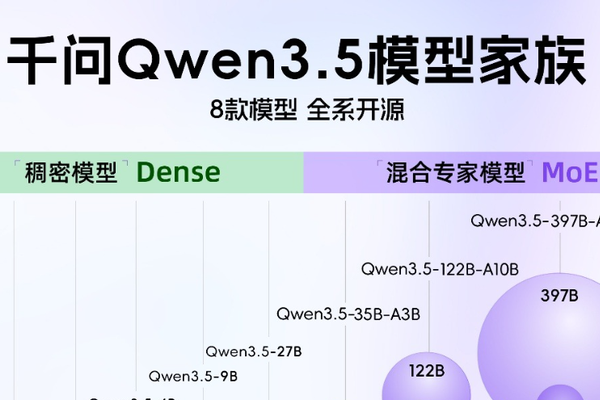
On March 3rd, Alibaba announced the open-sourcing of four small-sized models from its Qianwen 3.5 series, namely Qwen3.5-0.8B, Qwen3.5-2B, Qwen3.5-4B, and Qwen3.5-9B. These models demonstrate significant advancements in artificial intelligence technology, with the Qwen3.5-9B model performing comparably to systems with ten times more parameters. Notably, Elon Musk responded on social media, praising the models for their “impressive intelligence density.”
The breakthrough in the architecture and training of these models has enabled powerful native multi-modal capabilities in small-sized dense models for the first time. The enhancements notably include improved intelligence and visual understanding. The Qwen3.5 series manages to deliver performance levels akin to larger models, redefining what is possible in terms of intelligence density. Evaluations from multiple authoritative assessments, such as Instruction Following (IFBench) and Doctor-level Reasoning (GPQA), indicate that the Qwen3.5-9B model is on par with much larger models, including the Qwen3-Next-80B-A3B-Thinking, while significantly outperforming mainstream lightweight models.
Among the models, the Qwen3.5-4B strikes an effective balance between performance and resource consumption, making it particularly adept for lightweight Agents in multi-modal applications. In evaluations like the Visual Agent (ScreenSpot pro), its performance rivals that of the Qwen3-VL-30B-A3B model, which is nearly eight times its size. The Qwen3.5 series is engineered to operate autonomously on devices such as mobile phones and computers, enhancing user interaction capabilities.
Alibaba’s smaller Qwen3.5-0.8B and Qwen3.5-2B models exhibit rapid inference speeds, making them suitable for deployment on various terminal hardware, including mobile phones and smart glasses. This opens up new avenues for edge-side AI applications, such as offline voice interaction and real-time decision-making. Experts suggest that the introduction of these small models could catalyze the expansion of core AI application scenarios in edge computing environments.
With these latest developments, Alibaba has now made available a total of eight new Qianwen 3.5 models, all of which capitalize on the principle of achieving “winning with small size.” This advancement, noted by Musk, exemplifies the ability to deliver enhanced intelligence with reduced computational demands. The new-generation model, Qwen3.5-397B-A17B, released on Chinese New Year’s Eve, features fewer than 400 billion parameters, surpassing the previous flagship Qianwen 3 model, which had trillions of parameters.
Additionally, the three medium-sized models—Qwen3.5-35B-A3B, Qwen3.5-122B-A10B, and Qwen3.5-27B—released the previous month demonstrate competitive performance levels while being operable on consumer-grade graphics cards. Following its open-source release, the Qianwen 3.5 series has quickly ascended the global open-source model rankings, capturing four of the top five spots and generating significant interest within the AI community. Developers have noted that a medium-sized Qianwen 3.5 model can perform efficiently on standard laptops equipped with M4 chips, offering capabilities akin to more advanced models.
Alibaba’s commitment to full-scale open-sourcing across varying model sizes encompasses a wide range of applications, including large language models, mathematical reasoning, programming, voice recognition, and visual understanding. To date, over 400 Qianwen models have been made available, achieving more than 1 billion downloads globally and facilitating the creation of over 200,000 derivative models. This expansive open-source model system has established itself as a significant force in the global AI landscape.
See also Rwazi Launches AI Datasets for Real-World Applications Across 195+ Countries
 OpenAI Launches GPT-5.3 Update to Enhance ChatGPT’s Conversational Tone and Accuracy
 Inception Launches Mercury 2, a Diffusion LLM 10x Faster than OpenAI’s Models
 Agüera y Arcas Reveals New AI Theory Linking Computation to Biological Intelligence