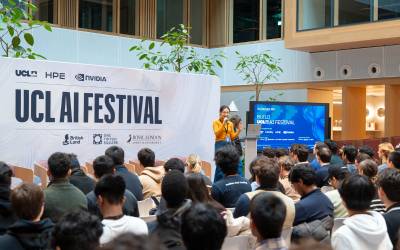
The four-day UCL AI Festival, held at One Triton Square, showcased a convergence of student talent, research innovation, and entrepreneurial spirit across several fields including healthcare, climate change, and robotics. Organized by UCL Innovation & Enterprise in collaboration with NVIDIA and HPE, the festival featured a mix of hands-on activities and research presentations aimed at exploring the potential of artificial intelligence in addressing real-world challenges.
The festival began with a two-day hackathon, co-organized with AI Engine, that drew over 200 participants. Teams were tasked with prototyping AI-based tools within a tight 24-hour window, focusing on impactful applications in areas such as public service, climate initiatives, and healthcare. The competition culminated in a showcase where participants presented their working demos to industry judges.
The winning team, comprising UCL students Lucas Lim, Joe Tan, Shashank Durgad, and University of Cambridge’s Desmond Zee, created “Sentrix,” an advanced policing tool designed to enhance crime prevention through autonomous technology. The team received tickets and funded travel to NVIDIA GTC 2026 in San Jose as part of their prize. “Winning the hackathon felt surreal; it goes to show that the urgent problems attract the most attention when you have the conviction to go after them,” Joe Tan remarked.
Another UCL team, featuring students Afthab Shiraz, Ashraya Poudel, and Mehul Chourasia, secured third place, earning a Nvidia DGX Spark for their efforts. The hackathon enjoyed support from a range of industry partners, including Cooley, N47, and Dawn Capital, as well as technology giants like NVIDIA, AWS, and Anthropic.
The second half of the festival shifted focus to research, beginning with an introductory address by Professor Geraint Rees, UCL’s Vice-Provost for Research, Innovation & Global Engagement. He emphasized the dual role of AI in society, highlighting both its transformative potential and ethical responsibilities. “The UCL AI Festival shows both the power and responsibility of AI,” Rees stated. “UCL is helping lead the field — advancing the science while ensuring AI delivers real-world impact for people and planet.”
During the research presentations, notable discussions included Professor Lourdes Agapito’s examination of Synthesia, a company that transitioned from UCL’s 3D vision research to a prominent player in generative AI. Other significant topics encompassed advancements in AI-driven healthcare diagnostics, climate modeling, and robotics.
Professor Pontus Stenetorp detailed efforts at UK-LLM to develop a large language model based entirely on British computational resources for public service applications. Dr. Michel Tsamados presented findings on climate change impacts in polar regions, while Dr. Chengxu Zhou discussed the UCL Humanoid Robotics Lab’s work on AI systems designed to operate safely in dynamic environments.
In research that marries AI with computational chemistry, Professor Peter Coveney showcased groundbreaking simulations of molecular mechanisms using quantum computing integrated with GPU-accelerated supercomputing. Meanwhile, Dr. James Ruffle highlighted AI’s role in aiding healthcare professionals in analyzing complex data sets for brain tumor diagnosis and treatment.
The UCL AI Festival not only provided a platform for showcasing innovative AI applications but also fostered meaningful discussions about the technology’s future trajectory and societal implications. As the event concluded, participants and industry leaders left with insights into how AI can be harnessed responsibly to tackle pressing global challenges.
See also Anthropic Reveals AI’s Ability to Deanonymize Online Accounts with 68% Recall Rate
 UK Launches £40M Fundamental AI Research Lab to Tackle Core Challenges and Drive Breakthroughs
 Microsoft Combines Quantum Computing and AI to Revolutionize Chemical Research Accuracy
 AMD Launches AI Research Lab at University of Toronto, Initiates 100 Projects in 3 Years
 Anthropic Study Reveals AI Could Replace 94% of Computer Jobs, Automation Remains Limited