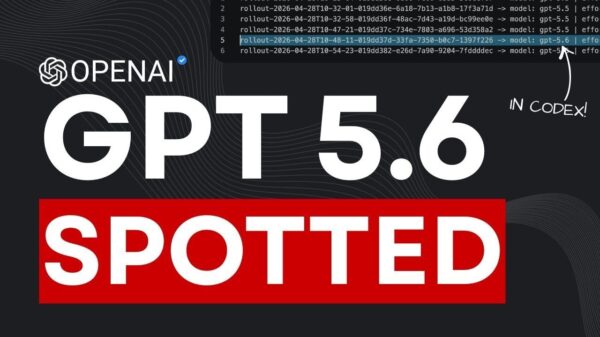
OpenAI has unveiled two new AI models, GPT-5.4 mini and GPT-5.4 nano, designed to enhance efficiency for high-volume tasks where speed and cost are critical. These models aim to incorporate several capabilities of the larger GPT-5.4 system into more agile formats, thereby improving response times significantly. The introduction of these models aligns with use cases where latency is crucial, including coding assistance, automated subagents, and real-time image processing applications.
The GPT-5.4 mini is positioned as a successor to its predecessor, GPT-5 mini, offering advancements in coding, reasoning, multimodal understanding, and tool utilization. OpenAI claims that this model operates over twice as fast as the earlier version and performs comparably to the larger GPT-5.4 model on specific benchmarks such as SWE-Bench Pro and OSWorld-Verified.
In contrast, GPT-5.4 nano is the smallest and most cost-effective variant in the new series. It is specifically tailored for lighter tasks including classification, data extraction, and ranking, while also supporting coding functions. According to OpenAI, this model represents a notable improvement over GPT-5 nano, emphasizing efficiency without compromising essential capabilities.
Both models are engineered for environments that demand quick and dependable outputs rather than maximum scale. Use cases include coding tools that require rapid responsiveness, systems interpreting screenshots, and applications reliant on real-time image analysis. OpenAI indicates that smaller models such as these can strike a better balance between performance and speed compared to their larger counterparts.
In coding workflows, OpenAI points out that both GPT-5.4 mini and nano are well-suited for tasks that benefit from swift iterations, including targeted edits, debugging, and navigating extensive codebases. Notably, the GPT-5.4 mini is reported to exceed the performance of GPT-5 mini while maintaining similar processing speeds, bringing it closer to the capabilities of the larger GPT-5.4 on various tests.
OpenAI has also underscored the significance of smaller models in multi-model systems. In setups like Codex, larger models may handle strategic planning and decision-making, while smaller models, such as GPT-5.4 mini, execute narrower tasks in parallel, such as searching codebases or processing documents. This design approach enables developers to allocate workloads more effectively, resulting in enhanced system performance.
Performance benchmarks reveal that the GPT-5.4 mini excels in multimodal tasks related to computer use, such as interpreting complex user interface screenshots. On the OSWorld-Verified benchmark, the model reportedly approaches the performance levels of GPT-5.4 while surpassing GPT-5 mini.
Developers can access the GPT-5.4 mini through OpenAI’s API, as well as within Codex and ChatGPT. In the API context, it supports both text and image inputs, tool utilization, function calling, web and file searching, and computer-based interactions, boasting a context window of 400,000 tokens. Pricing for this model is set at $0.75 per million input tokens and $4.50 per million output tokens.
Within the Codex environment, the GPT-5.4 mini is available across its app, command-line interface, IDE extension, and web interface. OpenAI states that it consumes approximately 30% of the GPT-5.4 usage quota, thereby allowing developers to tackle simpler tasks at a lower cost. Codex systems can also assign less complex assignments to GPT-5.4 mini while reserving more challenging tasks for larger models.
In ChatGPT, the GPT-5.4 mini is accessible to Free and Go users through the “Thinking” feature and serves as a fallback for GPT-5.4 Thinking in other tiers when usage limits are reached.
The GPT-5.4 nano model is currently only available via the API, with pricing set at $0.20 per million input tokens and $1.25 per million output tokens. As the landscape of AI continues to evolve, these new models from OpenAI are expected to play a critical role in enhancing efficiency and performance in various applications, ultimately shaping the future of AI-driven technologies.
See also Scaling GenAI: Achieving 5,000+ Concurrent Video Generations with Asynchronous Architecture
 Hardware-Optimized Diffusion Model IP Market Surges to $2.34B in 2025 with 25.8% CAGR
 OpenAI Reveals DALL-E 3 with Enhanced Prompt Accuracy and 4K Output Capabilities
 Top AI Courses for Mastering LLM Workflows in 2026: Essential Skills Revealed