
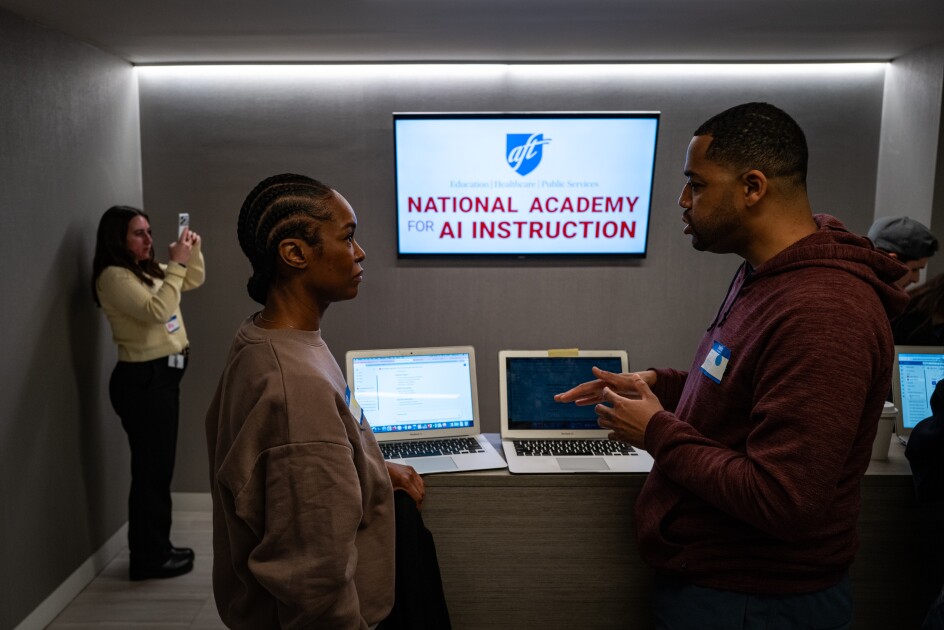
About 50 educators gathered in New York City on March 18 to explore advanced uses of artificial intelligence (AI) in classrooms, part of an initiative aimed at enhancing instructional practices. The training session was hosted by the National Academy for AI Instruction, a $23 million partnership between the American Federation of Teachers (AFT) and major AI developers including Anthropic, Microsoft, and OpenAI. The initiative seeks to prepare 400,000 teachers to effectively integrate AI into their teaching methods.
Many teachers currently utilize AI primarily for basic tasks such as lesson planning and administrative work. However, as AI technologies advance, there is a growing need for educators to learn how to apply their professional judgment alongside AI tools. This training focuses on developing “agentic” AI tools, which can handle more complex, multi-step tasks that involve reasoning, thereby supporting teachers across different subjects and educational levels.
Jing Liang Guan, a science teacher at the Brooklyn Science and Engineering Academy, highlighted the potential of these advanced AI tools. Unlike basic lesson planning software, these tools can assist educators in identifying content gaps and refining teaching methods over time. “A tool that can help me stress-test my lessons is invaluable,” Guan said, emphasizing the importance of using AI to enhance educational quality rather than merely automate routine tasks.
According to a national survey conducted by the EdWeek Research Center, the proportion of teachers utilizing AI tools nearly doubled from 2024 to 2025, with 60% reporting regular use. However, most applications remain superficial, focused on administrative functions rather than deeper instructional improvements. “We’re in this race for teachers to get this knowledge,” said Randi Weingarten, AFT president. She noted that educators must take the lead in mastering AI to ensure they remain the driving force in educational technology.
The training also aimed to empower teachers to create tailored AI tools that leverage their own insights. For instance, Seth Reznik, a team lead for Microsoft Elevate, pointed out that these new AI agents allow educators to guide the AI’s responses by narrowing the scope of information used, minimizing the risk of AI-generated inaccuracies. “This makes it less likely the AI will hallucinate or provide irrelevant information,” Reznik explained.
Teachers at the training expressed a need for AI that could assist with real-time problem-solving. Lois Torres, a preschool paraeducator, aims to develop research-backed AI tools that help her and her co-teacher brainstorm alternative teaching strategies when standard approaches fall short. “A lot of teachers are doing this work at home, just wracking their brains trying to figure out what’s going to work for the next day,” Torres stated.
Yasheema Cook, an educator working with 12th graders with diverse needs, shared her intention to create AI agents that can help monitor individualized education programs and adapt lessons based on students’ daily progress. However, she noted the challenge of balancing the need for context about student needs while safeguarding privacy. Despite ongoing efforts, New York City public schools have yet to release formal guidance on AI usage, leaving teachers uncertain about data privacy implications.
Jennifer Watters, a third-grade teacher, has been experimenting with AI since 2019 and has employed it for more advanced objectives, such as developing culturally relevant questioning techniques. However, privacy concerns recently prompted her to switch from using OpenAI’s ChatGPT to Anthropic’s Claude, particularly after Anthropic’s commitment to privacy in its operations. “It’s really important that teachers know that this information…can be very dangerous for our students, for our profession, and for our jobs,” Watters emphasized.
While some educators have begun to delegate routine tasks like letter writing to AI, experts caution against relying too heavily on these tools. The risk includes potentially diminishing teachers’ personal engagement with their students’ needs. Teachers have indicated that ongoing training and support will be essential for effectively navigating the rapidly evolving AI landscape. “What we’re seeing nationally is, the more someone uses [AI], the less fearful they are of using it,” Weingarten said. However, she also highlighted the persistent anxiety stemming from the lack of federal guidelines on data privacy and ethical AI use.
See also Trump Administration Reveals National AI Framework to Centralize Regulations and Boost Innovation
 University of Phoenix Study Reveals Generative AI’s Impact on Doctoral Research and Ethics
 BranchED Launches AI-Driven Simulations to Enhance Teacher Training Confidence
 Organizational Culture, Not Technology, Hinders AI Adoption in Education, Says Tanzania Times