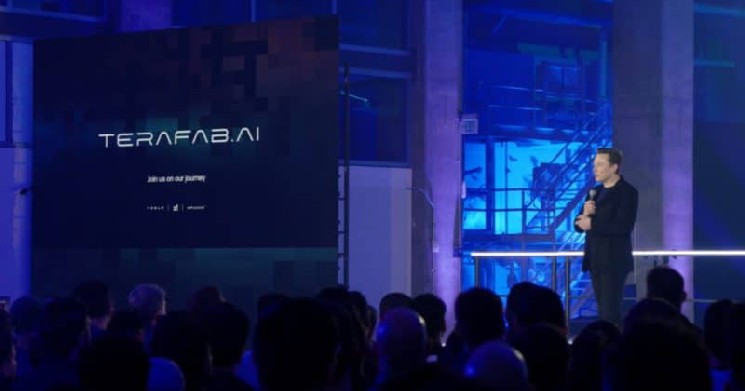
Elon Musk has unveiled Terafab, a hyper-scale chip production facility designed to enhance artificial intelligence computing power and support future space-based infrastructure for human expansion beyond Earth. The initiative is being developed collaboratively by Tesla, SpaceX, and Musk’s company, xAI, with the ambitious goal of producing one terawatt of computing power annually, a figure that is approximately 50 times greater than the current global output of AI chips.
“The way to actually scale civilization is to scale power in space…because we actually capture such a tiny amount of the sun’s energy on Earth,” Musk stated during a recent SpaceX broadcast. He further emphasized, “We want to be a civilization that expands to the galaxy with spaceships that anyone can go anywhere they want at any time. To do that, we need to harness the power of the sun. A Terafab, while it is enormous, a terawatt of compute per year is enormous by our sort of civilizational standards, it is still just one step along the way of being even a Kardashev.”
The Terafab facility aims to integrate the complete chip development lifecycle within a single site. According to Musk, this would encompass lithography mask creation, chip fabrication, testing, and redesign, facilitating a rapid feedback loop to optimize chip designs. This approach is expected to significantly quicken improvement cycles compared to the fragmented structure of today’s chip supply chain. The project is set to commence with an advanced manufacturing facility in Texas, backed by state-level support.
The initiative anticipates creating two distinct categories of chips. The first category would be optimized for edge inference, specifically catering to onboard processing needs for Tesla’s Optimus humanoid robots and autonomous vehicles, including the upcoming Cybercab. Musk forecasts that manufacturing for humanoid robots could eventually yield between one billion and ten billion units annually, overshadowing the roughly 100 million vehicles produced globally each year.
The second type of chip will be engineered for space conditions, designed to endure high-energy particle bombardment and function at elevated temperatures, thus minimizing the mass of thermal radiators needed on orbiting platforms. Musk articulated that the terrestrial power limitations make it impractical to achieve a terawatt of compute on Earth, where total U.S. electricity generation is around 0.5 terawatts. Consequently, the bulk of computing infrastructure is envisioned to orbit the planet via solar-powered AI satellites.
A proposed “mini-satellite” specification calls for 100 kilowatts of output, with future advancements targeting the megawatt range. To reach the full terawatt goal, it would necessitate launching approximately ten million tons of material into orbit each year, maintaining an efficiency of 100 kilowatts per ton. The current Starship V3 variant can deliver about 100 tons per payload, while the upcoming V4 model aims to double this capacity to 200 tons. SpaceX has successfully completed more than 500 booster landings, dramatically reducing launch costs from over $65,000 per kilogram during the Space Shuttle era to an estimated $1,000 to $2,000 per kilogram today.
Musk expressed a target to further decrease this cost to between $100 and $200 per kilogram through Starship optimization, a threshold he believes would render space-based AI deployment more economical than ground-based alternatives within the next two to three years. He underscored the necessity of fully reusable launch systems like Starship to transport the voluminous equipment required for this ambitious endeavor.
“Starship is a critical piece of the puzzle, because in order to scale compute and scale power, you have to go to space, which means that you need massive payload to space. And Starship will enable that,” Musk stated. He also discussed long-term concepts, such as utilizing lunar-based manufacturing and mass drivers to further lower costs for deploying infrastructure into orbit.
Global AI compute capacity is currently estimated at approximately 20 gigawatts per year. Musk highlighted that the combined output of every semiconductor fabrication plant worldwide accounts for only about 2% of what Terafab would require to meet its one-terawatt annual target. While he acknowledged the importance of existing suppliers, including major global foundries, he noted that their maximum comfortable expansion rate falls significantly short of his ambitious requirements. “We either build the Terafab or we don’t have the chips,” Musk asserted. “And we need the chips, so we build the Terafab.”
The Terafab project represents a significant leap toward realizing Musk’s vision of a space-faring civilization, leveraging cutting-edge technology to overcome Earth’s limitations and propel humanity into the cosmos.
Disclosure: This article was edited by Vivian Nguyen. For more information on how we create and review content, see our Editorial Policy.
See also IonQ and D-Wave Quantum Stocks Surge as Alphabet Expands Quantum Computing Efforts
 Jabil Raises AI Infrastructure Guidance, Targets $34B Revenue Amid 14.2% Undervalued Stock
 AI Privacy Concerns Escalate as Ring, OpenAI, and Google Face Backlash Over Surveillance
 Oil Prices Surge Over $112 Per Barrel, Threatening AI Costs Amid Iran War Escalation
 Hewlett Packard Enterprise Launches New AI Infrastructure Amidst Valuation Discount