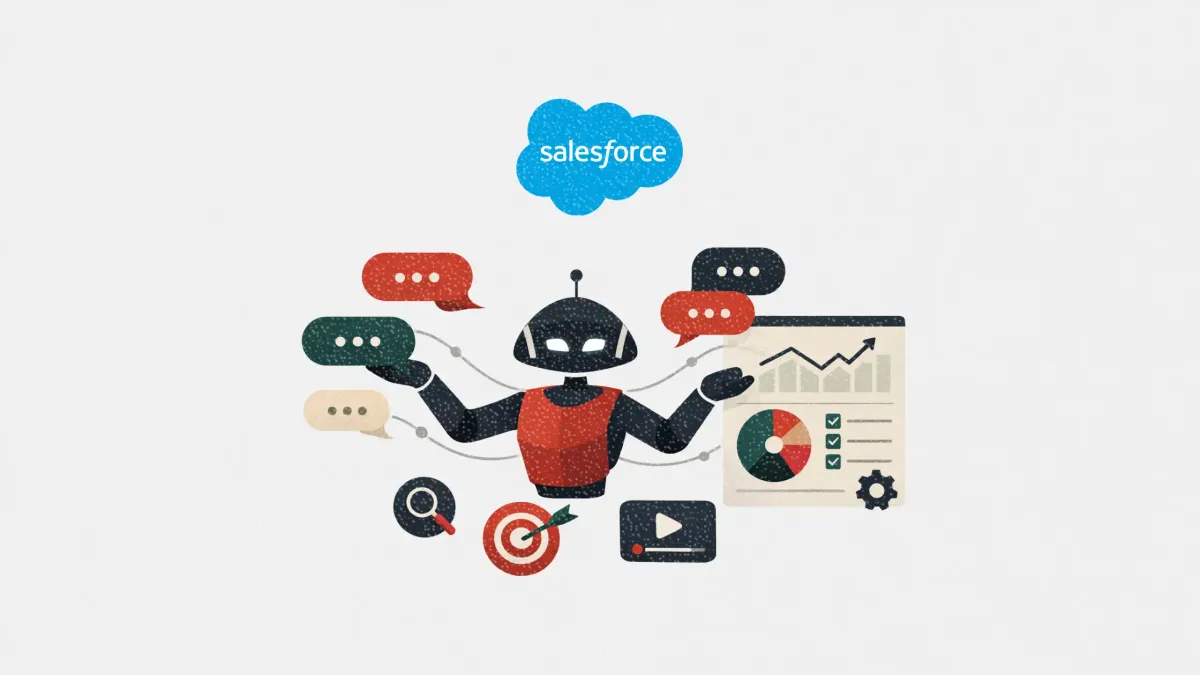
Marketing is undergoing a significant transformation as it shifts from manual execution to AI-driven systems that function in real time. According to Salesforce’s latest State of Marketing 2026 report, this evolution introduces the concept of agentic marketing, where artificial intelligence takes on more autonomous roles in execution, optimization, and customer engagement. This move is not merely theoretical; it is already being implemented in high-performing teams today, changing the landscape of marketing operations.
In essence, agentic marketing represents a departure from traditional campaign-driven approaches to a model centered on real-time conversations. As brands adapt to changing customer expectations, they are expected to engage in meaningful, two-way dialogues rather than simply pushing messages out. The report reveals that 83% of marketers acknowledge that customers now expect these interactions. Yet, 69% admit they struggle to respond promptly to customer inquiries, highlighting the limitations of conventional marketing strategies that cannot accommodate continuous engagement.
The potential of agentic marketing lies in its ability to leverage AI systems capable of acting, responding, and optimizing in real time. Traditionally viewed as a support layer—assisting with content generation or performance analysis—AI is now evolving into a core component of marketing workflows. According to the report, 81% of marketers express confidence in AI’s ability to handle customer inquiries, and high-performing teams are nearly twice as likely to employ AI agents compared to their peers.
These AI agents are not merely tools; they are designed to perform a range of functions that can significantly reduce the burden on human marketers. They can manage customer interactions across multiple channels, execute campaigns autonomously, and optimize performance based on real-time data. This marks a crucial shift, enabling marketing teams to delegate repetitive tasks to AI, thus allowing human professionals to focus on strategic and high-value activities.
The measurable impact of adopting agentic marketing is evident among teams that have embraced this new approach. High-performing marketers utilizing AI agents report a 20% increase in ROI and a 19% reduction in costs. Moreover, these teams are able to reclaim up to eight hours per week, time that can be redirected towards more strategic initiatives. Notably, teams that harness unified data are 60% more likely to employ AI agents to scale their efforts and 42% more likely to respond to customers consistently.
Despite the clear benefits, the integration of agentic marketing into organizations remains in its infancy. Only 13% of marketers currently utilize agentic AI, and 61% report that AI is not yet fully integrated into their marketing systems. Challenges contributing to this gap include fragmented data systems that limit AI agents’ functionalities, incomplete integration across various tools and workflows, and the absence of operational structures necessary to support autonomous systems. As a result, many teams find themselves in a transitional phase, exploring how to effectively leverage AI agents rather than fully operationalizing them.
For B2B marketers and PR professionals, the rise of agentic marketing signifies a substantial shift in operational dynamics. The focus is transitioning from manual execution of campaigns to the orchestration of AI-driven systems. Marketers will increasingly find themselves in roles that require them to define goals, set parameters, oversee AI operations, and refine strategies based on outputs rather than executing every tactical detail themselves. As this landscape evolves, the competitive advantage will not solely stem from the use of AI but rather from how effectively teams design and manage these systems. In this new paradigm, agentic marketing is not set to replace marketers, but rather to redefine their roles within the industry.
See also Durham University Partners with Sage to Enhance AI Skills in North East England
 Micron Technology Poised for $1 Trillion Boost from Nvidia’s AI Sales Surge
 GoodVision AI Launches Intelligent Compute Scheduling to Combat AI Token Shortage
 ANDRITZ Deploys IndustrialMind.ai to Streamline Engineering Workflows by 30%