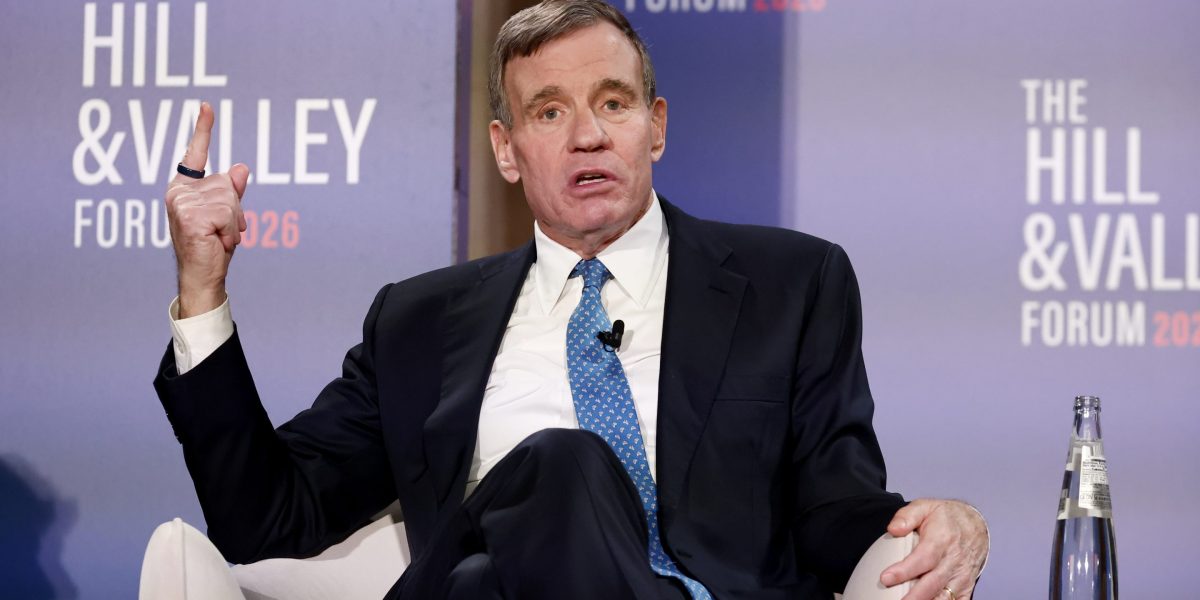
Senator Mark Warner (D-VA) has warned that the rise of artificial intelligence (AI) will be a defining challenge of this generation, particularly for recent college graduates facing a 5.6% unemployment rate. Speaking at the Hill and Valley Forum in Washington, Warner stated, “I will bet anybody in the audience that goes to 30 or 35% within the next two years,” emphasizing the urgency of addressing the potential fallout from AI technologies.
While Warner’s estimates may seem alarming, they align with sentiments expressed by other leaders in the AI sector who are grappling with the balance between cautioning the public and avoiding undue panic. Warner noted that AI evangelists are moderating their predictions, likely due to the short-term economic disruptions already being felt across various sectors. He serves as the vice chairman of the Senate Intelligence Committee, where he has consistently voiced concerns around the implications of AI on the workforce.
During the panel discussion titled “From Capital to Capability: Rebuilding U.S. Industrial Strength,” Warner criticized the Biden administration’s AI regulatory framework for its perceived lack of depth. He pointed to the previous Trump administration’s approach, which outlined important policy areas such as children’s privacy and intellectual property rights but failed to adequately address national security threats associated with advanced AI technologies.
Warner emphasized that it is primarily up to the technology companies to mitigate the adverse impacts of AI on employment. “If you expect the government officials alone to solve this, you’re missing the boat,” he stated, making a case for increased collaboration between industry and policymakers. Warner’s background as a venture capitalist informs his perspective on the need for industry input in drafting effective strategies to manage AI disruption.
He specifically referenced the impact of AI on job losses in sectors such as human resources and software, citing the technology’s potential to significantly disrupt white-collar employment. Last month, OpenAI’s CEO Sam Altman claimed that companies were “AI-washing” layoffs, using AI as a catch-all excuse for workforce reductions. In contrast, Anthropic’s CEO Dario Amodei has moderated his earlier predictions about AI’s capacity to eliminate 50% of entry-level office jobs, instead suggesting that the transition would result in “unusually painful” economic disruption.
Recent surveys show that only 0.4% of CFOs expect job losses this year due to AI, translating to roughly 502,000 roles out of 125 million. Warner argued that the nature of AI disruption is fundamentally different from the labor transformations caused by globalization, as AI poses a more immediate threat to skilled jobs.
Looking ahead, Warner noted that students are already considering career paths resistant to AI displacement. In 2025, nearly 1.63 million students—representing approximately 9% of enrollees—were pursuing business degrees, a field particularly vulnerable to AI advancements. He suggested that tech companies like Anthropic and OpenAI may want to consider funding initiatives to redirect business students into less automatable fields, such as nursing.
Warner has expressed skepticism regarding government retraining programs, like the Trade Adjustment Assistance for Workers, calling them largely ineffective. He pointed out the government’s struggles in regulating social media, remarking that the challenge posed by AI is of a far greater magnitude. “Social media is tiny compared to AI,” he said, warning that without effective oversight, opportunities for innovation and advancements in health care could be stifled.
Concerns about immigration barriers further complicate the landscape, with Warner highlighting the challenges faced by international tech talent, such as the Trump administration’s $100,000 fee on H-1B visas. As the transition to an AI-driven economy accelerates, Warner’s call for enhanced cooperation between industry and government underscores the urgent need for proactive measures to navigate the complexities of this technological evolution.
See also Palantir Technologies Stock Surges on Golden Dome AI Breakthrough and Analyst Buy Rating
 Scottish Government Issues New AI Guidelines for Schools to Ensure Safe Use
 Mila Partners with Mozilla, Investing $1M to Develop Open-Source AI Tools
 Federal Judge Blocks Pentagon’s Ban on Anthropic, Citing ‘Orwellian’ Measures
 UK Government Abandons Broad TDM Exception for Copyright in AI Training