Marketers must reevaluate their audience segmentation strategies as artificial intelligence (AI) transforms consumer behavior, according to Klaviyo’s latest AI Consumer Personas Playbook. The report argues that traditional segmentation models are increasingly inadequate in explaining the complex ways consumers engage with AI-driven tools for research and purchasing decisions.
The study reveals a widening behavioral divide among consumers regarding their use of AI. While 96% of AI Holdouts avoid AI during shopping, treating it as an extraneous option, AI Enthusiasts embrace these technologies, with 85% having used AI for shopping in the past six months and 43% making purchases based on AI recommendations. This dichotomy means that two individuals with similar demographic profiles may respond to marketing efforts in fundamentally different ways based on their relationship with AI.
This gap in consumer behavior presents a significant blind spot for traditional segmentation methods, which often categorize users solely by demographic data. Such models fail to account for critical behavioral aspects, such as why some consumers instantly trust AI-generated recommendations and why others approach them with skepticism. Consequently, marketers are challenged to adapt to a landscape where AI influences nearly every aspect of the purchasing journey.
New Behavioral Frameworks
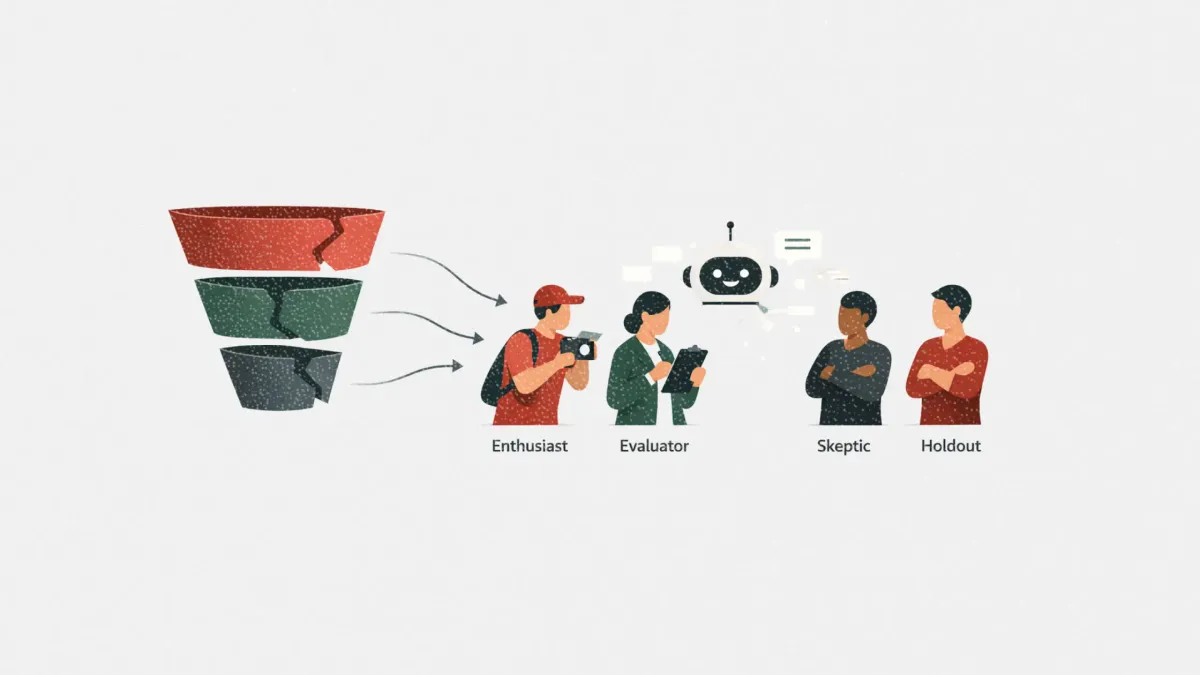
Klaviyo’s report proposes a new framework categorizing consumers into four distinct personas: Enthusiasts, Evaluators, Skeptics, and Holdouts, based on measurable factors like trust in AI and frequency of usage. Enthusiasts display strong positive sentiment, with 81% believing AI enhances product recommendations and 74% asserting it improves customer support. In stark contrast, Skeptics are less likely to trust AI, with just 25% having purchased AI-recommended products, while Holdouts express an even more pronounced distrust, with only 1-4% believing AI improves their shopping experiences.
The most intriguing group, the Evaluators, frequently use AI yet remain hesitant to fully embrace it. Approximately 54% are less likely than Enthusiasts to depend on AI for decision-making, illustrating a crucial segmentation-level divide. The same AI-powered marketing campaign might resonate with one group while performing poorly with another, underscoring the importance of understanding these nuanced consumer behaviors.
This shift in consumer behavior carries significant implications for marketing strategies. First, segmentation must evolve from static profiles to dynamic, behavior-driven frameworks that account for how consumers engage with AI throughout their buying journey. Second, personalization efforts need to align with consumers’ trust levels in AI; for instance, personalized recommendations should be more predictive for Enthusiasts while adopting a more restrained approach for Skeptics and Holdouts.
Furthermore, AI is redefining the customer journey itself, leading to a more fragmented approach where discovery occurs across various platforms, including large language models (LLMs) and traditional channels. This presents a challenge for marketers who have relied on linear funnel models to guide their strategies.
Recent data from Adobe indicates that AI referrals are nearing parity with traditional digital channels in revenue generation, engagement, and trust metrics. This shift signals a broader transition in which marketers must adapt to not only group audiences but also tailor experiences based on distinct levels of AI comfort and expectations.
To navigate this evolving landscape, marketers should not entirely abandon their existing segmentation models but rather enhance them. Practical steps include integrating AI behavior into segmentation frameworks, adjusting personalization depth according to audience trust levels, and monitoring negative signals like disengagement or reduced interaction with AI-driven experiences.
In an era where AI is reshaping consumer interactions and decision-making, Klaviyo’s findings point to a critical juncture for marketers. Those who can effectively adapt to these changes will likely gain a competitive edge. Ultimately, the ability to align marketing strategies with how consumers think and behave in an AI-first world is paramount for achieving success.
See also AI Email Tools Enhance Contextual Responses and Curb Overload in 2026
 McKesson Adopts AI Personalization Platform to Boost Client Loyalty and Drive Growth
 OpenAI Shuts Down Sora App After Six Months, Signals Shift in AI Video Strategy
 Samsung Skips TikTok’s AI Ad Labels, Highlighting Enforcement Failures in Transparency Policies
 BVDW Reveals Email Marketing Guide Addressing AI Agents and 376 Billion Daily Messages