






















































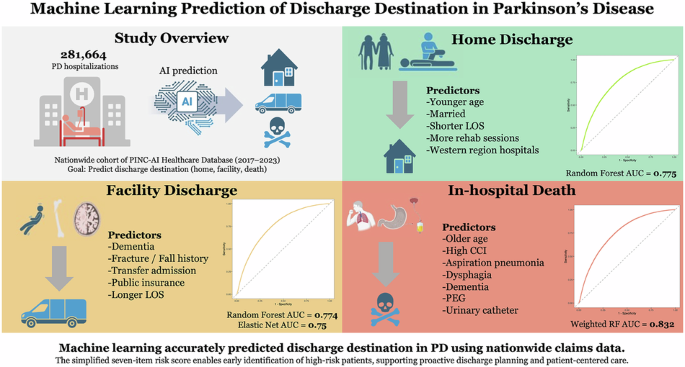
Recent advancements in artificial intelligence (AI) are reshaping the landscape of healthcare, particularly in the management of chronic conditions such as Parkinson’s disease. A growing body of research highlights the potential of AI-driven tools to improve patient outcomes, streamline treatment protocols, and enhance caregiver support.
Parkinson’s disease affects millions globally, and its management is often complicated by co-morbidities and the progressive nature of the disorder. Significant studies, including those by Aarsland et al. (2000) and Gonzalez et al. (2022), emphasize the complexities of managing this condition and the importance of timely intervention. These findings underscore the critical role that AI can play in predicting patient needs and improving care strategies.
One notable approach involves the integration of machine learning algorithms to predict discharge destinations and hospital readmissions. Research from Kamo et al. (2025) illustrates how predictive models can effectively assess the discharge needs of patients with Parkinson’s disease, ultimately leading to better resource allocation and care planning. This is further supported by the findings of Chen et al. (2023), which validate machine learning’s generalizability in clinical settings.
The implications of these technologies extend beyond immediate patient care. For instance, the systematic review by McMillan et al. (2021) highlights the impact of frailty in Parkinson’s patients and suggests that AI tools could help identify these vulnerabilities early on, allowing for proactive management strategies. Furthermore, studies like that of Schrag et al. (2006) have established a clear connection between caregiver burden and patient outcomes, indicating that AI could also play a pivotal role in alleviating stressors for caregivers by enhancing communication and care coordination.
In the realm of telemedicine, AI applications are being explored for their potential to deliver specialized care remotely. The work of Klaptocz et al. (2019) on hospital admissions prior to care home placements points to a critical need for ongoing monitoring and support for patients transitioning to long-term care. AI technologies could facilitate continuous engagement, ensuring that healthcare providers remain informed about changes in a patient’s condition.
The cost implications of managing Parkinson’s disease are significant, with Weir et al. (2018) highlighting the burden on healthcare systems in the UK. AI-driven solutions may yield substantial savings by optimizing treatment pathways and reducing unnecessary hospital visits. This aligns with the findings of Zhou et al. (2024), which link glymphatic system dysfunction to increased clinical challenges in Parkinson’s patients, indicating an urgent need for monitoring and intervention.
As AI continues to evolve, the potential for its application in predicting fall risks—an area of concern for many Parkinson’s patients—is gaining traction. Hatano and Kamo (2026) discuss the management of fall risk in patients, suggesting that AI could provide real-time data that informs preventative strategies. The integration of non-wearable AI technologies to detect falls in real-time is already being explored, as demonstrated in studies like that of Kamo HaO et al. (2024).
Looking ahead, the integration of AI in Parkinson’s disease management presents numerous possibilities. With ongoing research and technological advancements, healthcare systems may witness a transformation in care delivery models, ultimately enhancing the quality of life for patients and easing the burden on caregivers. As these innovations unfold, the focus will remain on ensuring that AI tools are accessible and effective in meeting the diverse needs of this patient population.
In conclusion, the intersection of AI and healthcare is poised to revolutionize the treatment of chronic diseases like Parkinson’s. By harnessing predictive analytics and machine learning, healthcare providers can develop more personalized care plans, improve patient outcomes, and enhance the overall efficiency of healthcare delivery. As the research continues to expand, the hope is that these technological advancements will lead to a future where managing Parkinson’s disease becomes more streamlined and effective.
See also AI Scientist Completes Full Research Cycle, Passes Peer Review in Major Study
 AI Model LiMPC Achieves 81% Sensitivity in Detecting Pancreatic Cancer Liver Metastasis
 UK Government Launches £40M AI Research Lab to Drive Transformational Innovations
 AI Scientist Achieves End-to-End Automation in Research with Novel LLM Integration
 Private Equity Firms Embrace AI for Enhanced Research and Valuation Efficiency















