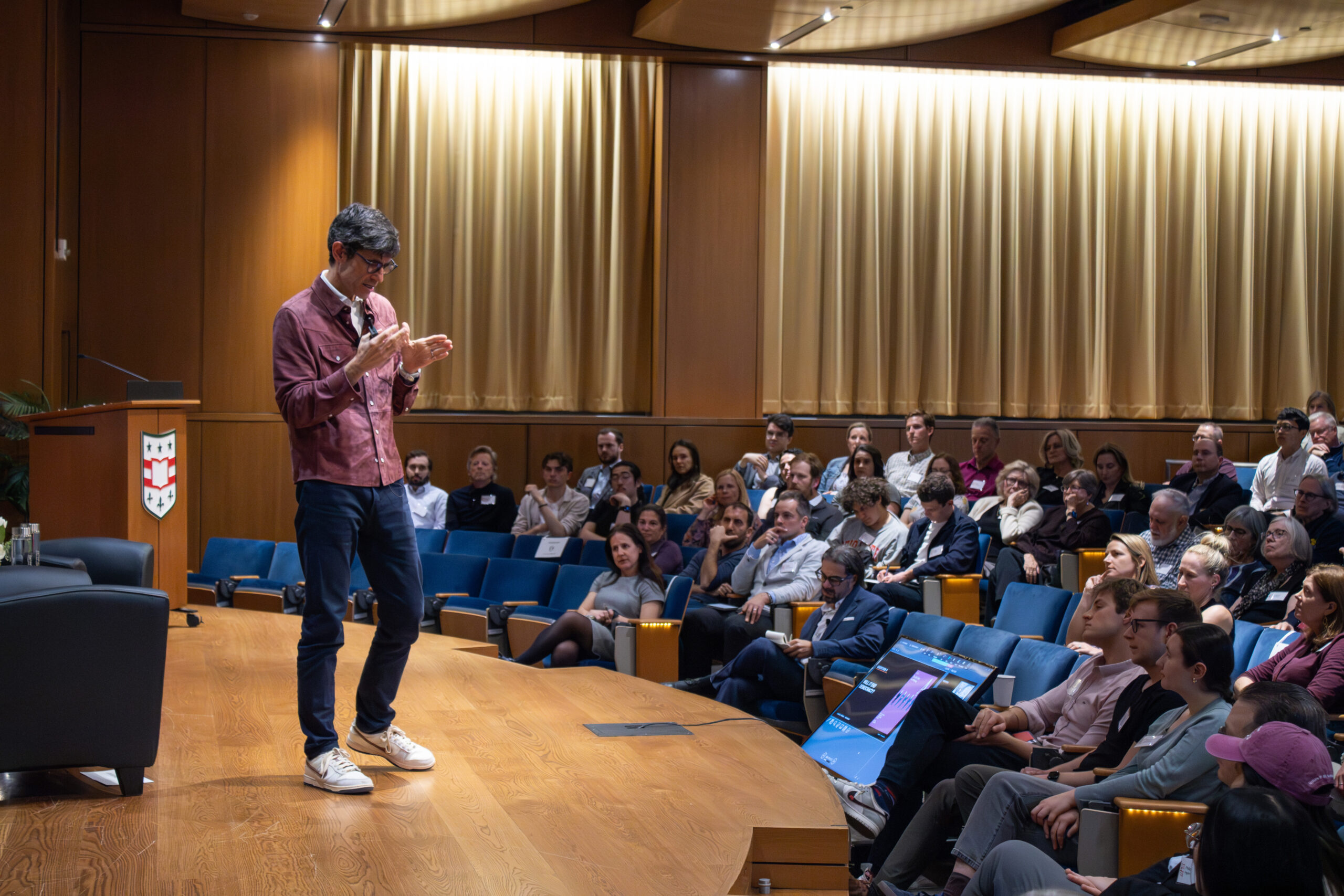
Nicholas Thompson, former Editor-in-Chief of WIRED and now CEO of The Atlantic, addressed a crowd of students and community members at Washington University (WashU) on March 25 as part of the university’s +AI Perspectives Week. With a focus on artificial intelligence, Thompson shared insights from his reporting on the subject since 2017 and offered guidance on navigating the complexities of this rapidly evolving technology.
Thompson struck a balance between optimism and caution, urging attendees to embrace the opportunities presented by AI while also acknowledging the societal risks associated with its overutilization. “AI tools are amazing. If you don’t use them, use them. If you’re a student, use them,” he emphasized. However, he warned, “remember also that they’re fools. They still hallucinate all the time; these agents make up garbage constantly.”
During his talk, Thompson presented a framework comprising 11 questions about AI and six guiding principles. He explored various controversial topics within the academic community, such as the potential of AI to enhance or diminish human intelligence, its effects on employment, and its implications for climate change, art, and democracy.
Thompson pointed out that early evidence does not support the notion that AI will lead to widespread unemployment, particularly in entry-level careers. However, he acknowledged that industries like engineering and media are experiencing hiring slowdowns due to the use of industry-generated data for AI training. “I was just talking to undergraduates about a chart showing professions of ‘where there’s going to be the most churn.’ My answer is you probably do want to work close to AI because that’s where the action is,” he said.
While encouraging students to leverage AI, Thompson cautioned against using it as a substitute for essential human skills. “Every time you offload tasks to AI, you weaken muscles in your own body,” he warned. He raised questions about which skills should remain untouched by AI, leading to a discussion on the cultural and personal significance of human effort. “Are there areas of our life that we’re like, ‘no, no, I’m gonna write the toast at my sister’s wedding?’” said Ben Huebner, a WashU MBA alum, echoing Thompson’s concerns.
Thompson expressed hope that AI could help reduce societal inequality, although he noted that technological advances like the Internet have often exacerbated disparities. “If I were president for the day, I would do everything I could to try to figure out how to make it so the benefits of AI accrue most widely,” he stated, highlighting the importance of equitable access to AI advancements.
He also raised alarms about the lack of understanding among developers regarding the inner workings of the AI models they create. “Just like we don’t really know how our brains work, they don’t know how the AI models work,” he commented, emphasizing the unpredictability of AI systems. “They know that if you pour a whole bunch of data into a big bucket and stir it around, you somehow get intelligence. But they don’t know exactly what’s going on underneath it.”
Despite acknowledging the anxieties surrounding AI, Thompson urged listeners to adopt a more positive outlook. “Human society is very resilient. Work is very resilient,” he remarked. In a subsequent interview with Student Life, Thompson discussed his approach at The Atlantic, where he encourages employees to utilize AI effectively without making it mandatory. “If you use AI smartly, you’re going to end up a lot more efficient than somebody who doesn’t,” he noted.
Thompson further encouraged young people to view AI as a tool that will reshape their lives positively. “The world is going to get remade, and it’s going to get remade by people who know how to use these tools,” he said. He expressed confidence that students would learn to harness AI, ultimately reaping its benefits.
Sophomore Devin Wallace reflected on Thompson’s insights, feeling motivated to explore AI while remaining aware of its limitations. “I think it’s a powerful tool to learn stuff,” he said, emphasizing the importance of focusing on what truly engages and inspires him. As the conversation around AI evolves, Thompson’s balanced perspective serves as a reminder of both the potential and the pitfalls of this transformative technology.
See also Microsoft Launches Elevate Program to Empower Nonprofits with AI Skills and Credential
 Education Next Reveals Polling Insights: Progressives’ Trust in Education Plummets
 AI’s Evolving Role in Higher Education: Insights from Boston City Campus’ Stephan van der Westhuizen
 17 Education & Technology Achieves Resilience Post-Regulation with AI-Driven K12 Solutions
 Discovery Education Launches Connected Ecosystem to Integrate AI and K-12 Instruction