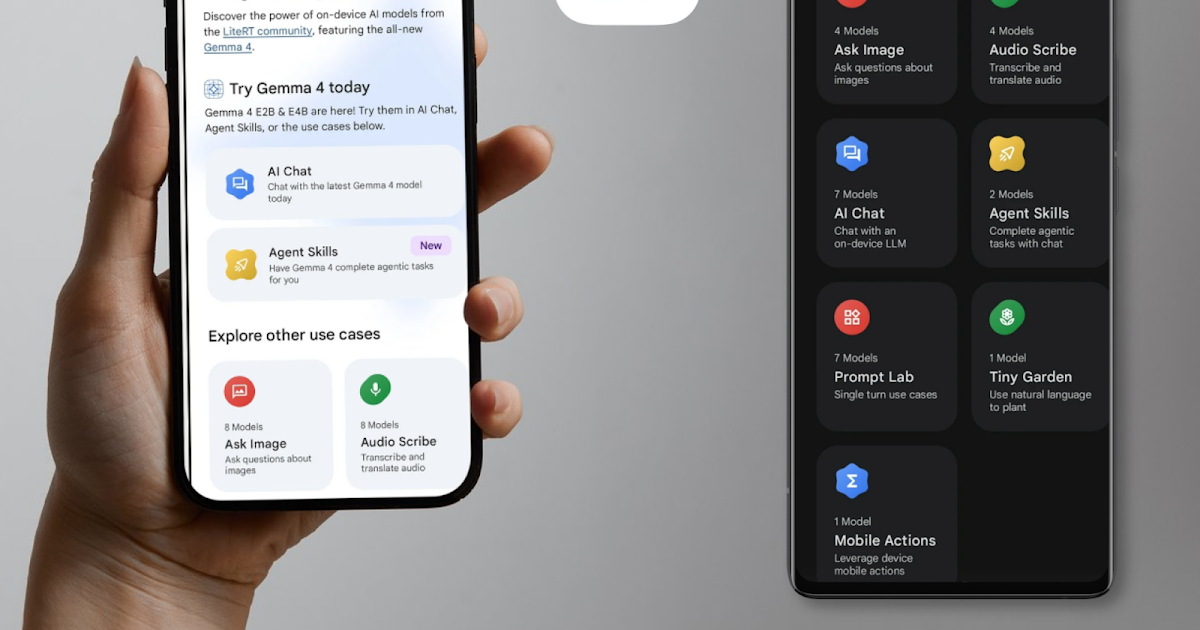
Google has launched its AI Edge Gallery app, powered by the new Gemma 4 models, allowing advanced artificial intelligence to operate fully offline without needing internet connectivity. Released in April 2026, this application prioritizes user data safety and privacy, offering immediate AI experiences directly on devices. Available for both iOS and Android, the AI Edge Gallery lets users create and experiment with AI solutions that process data locally, significantly minimizing the risk of data leaks or misuse.
The app’s features include offline AI execution, which enables generative AI and machine learning models to run directly on devices. This capability is particularly significant in today’s digital landscape, where data privacy concerns are paramount. By keeping user data local, Google aims to address growing apprehensions about cloud-based data security, where information is often vulnerable to breaches. Additionally, the app supports over 140 languages, broadening its accessibility to a global audience.
Among the notable functionalities, Google has introduced Agent Skills, which facilitate multi-step, autonomous workflows entirely on-device. This represents a shift in how AI can operate, moving from traditional cloud-based models that require constant internet access to more versatile, localized applications. This change not only enhances response times but also empowers users to leverage AI without worrying about connectivity issues.
The launch of AI Edge Gallery comes at a time when Google DeepMind has released its Gemma 4 AI models. This has led to remarkable interest in the application, with reports indicating a staggering 9,800% week-over-week growth in downloads following its introduction. The app is positioned to attract a diverse audience, including developers, enterprises, and everyday consumers seeking secure AI solutions without the constraints of internet reliance.
However, the shift toward on-device AI is not without its challenges. The performance of the AI Edge Gallery is dependent on the local hardware capabilities of users’ devices. Furthermore, developers will need to adapt their existing workflows to accommodate this new approach to AI, which may require a learning curve. The competitive landscape is also intensifying, with companies like Apple, Qualcomm, and NVIDIA investing heavily in edge AI technologies, each vying for a foothold in this emerging market.
Overall, the introduction of Google’s AI Edge Gallery marks a significant development in the field of artificial intelligence, emphasizing user privacy and instant accessibility. This aligns with broader trends advocating for decentralized, user-centric technology solutions. As businesses and consumers increasingly prioritize data security, solutions like the AI Edge Gallery could redefine the way AI is integrated into daily tasks, presenting opportunities for innovation and enhanced functionality in the tech ecosystem.
See also Google Pixel’s Private Space: A Game-Changer for Productivity and Digital Security
 AI in eLearning Market to Reach $12.2B by 2033, Driven by Personalized Learning Tools
 Duolingo CEO Luis von Ahn Reverses AI Performance Evaluation Amid Employee Backlash
 Ultrahuman Launches AI Health Platform Jade with New Ring PRO for Enhanced Tracking