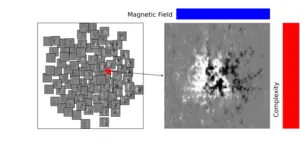
SAN ANTONIO — April 14, 2026 — New research from the Southwest Research Institute (SwRI) has employed a sophisticated integration of three types of machine learning models to generate solar magnetic patches with real physical properties. This novel approach transforms generative artificial intelligence (AI) from merely producing artificial data to serving as a powerful tool for scientific data interrogation, with implications extending beyond heliophysics.
Dr. Subhamoy Chatterjee, the first author of a paper published in the Astrophysical Journal Supplement Series, emphasized the growing challenge of managing astronomical data. “Modern astronomical observatories may produce millions of gigabytes of data during their lifetime. Manually labeling and sifting through such a vast dataset is becoming impossible in a human lifetime,” he noted. The difficulty lies not only in the volume of data but also in extracting meaningful information hidden within these extensive datasets.
The cyclical nature of solar activity, which spans roughly 11 years, has intrigued scientists for over a century. Understanding the patterns associated with solar active regions is crucial for linking them to solar flares, coronal mass ejections, and other significant space weather events that can impact technology on Earth. These active regions provide critical insights into the Sun’s polar magnetic field, essential for predicting future solar cycles.
“For example, rogue active regions of unusual size, tilt, and location have been found to make substantial impacts on solar cycles,” explained Dr. Andrés Muñoz-Jaramillo, the paper’s second author. “However, such regions are rare occurrences. To efficiently explore possible outcomes and their impacts on solar cycles, a scientist might want to create additional artificial examples.” This necessity underpins the potential of deep generative models, which can produce unseen artificial data that mirrors the properties of real data.
The research involved training a generative AI model using magnetic field measurements from Space-weather HMI Active Region Patches (SHARPs). This model connects physical properties to hidden data, allowing scientists to create virtual representations of regions that exhibit interesting characteristics. Consequently, researchers can re-analyze historical data to identify equivalent features without the need to examine every active region in prior datasets.
Such techniques not only enhance the scientific understanding of solar processes but also build confidence in the generative AI models through direct interaction with familiar real data. “We used magnetic field measurements from Space-weather HMI Active Region Patches (SHARPs) to train a generative AI model,” Chatterjee reiterated. “We then trained a model to connect the physical space and hidden generative space through ‘directions’ that correspond to different specific physical properties of active regions, including polarity, magnetic flux, complexity, and flaring nature.”
The derived connections allow users to manipulate generated active region images physically, enabling variability in their properties. The research team subsequently trained another machine learning model capable of querying generated images to find corresponding real images. “The generative and supervised model combination enables users to make generative model outcomes physically consistent,” noted Dr. Anna Malanushenko, the paper’s third author from the National Center for Atmospheric Research’s High Altitude Observatory. “Those outcomes can be used to retrieve real data that shares the same physical properties as the generated query.”
This innovative approach in heliophysics serves as a generic framework that can address various challenges, such as instrument-to-instrument translation, artifact correction, reconstruction of far-side active regions, and space weather forecasting. By enhancing the efficiency and accuracy of data processing in heliophysics, the research underscores the profound implications of generative AI in scientific exploration.
For those interested in the technical details of this research, the paper can be accessed at arXiv, with DOI 10.3847/1538-4365/ae47d9. For more information about the Southwest Research Institute’s work in the field of heliophysics, visit SwRI’s official site.
See also Microsoft Launches MAI-Image-2, Securing 3rd Place on AI Image Leaderboard
 OpenAI Reveals Language Models Can Learn Traits Subliminally Through Data Filtering
 rDPO Achieves 82.69% Macro Average Score with Instance-Specific Rubrics in Visual AI Tasks
 OpenAI Set to Launch GPT-6 This Week with Major Upgrades and Faster Development Cycle
 OpenAI Launches GPT-5.3 Instant Mini and $100 Pro Plan Amid User Backlash and Protests