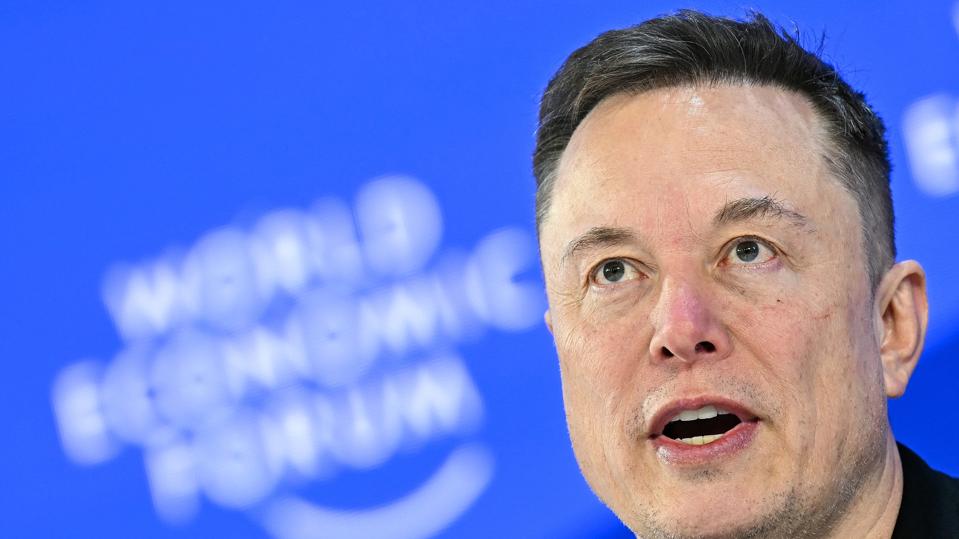
Elon Musk on Friday advocated for what he calls “Universal HIGH INCOME” as a potential remedy for widespread unemployment anticipated from advancements in artificial intelligence (AI). This declaration comes just days after OpenAI, a competitor in the tech landscape, unveiled its own policy suggestions, which include the creation of a public wealth fund and increased taxation on companies.
In a post shared on X, Musk detailed his version of universal high income, proposing that it would involve federal government checks funded by an “increase in the money supply” stemming from the proliferation of AI and robotics. He asserted that the “output of Business Services” would surpass the existing money supply, suggesting a new economic paradigm driven by technological advancement.
Musk’s advocacy for a universal basic income dates back to at least 2016, and he previously endorsed Democratic presidential candidate Andrew Yang in 2019, who proposed a similar initiative known as the “Freedom Dividend.” Recently, Musk reframed his concept as “universal high income.” Speaking at the Saudi-US Investment Forum, he expressed optimism, suggesting that AI could engender a level of prosperity that is currently unimaginable.
In a notable context of rivalry, OpenAI CEO Sam Altman, who is embroiled in a legal dispute and a public feud with Musk, has also championed universal basic income. Earlier this week, OpenAI released a document outlining a sweeping industrial policy aimed at addressing the ramifications of so-called “superintelligence,” defined as AI systems outperforming human intelligence. Although the proposal does not explicitly mention universal basic income, it advocates for a Public Wealth Fund designed to ensure that Americans have an automatic stake in AI companies and related infrastructure, irrespective of their direct investments in financial markets. The document also suggests raising corporate tax rates to counterbalance income tax losses and implementing taxes on businesses that replace human workers with AI technologies.
Economist and Nobel Laureate Joseph Stiglitz recently commented on the potential for AI to exacerbate inequality, warning that without proactive measures, its impact could be detrimental to socio-economic stability. He criticized proponents of reduced government intervention, stating, “If the tech oligarchs continue in their mindset overall of downscaling government, that will impair the ability of government to facilitate the AI transition.”
Contrasting with Musk’s vision, some of his close associates, including venture capitalist Marc Andreessen and former White House AI Czar David Sacks, have expressed skepticism about the feasibility of universal basic income. Sacks articulated this viewpoint in a post on X last year, arguing that the future of AI has become a “Rorschach test” where different factions see their own ideals. He accused some on the left of envisioning a society where people cease to work and rely solely on government benefits. Similarly, Andreessen, in his 2023 Techno-Optimist Manifesto, described universal basic income as a concept that would reduce individuals to “zoo animals to be farmed by the state.” He asserted that human beings are inherently meant to be productive and fulfilled rather than dependent on government provisions.
Musk’s latest remarks reinvigorate the ongoing debate surrounding the implications of AI advancements, particularly in the context of employment and economic stability. As the tech industry continues to evolve, discussions around wealth distribution and the role of government in mitigating inequality will likely gain further prominence, challenging conventional economic paradigms and necessitating a reevaluation of labor in an increasingly automated world.
See also OpenAI’s Chris Lehane Urges AI Firms to Improve Messaging Amid Rising Backlash
 Secure Traces Launches AI Readiness Offering, Reducing Risk by Up to 91% for Enterprises
 AI-Powered IoT Systems Boost Workplace Safety Compliance with Real-Time Monitoring
 Cybersecurity Experts Urge Swift AI Regulation Amid 44% Rise in Cyberattacks