SANTA CLARA, Calif., December 01, 2025 – A new study from Digitate reveals that enterprises in North America are evolving their artificial intelligence (AI) strategies, shifting the role of IT from a cost center to a driver of measurable business value. The report, titled Agentic AI and the Future of Enterprise IT, indicates that organizations are increasingly adopting intelligent systems that enhance operational autonomy.
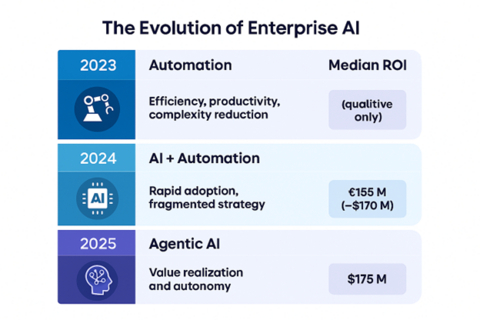
The research, conducted by Sapio Research, surveyed 600 IT decision-makers across the U.S. and Canada. The findings highlight a growing maturity in AI adoption, with nearly universal uptake among respondents. The study builds on Digitate’s previous analyses from 2023 and 2024, showing that enhanced trust in AI technologies is facilitating the transition to Agentic AI systems, which generate substantial returns on investment (ROI) and position IT as a core component of autonomous enterprises.
Key insights from the report emphasize that generative AI (GenAI) remains the most widely deployed model, utilized by 74% of the surveyed organizations. Additionally, over 40% have implemented agentic AI (44%) or agent-based AI (43%). On average, organizations are employing five different AI tools across various functions, underscoring the expanding role of AI in enterprise operations.
Despite varying levels of trust in AI, the report indicates that 94% of organizations consider these technologies reliable, although confidence dips to 87% in sensitive sectors such as healthcare and government. The trend towards autonomy is noteworthy, with 45% of enterprises currently operating semi- to fully autonomously, a figure projected to rise to 74% by 2030. Furthermore, 53% of organizations expect to achieve full autonomy within that timeframe.
The study also quantifies the financial impact of AI integration. Enterprises reported median returns of $175 million on $71.6 million in AI implementation expenses. IT operations (ITOps) lead AI adoption, with 78% of organizations deploying AI in this area and 65% recognizing the greatest benefits there, followed by software development and business intelligence.
As AI adoption flourishes, the role of ITOps is evolving into a strategic engine for enterprises. While nearly half of organizations still regard IT as a cost center, expectations are shifting towards recognizing its potential for profit generation within the next two to three years. High-investment companies, particularly those with budgets exceeding $500 million, are witnessing the most significant ROI, establishing a direct correlation between scale and strategic value as AI matures.
The report also addresses the operational challenges that organizations face. Despite the overall optimism surrounding AI, 94% of respondents indicated they have encountered limitations with their existing AI tools. Issues related to human intervention (47%), implementation costs (42%), and the need for ongoing oversight were cited as primary concerns. Furthermore, 96% of the organizations reported obstacles to adoption, primarily attributed to insufficient technical skills or the demand for staff upskilling (33%) and budget constraints (31%).
The research underscores a dual perspective within organizations, revealing a “strategy-execution gap.” While C-suite executives display a higher trust in AI, this sentiment is not uniformly shared among non-executives. Executives tend to concentrate on profitability and ROI, while operational teams prioritize efficiency and accuracy. As a result, leaders cite governance and cost control as main obstacles, whereas practitioners focus on technical skills and integration.
As organizations prepare for the future, almost three-quarters anticipate being semi- or fully autonomous by 2030. AI performance metrics are expected to evolve from basic uptime and cost reduction to encompass profitability, resilience, and innovation speed. The success of enterprises will hinge on investments in upskilling, integration, and responsible AI governance.
“In just three years, AI has moved from an operational utility to a strategic capability – one that’s trusted, governed, and measurable,” stated Avi Bhagtani, Chief Marketing Officer of Digitate. “AI maturity is accelerating the shift to the autonomous enterprise, enabling effective human-AI collaboration, and proving that IT is a driver of tangible business outcomes.” The report encapsulates a significant transition in enterprise operations, highlighting the need for a balanced approach between automation and human expertise in navigating the complexities of AI.
For additional insights, Digitate’s complete report Agentic AI and the Future of Enterprise IT is available online.
About the Report: The study, conducted by Sapio Research in September-October 2025, surveyed IT decision-makers from North American enterprises with over 1,000 employees that have implemented AI within the last two years. The findings are accurate to ±4% at the 95% confidence level.
About Digitate: Digitate develops AI technologies for the autonomous enterprise. Its Agentic AI platform, ignio™, integrates observability, AI-driven insights, and automation to enhance operational efficiency across industries. For more information, visit www.digitate.com.
See also Professors in ASEAN Call for AI Guidelines as ChatGPT Use Surges in Higher Education
 AI Agents Use GPT-5 and Claude to Simulate $4.6M in DeFi Exploits, Warns Anthropic Study
 Nvidia Launches Open-Source AI Models for Speech and Self-Driving Systems at NeurIPS 2025
 BC Medical Advancement Foundation Launches AI Lab Using 500M Medical Records for Enhanced Diagnosis
 Researchers Evaluate Five DNA Language Models for Genomic Tasks, Revealing Key Insights