Agriculture remains a cornerstone of global economic stability, providing essential food, jobs, and income for billions. However, the sector is increasingly threatened by factors such as climate change, dwindling resources, and financial instability. As rising temperatures and unpredictable rainfall disrupt agricultural productivity, especially in developing countries, the gaps in agricultural finance and policy execution exacerbate issues of inequality and food insecurity.
In response to these challenges, the integration of artificial intelligence (AI) into sustainable agriculture and agri-finance systems presents a transformative opportunity. AI technologies are poised to enhance climate intelligence, improve financial transparency, and refine agricultural value chains, leading to a more resilient global food system.
Yet, the adoption of AI-driven sustainable agri-finance and policy systems is notably limited in Nigeria, largely due to a lack of awareness. An Osun-born agricultural economist, Mr. Adedapo Emmanuel Alawode, has taken significant steps to bridge this knowledge gap through his extensive research. With a notable portfolio in AI, agricultural finance, climate resilience, and food security, Alawode’s contributions are beginning to reshape the discourse in this critical area.
His research paper, titled AI-Driven Climate-Smart Agriculture and Fraud-Resistant Green Finance, delves into how AI is revolutionizing agriculture into a data-driven and climate-resilient sector. By employing technologies such as drones, sensors, and satellite data, AI enhances various aspects of farming, from crop management to pest control. Additionally, Alawode addresses the risks of fraud in green finance, advocating for AI-based verification and geospatial monitoring to promote transparency.
Another significant work, Agricultural Subsidy Reforms and Their Effects on Smallholder Farmers, analyzes the impact of subsidy reforms on agricultural income and efficiency using data from Malawi, Nigeria, and Zambia. The study concludes that targeted and transparent subsidy systems, supported by extension services and credit access, can markedly improve productivity. However, challenges in administration and infrastructure continue to hinder progress.
In his paper Integrating IoT and AI in Sustainable Agriculture, Alawode illustrates how interconnected sensors and AI analytics can optimize resource use, minimize environmental damage, and enhance financial accountability. By utilizing predictive modeling, this research aims to bolster insurance accuracy and improve risk management. It proposes a framework that connects environmental sustainability with financial integrity.
Further, his study on Financial Derivatives and Risk Management in Agricultural Markets discusses how financial instruments like futures and options can mitigate market volatility and stabilize prices. While acknowledging the importance of derivatives in price discovery, the research emphasizes the necessity for inclusive regulations and financial education, given challenges posed by speculative trading.
Alawode’s exploration of The Role of Agricultural Value Chains in Enhancing Food Security and Economic Development highlights the significance of connecting farmers to markets and processors, thus boosting efficiency and minimizing losses. The upgrade of value chains can encourage food security, rural employment, and gender equity.
His comprehensive analysis on Climate Change Impacts on Agricultural Productivity and Rural Livelihoods in sub-Saharan Africa sheds light on how erratic weather patterns undermine yields. The research advocates for adaptation through technology and indigenous practices, emphasizing the need for inclusive policies that empower women and youth in resilience-building efforts.
In a recent article, Assessing Climate Change Impacts on Agricultural Productivity and Rural Livelihoods in sub-Saharan Africa, Alawode critically evaluates the multi-dimensional effects of climate change on agricultural productivity and the subsequent impact on rural incomes and employment trends. His findings offer a roadmap for integrating climate-smart agriculture with broader rural development agendas.
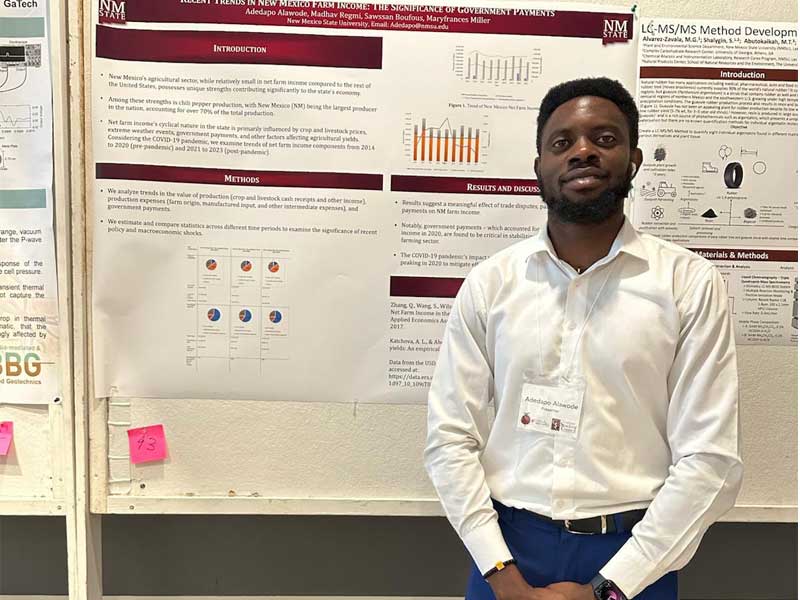
Moreover, Alawode has examined the complexity of U.S. food consumption in relation to food price changes and social demographics, as well as trends in New Mexico farm income in the context of government payments pre- and post-pandemic. His work in AI-Enhanced Scenario Planning for U.S. Food Trade Policy illustrates how AI can bolster trade policy amid global disruptions, advocating for ethical governance and collaborative measures to build resilient food systems.
The collective insights from Alawode’s research serve as a comprehensive guide for the modernization of agriculture and finance, emphasizing the critical interplay between technological advancement and economic policy. His work advocates for robust, fraud-resistant green finance mechanisms and transparent governance as essential components for a climate-resilient global food system.
Ultimately, Alawode’s research underscores the importance of integrating AI, digital integrity, and strategic policy planning to address the future challenges of agriculture, particularly in developing regions. By linking value chain enhancements to subsidy reforms and promoting environmental sustainability, his work offers a proactive vision aimed at transforming agriculture to withstand both current and future global challenges.
* Dr. Kehinde Ayodeji Damilola, a senior lecturer in the Department of Agricultural Economics at Obafemi Awolowo University, Ile-Ife, writes from Ife, Osun State.
See also Time Names “Architects of AI” as 2025 Person of the Year, Celebrating Transformative Innovations
 Mistral Launches Open Source Devstral Small 2 with 24B Parameters for Offline Coding
 Google DeepMind Launches UK Lab in 2026 to Innovate AI-Driven Material Discovery
 Disney Invests $1B in OpenAI for Groundbreaking Character Licensing Deal, Expanding AI Content Creation
 Flexible Procurement Practices Essential for Successful AI Adoption in Government