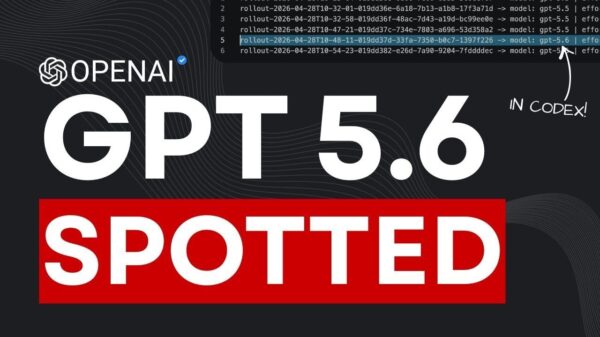

OpenAI has officially launched GPT-5.2, a significant upgrade designed to tackle complex, multi-step tasks across various domains, including spreadsheets, presentations, coding, images, and extensive documents. The new model is reported to enhance reasoning capabilities and tool usage for agentic workloads. This rollout follows a detailed announcement on OpenAI’s blog and a series of promotional posts from senior executives on LinkedIn, emphasizing the model’s potential applications in professional settings.
Fidji Simo, CEO of Applications at OpenAI, asserted on LinkedIn that “GPT-5.2 is here and it’s the best model out there for everyday professional work.” The company positions GPT-5.2 not merely as an upgrade for chat functionalities but as a robust engine for professional knowledge work. OpenAI has launched three variants of the model within ChatGPT: GPT-5.2 Instant, GPT-5.2 Thinking, and GPT-5.2 Pro, with initial availability under paid plans.
Kevin Weil, OpenAI’s VP for Science, highlighted the model’s advanced capabilities, noting that GPT-5.2 has achieved impressive results on several specialist benchmarks. This includes a score of 92.4% on GPQA Diamond, which consists of PhD-level questions in various scientific fields, and a 40.3% on Frontier Math, a climb from GPT-5.1’s previous score. Moreover, GPT-5.2 reached 70.9% on GDPval, a benchmark evaluating professional work across 44 occupations.
The company claims that GPT-5.2 is particularly well-suited for “professional knowledge work,” citing that average users of ChatGPT Enterprise report saving between 40 to 60 minutes daily, with heavy users benefiting from over 10 hours saved each week. OpenAI underscores GPT-5.2 Thinking as the primary tool for handling intricate workflows, achieving a remarkable performance on GDPval, where it surpassed or matched top industry professionals in 70.9% of cases evaluated.
On the engineering front, GPT-5.2 Thinking has reportedly set a new benchmark score of 55.6% on SWE-Bench Pro, which evaluates real-world software engineering across four programming languages. This improvement translates to enhanced capabilities for debugging production code, implementing feature requests, and refactoring extensive codebases with minimal manual intervention. Early feedback indicates a marked improvement in front-end tasks and complex UI work, including the creation of interactive web apps from single prompts.
In addition to coding enhancements, OpenAI asserts that GPT-5.2 Thinking has achieved a new high of 98.7% on the Tau2-bench Telecom benchmark for multi-turn customer support tasks, demonstrating its reliability in tool usage. The model also excels in long-context reasoning, achieving near 100% accuracy on OpenAI’s MRCRv2 evaluation, allowing for deep analysis of contracts, research papers, and multi-file projects without compromising coherence.
Notably, OpenAI has detailed significant gains in areas such as scientific workloads and reasoning benchmarks. In tests like GPQA Diamond and FrontierMath, GPT-5.2 Pro achieved 93.2% and 40.3% accuracy, respectively, highlighting the model’s capabilities in supporting scientific inquiry. Additionally, the new model surpassed previous benchmarks in abstract reasoning, breaking new ground in ARC-AGI assessments.
Despite these advancements, OpenAI acknowledges the limitations of GPT-5.2, particularly concerning safety and reliability. The company reports a 30% reduction in errors compared to GPT-5.1, although it emphasizes the necessity of double-checking results for critical applications. OpenAI has also made strides in safety measures, improving the model’s responses to prompts indicating potential mental health concerns.
As for pricing, GPT-5.2 is available in different tiers, with costs reflecting its capabilities. The Instant model is priced at $1.75 per million input tokens and $14 per million output tokens, while the Pro version is set at $21 per million input tokens and $168 per million output tokens. OpenAI clarifies that while GPT-5.2 is priced higher than its predecessor, its greater efficiency may result in lower overall costs for users.
Developed in collaboration with partners including NVIDIA and Microsoft, GPT-5.2 represents a further evolution in OpenAI’s ongoing advancements in artificial intelligence. As the company notes, this release is part of a broader roadmap, with ongoing efforts to enhance safety, reliability, and performance in high-stakes applications. The future of AI in professional workflows appears promising, driven by the capabilities introduced with GPT-5.2.
See also UK Government Partners with Google DeepMind to Launch Automated Research Lab in 2024
 University of California Launches CourseWise AI Tool to Streamline Credit Transfers at 120 Campuses
 AI Study Reveals Personalized Training Programs Transform University Physical Education
 Purdue University Mandates AI Competency for All Undergraduates Starting 2026
 Allentown School District Launches Podcast on AI in Education, Highlights Student Innovations