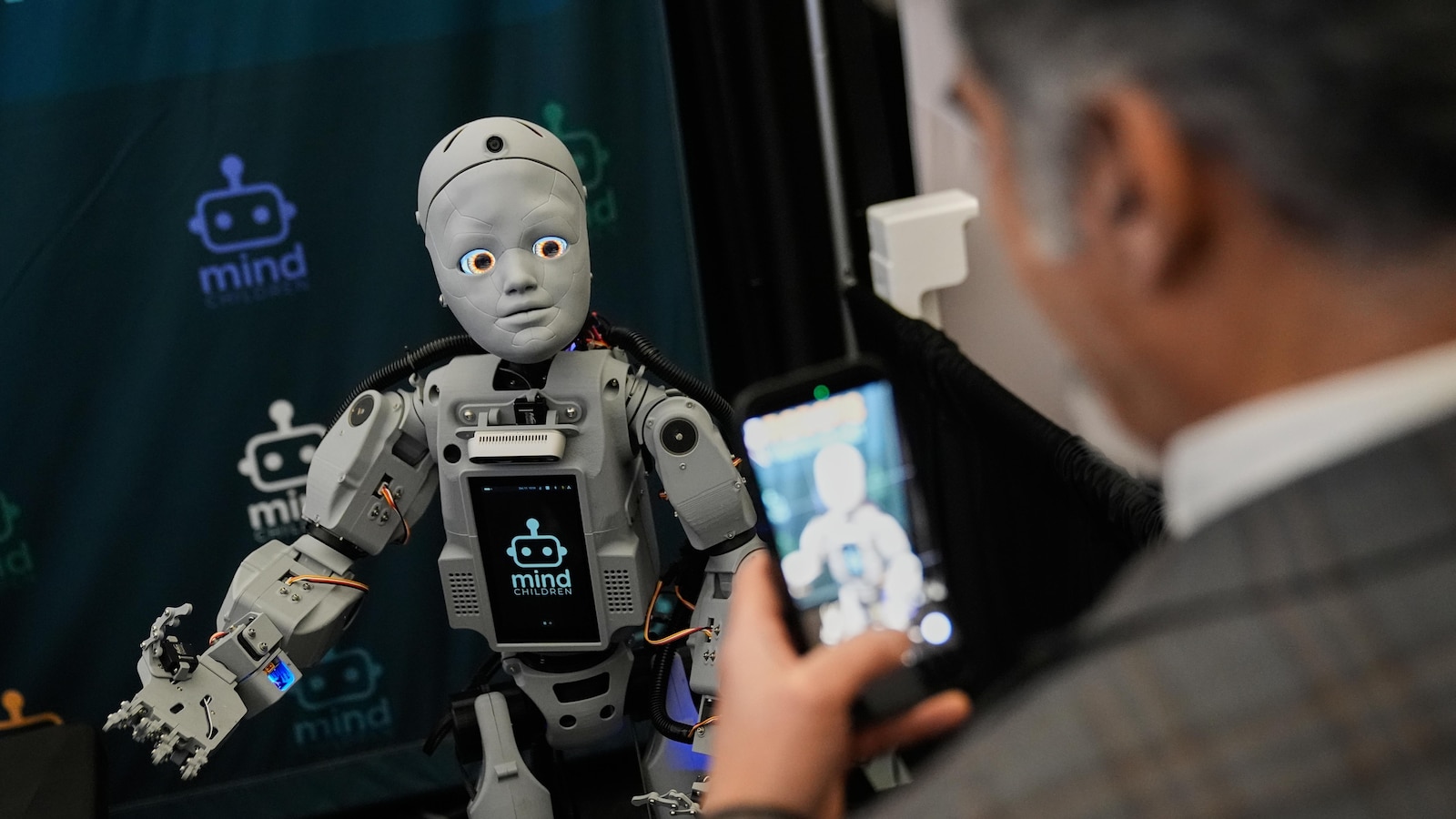
MOUNTAIN VIEW, Calif. — The rise of artificial intelligence (AI) has rejuvenated interest in humanoid robots, once considered a risky investment by Silicon Valley venture capitalists. Modar Alaoui, a prominent venture capitalist, described the field as “too complicated, capital-intensive and boring” but acknowledges that the commercial boom in AI has sparked renewed visions for robots that can mimic human movement and perform everyday tasks.
Alaoui, founder of the Humanoids Summit, recently hosted over 2,000 attendees, including leading robotics engineers from companies such as Disney and Google, to discuss the future of humanoid technology. He stated that many researchers believe physical embodiments of AI will “become the norm,” adding, “the question is really just how long it will take.”
One of the standout contributions from Disney is a walking robotic version of “Frozen” character Olaf, which is set to appear in Disneyland parks in Hong Kong and Paris next year. Despite the advancements in entertaining and complex robots, genuine “general purpose” robots—capable of functioning effectively in homes or workplaces—remain years away.
Even within a forum aimed at fostering excitement for humanoid technology, skepticism persists regarding the timeline for achieving true human-like robots. Cosima du Pasquier, founder and CEO of Haptica Robotics, emphasized the substantial challenges ahead, noting, “The humanoid space has a very, very big hill to climb. There’s a lot of research that still needs to be solved.” This sentiment reflects the cautious optimism that permeated the conference, held at the Computer History Museum.
According to researchers at McKinsey & Company, approximately 50 companies worldwide have raised at least $100 million for humanoid development, with around 20 in China and 15 in North America. China’s leadership in this sector is supported by government incentives aimed at stimulating component production and fostering robot adoption, including a mandate to establish a humanoid ecosystem by 2025.
Amidst the growing excitement for humanoid robots, advancements in generative AI, exemplified by tools like OpenAI’s ChatGPT and Google’s Gemini, have invigorated the robotics industry. Investors are increasingly funding startups focused on merging AI capabilities with physical robotic platforms. The same technological breakthroughs that enhanced AI chatbots have also aided robots in improving task performance, particularly when combined with computer vision.
Despite the burgeoning investment, some industry veterans remain skeptical. Rodney Brooks, co-founder of iRobot, recently expressed doubt regarding the ability of current humanoid robots to achieve dexterity, highlighting the limitations even amid substantial financial backing. His critical views were echoed frequently during the conference, even though he was not in attendance.
Notably absent from the discussions was any mention of Tesla CEO Elon Musk’s humanoid project, Optimus, which Musk claims will be “extremely capable” and available in high volumes. He had previously asserted that consumers could expect to purchase an Optimus within three to five years.
Alaoui, who has a background in automotive driver attention systems, drew parallels between the development of humanoids and the early days of self-driving cars. He referenced an exhibit at the summit showcasing Google’s 2014 prototype of a self-driving vehicle, noting that today, fully autonomous cars operated by Google’s affiliate Waymo are a common sight in the area.
Some humanoid robots are already being piloted in real-world settings. Just before the summit, Agility Robotics announced plans to deploy its tote-carrying robot, Digit, at a Texas distribution facility operated by Mercado Libre, a major Latin American e-commerce player. This robot boasts birdlike legs and is part of a trend that sees industrial robots commonly performing specific tasks in manufacturing.
Jeff Burnstein, president of the Association for Advancing Automation, noted ongoing lobbying efforts to enhance national strategies for developing domestic robots, whether humanoid or otherwise. “We have a lot of strong technology, we have the AI expertise here in the U.S.,” he stated, emphasizing that while the U.S. possesses significant capabilities, China currently enjoys more momentum in the humanoid sector.
As the landscape of robotics continues to evolve, the interplay between AI advancements and humanoid development will likely shape the future of automation across various industries, leaving industry watchers keenly attuned to the next wave of innovation.
See also Hitachi’s ITxOT and AI Strategy Reshapes Investment Outlook Amid Rising Costs
 Scott Bessent Proposes AI-Driven Finance Oversight, Aims to Cut Regulatory Barriers
AI Supply Chain: U.S.-China Rivalry Fuels Tech Cold War, Reshaping Global Power Dynamics
 3 Billion Lack Internet Access Amid AI Governance Debate, Threatening $3.5 Trillion Economic Boost
 NVIDIA Faces Growing Competition as Cloud Giants Drive $50B AI Infrastructure Surge