US companies are increasingly investing in artificial intelligence (AI), raising concerns about whether this spending boom masks a weaker underlying economic scenario. Despite a contraction in the first quarter following President Donald Trump‘s sweeping tariff announcement, the US economy has outperformed expectations this year, with projections for 2025 GDP growth ranging between 1.7 percent and 3 percent.
Moderate tariff increases have contributed to these revised estimates, but AI spending has emerged as a significant driver of growth. Analysis by KKR, a global investment firm, indicates that AI-related capital expenditures (capex) for the four largest hyper-scalers exceeded $350 billion this year. Meanwhile, UBS forecasts global AI capex spending to reach $423 billion in 2025, up from an earlier estimate of $375 billion, with spending expected to surpass $500 billion by next year.
Technology analyst Tim Bajarin, who has consulted for major firms like Apple and Microsoft, expressed caution regarding the sustainability of economic growth, but he distinguished the current situation from the 1990s dot-com bubble. He noted, “The fundamentals are strong compared to other hype cycles,” highlighting that AI tools such as Gemini and ChatGPT boast hundreds of millions of users. He emphasized the depth and focus of AI technology today, asserting that investments in data centers will have “lasting value.”
New projections from the US Federal Reserve indicate that the American economy will expand at a 2.3 percent pace next year, an increase of half a percentage point from earlier forecasts. Fed Chairman Jerome Powell attributed part of this growth to resilient consumer spending, stating, “AI spending on data centers and related to AI has been holding up business investment.” The AI boom has also led to a projected 9.9 percent growth in business equipment investments this year, according to the Equipment Leasing and Finance Foundation.
Despite tariffs weighing on exports, Matthew Martin, a senior US economist at Oxford Economics, noted that imports of computers and semiconductors have surged by 40 percent to 50 percent year-on-year, indicating strength in that sector. However, increasing demand for data centers raises concerns about rising energy costs, as these large-scale projects require substantial energy to operate.
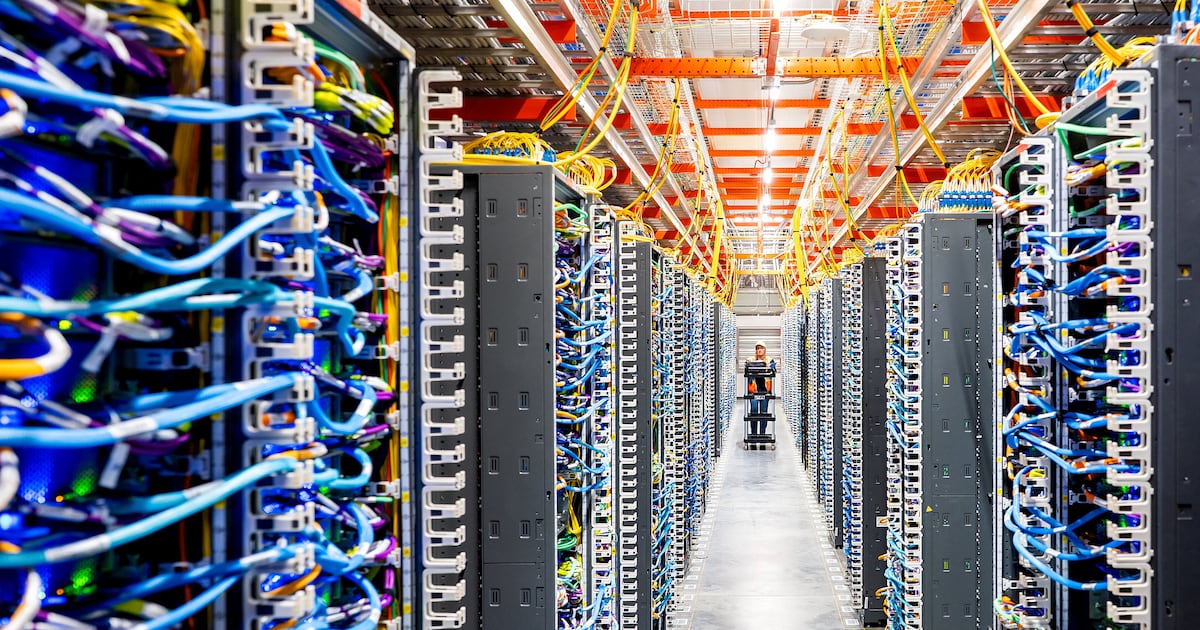
The International Energy Agency projects global electricity demand from data centers to more than double over the next five years, particularly affecting the US and Japan. Rising energy costs could ultimately be passed on to consumers as higher electricity bills, potentially dampening economic growth. Sean McDevitt, a partner at Arthur D Little, remarked, “We’re not talking about megawatt data centers anymore. These are gigawatt data centers,” stressing the industrial nature of these facilities.
While concerns about energy costs have contributed to market volatility, they have not halted the impressive performance of US markets. All three major Wall Street indices have reached record highs this year, spurred by AI-related investments. The top five companies in the S&P 500—Nvidia, Apple, Microsoft, Amazon, and Alphabet—now comprise roughly 30 percent of the index. Institutions such as the Fed and the International Monetary Fund have described these AI valuations as “stretched,” fueling debates over the potential for a market correction if productivity gains do not materialize.
However, economists assert that, unlike the dot-com bubble, companies engaged in the current AI frenzy are posting profits and maintaining viable business models. “If we see a correction next year, I believe it will clarify the investment opportunity in AI infrastructure, rather than weaken it,” remarked Natalie Hwang, founding managing partner at Apeira Capital.
Hyper-scalers show no signs of diminishing their AI investments. Firms such as Alphabet, Amazon, Meta, Microsoft, and Oracle have all increased their AI capex forecasts, with private companies like Anthropic and OpenAI also committing substantial investments. This surge in demand is expected to create compounding economic effects, necessitating increased spending on construction, technology, and energy to support the development of AI infrastructure.
As the US grapples with stagflationary tendencies characterized by higher inflation and lower job gains, a recent AI pulse survey by accounting firm EY revealed that companies investing in AI are witnessing productivity gains. Although some firms are downsizing, the survey found that most productivity gains are being reinvested to enhance talent and resilience. Martin pointed out that while increased productivity might suppress hiring, stronger economic growth could yield job creation in other areas, positively influencing wage growth without significant price hikes.
While uncertainties remain, Martin concluded, “Ultimately, the increased productivity would be very positive for the economy overall.”
See also European AI Startups Embrace Forward Deployed Engineers to Secure Top Talent Amid Competition
 Lunit and Daiichi Sankyo Join Forces to Accelerate AI-Driven Biomarker Discovery in Oncology
 2025 AI Rollouts: Companies Thrive by Tackling Real Problems, Not Technology Hype
 Amazon Launches AI Assistant in Kindle App to Answer Character and Plot Questions
 Merriam-Webster Declares “Slop” Word of the Year 2025 Amid AI Content Surge