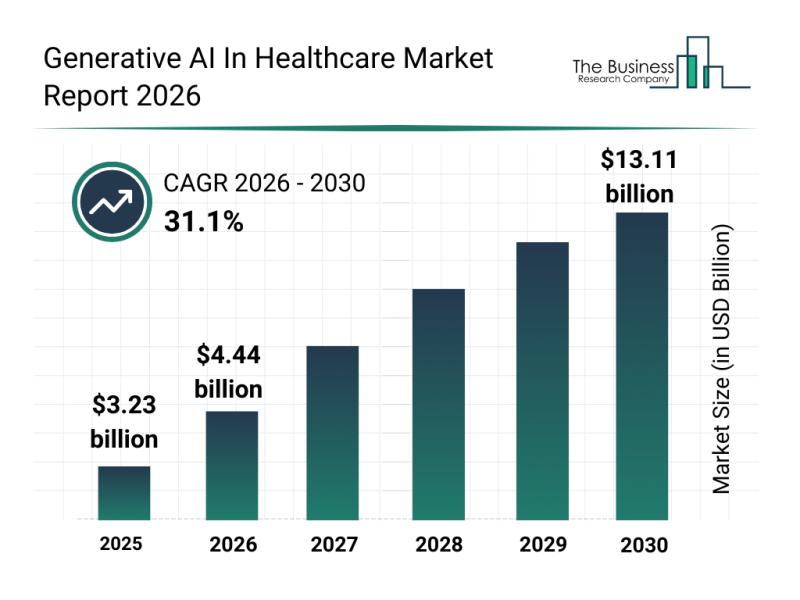
The healthcare industry is experiencing a profound evolution driven by advancements in generative AI technologies. These innovations are set to transform how medical professionals diagnose, treat, and manage patient care. The generative AI in healthcare market is projected to reach a market size of $13.11 billion by 2030, growing at an impressive compound annual growth rate (CAGR) of 31.1%. This remarkable growth is primarily fueled by increasing regulatory approvals for AI tools, wider adoption of clinical AI applications, and the growing utilization of real-world healthcare data.
Enhanced hospital automation and AI-enabled personalized treatment approaches are also significant contributors to this expansion. Key trends include the rising implementation of AI-assisted clinical decision support, the broader use of AI in medical imaging interpretation, the integration of virtual nursing assistants, and the expansion of predictive analytics in healthcare settings. These developments create a fertile environment for the generative AI healthcare market to flourish.
A crucial factor propelling market growth is the strong regulatory acceptance of AI technologies in healthcare, which encourages companies to innovate and deploy AI-driven solutions more widely. Hospitals and clinics are increasingly adopting automated systems powered by AI to enhance operational efficiency and improve patient outcomes. These advancements in AI tools are enhancing clinical workflows by analyzing vast datasets to inform tailored treatment plans, further reinforcing this momentum.
Several major corporations are influential in this burgeoning sector, including Alphabet Inc., Microsoft Corporation, Amazon Web Services Inc., Johnson & Johnson Services Inc., Siemens AG, and IBM Watson Health Corporation. In a notable collaboration in July 2024, GE HealthCare, a U.S.-based provider specializing in medical imaging, diagnostics, and healthcare IT, partnered with Amazon Web Services. This alliance aims to accelerate cloud-based imaging and AI-powered clinical workflow solutions, leveraging AWS’s generative AI infrastructure to enhance diagnostic accuracy and streamline clinical processes.
Innovations in assistive technologies are also playing a critical role in advancing healthcare AI applications. Companies are focusing on the development of AI-powered smart glasses designed for low vision support, enabling enhanced visual clarity and independence for individuals with visual impairments. For instance, in August 2024, Eyedaptic Inc., a vision technology firm based in the U.S., introduced the EYE6 smart glasses. These advanced wearable devices combine augmented reality with AI-driven vision enhancement to improve contrast and clarity for users with central vision loss.
The generative AI in healthcare market can be categorized into several segments for a comprehensive analysis. By component, it is divided into solutions and services. The functional breakdown includes AI-assisted robotic surgery, virtual nursing assistants, workflow and administrative tasks, and image analysis. The applications are categorized into clinical and system use, while the end users encompass hospitals and clinics, clinical research organizations, diagnostic centers, and other healthcare entities.
Under solutions, specific applications include diagnostic imaging analysis, drug discovery and development tools, personalized treatment planning, and AI-powered clinical decision support. Meanwhile, the services encompass consulting and advisory, implementation and integration, support and maintenance, and training and education services. This detailed segmentation showcases the diverse ways in which generative AI is applied across healthcare, catering to a broad spectrum of clinical and operational needs.
As the generative AI in healthcare market continues to evolve, the integration of AI technologies stands to enhance patient care and operational efficiency significantly. The ongoing collaborations and innovations within this field signal a robust growth trajectory in the years ahead, promising to reshape the healthcare landscape by leveraging data-driven insights and advanced diagnostic capabilities.
See also Australians Favor Brokers Over AI for Financial Decisions, Study Reveals Key Trends
 Anthropic’s Mythos Raises Cybersecurity Concerns as Major Banks Seek Access
 Ellucian Launches AI-Powered Student Platform to Transform Higher Education Outcomes
 Top 10 Private AI Companies Surpass $2.5T, Outpacing 115 Public SaaS Firms
 Adobe Approves $25B Buyback and Partners with DICK’S, Xfinity for AI Marketing Solutions