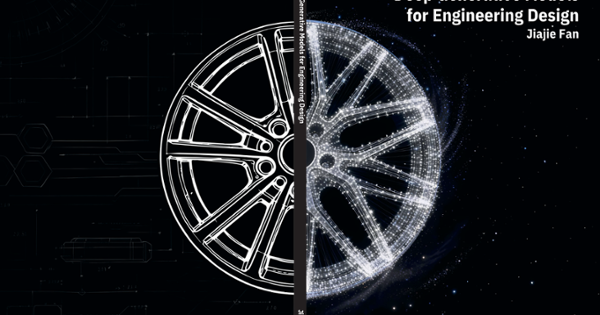
In a groundbreaking thesis, J. Fan explores the potential of deep generative models to enhance technical and industrial design, with a focus on creating realistic, efficient, and usable designs for complex 2D and 3D applications. The research, titled “Dissertation,” was published on March 24, 2026, and is available in the Leiden Repository.
Fan’s study emphasizes the critical role of noise in diffusion models, revealing that its application significantly influences the quality of generated designs. By developing a novel analysis method, the research identifies the optimal noise range for various datasets, addressing a gap in existing evaluation methods that often fail to align with human judgment. The new assessment method improves the consideration of structural quality in design evaluation, fostering advancements in AI-driven design processes.
The practical implications of these methodological advancements are demonstrated through a design autocompletion tool integrated into the BMW A-pillar design process. In this scenario, engineers provide incomplete geometries, and the model generates plausible initial proposals, greatly reducing the time needed for design completion. This innovation allows engineers to transition more swiftly to optimization and validation tasks, illustrating how generative tools can effectively support early-stage engineering workflows.
Shifting focus from 2D to 3D designs, Fan introduces a method to simplify complex 3D mesh shapes without sacrificing essential information, making them viable for generative modeling. The research showcases the system’s ability to generate diverse three-dimensional design variations, particularly applied to BMW car rim design. Rather than replacing human designers, the generative system serves as a catalyst for inspiration, broadening the design space and helping to overcome creative bottlenecks during concept development.
Moreover, Fan’s research demonstrates how these models can directly produce CAD geometry, including NURBS surfaces and B-Rep solids, marking a significant step toward practical applications within the industry. This capability facilitates integration with downstream engineering tools, enabling a synergistic relationship between generative modeling and simulation workflows. The theoretical framework established in this study suggests that simulation feedback can guide generative models toward structurally improved designs, allowing for iterative refinement driven by performance evaluation rather than solely geometric criteria.
In summary, Fan’s dissertation bridges the gap between cutting-edge AI research and practical industrial design, contributing to the development of more reliable and usable AI tools for designers and engineers. The findings underscore how generative AI can accelerate the creation of technical products, enabling firms to innovate faster and more efficiently. As the integration of generative models into design processes continues to evolve, the potential for such technology to reshape the landscape of industrial engineering remains significant.
See also OpenAI Launches ChatGPT Images 2.0, Surpassing Competitors in Image Generation Quality
 OpenAI Unveils ChatGPT Images 2.0, Enhancing Text Accuracy and Resolution Up to 2K
 Intel Launches vllm-0.14.0-b8.2 with Official Support for Arc Pro B70 GPU