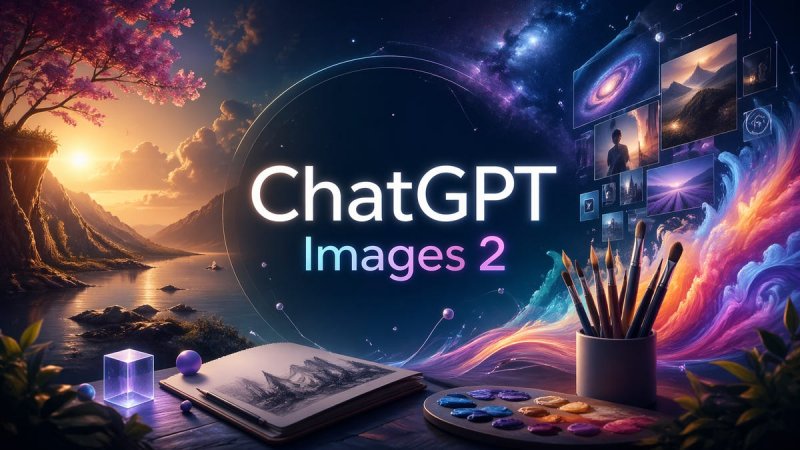
OpenAI has unveiled its latest image generation model, ChatGPT Images 2.0, which marks a significant advancement in the ability of artificial intelligence to create visually appealing and contextually appropriate images. Released recently, this model improves upon its predecessors by producing images that can convincingly mimic real-world items, such as a restaurant menu, with fewer errors in detail and accuracy.
Just a couple of years ago, earlier models struggled with basic tasks, often generating nonsensical words like “enchuita” and “burrto” when tasked with creating simple visuals. In contrast, Images 2.0 can generate a Mexican restaurant menu that appears realistic, though some prices, such as a $13.50 ceviche, may still seem questionable, according to reports from News.Az and TechCrunch.
Historically, AI image generators faced challenges in accurately rendering text due to their reliance on diffusion models. These models reconstruct images from noise, focusing primarily on broader visual patterns, which makes it difficult to capture finer details like written words. As noted by Asmelash Teka Hadgu in 2024, this limitation has been a persistent issue in the field of AI image generation.
To overcome these shortcomings, researchers have turned to alternative methods, including autoregressive models that generate images based on predictive capabilities, akin to how large language models function. While OpenAI has not disclosed the specific architecture of Images 2.0, the company highlighted its inclusion of “thinking capabilities” that enhance its versatility. These improvements allow the model to search the web, produce multiple images from a single prompt, and verify its outputs.
Among the notable advancements, OpenAI has indicated that Images 2.0 is better equipped to render non-Latin scripts, enhancing its usability across languages like Japanese, Korean, Hindi, and Bengali. However, the model’s knowledge base is limited to data available up to December 2025, which may impact its ability to reflect the most recent developments in various sectors.
OpenAI asserts that Images 2.0 offers higher precision and detail in image generation. It is capable of closely following instructions, maintaining requested design elements, and accurately rendering components that have historically posed challenges to image models, such as small text and icons. The model can produce images at resolutions up to 2K, allowing for intricate and dense visual compositions.
Despite these advanced capabilities, the process of image generation may take longer than simply typing out a standard query. Nonetheless, even complex outputs, such as multi-panel comic strips, can be produced within minutes, illustrating the efficiency improvements over earlier models.
Access to Images 2.0 is gradually being rolled out to all ChatGPT and Codex users, with paid subscribers gaining access to enhanced features. In addition, OpenAI is launching the gpt-image-2 API, with pricing structures tailored to output quality and resolution.
This launch underscores the continuous evolution of AI technology and its growing proficiency in creative fields. As AI-generated images become increasingly indistinguishable from human-created works, the implications for industries such as marketing, entertainment, and publishing are significant. With advancements like Images 2.0, OpenAI is positioning itself as a leader in the AI image generation landscape, paving the way for more creative possibilities in the digital age.
See also Intel Launches vllm-0.14.0-b8.2 with Official Support for Arc Pro B70 GPU
 OpenAI’s RealityForge 2.0 Launches, Surging AI Video Content by 40% in One Week
 Kuaishou’s Kling AI Surpasses $300M ARR and Hits 12M Monthly Active Users in 2026