






















































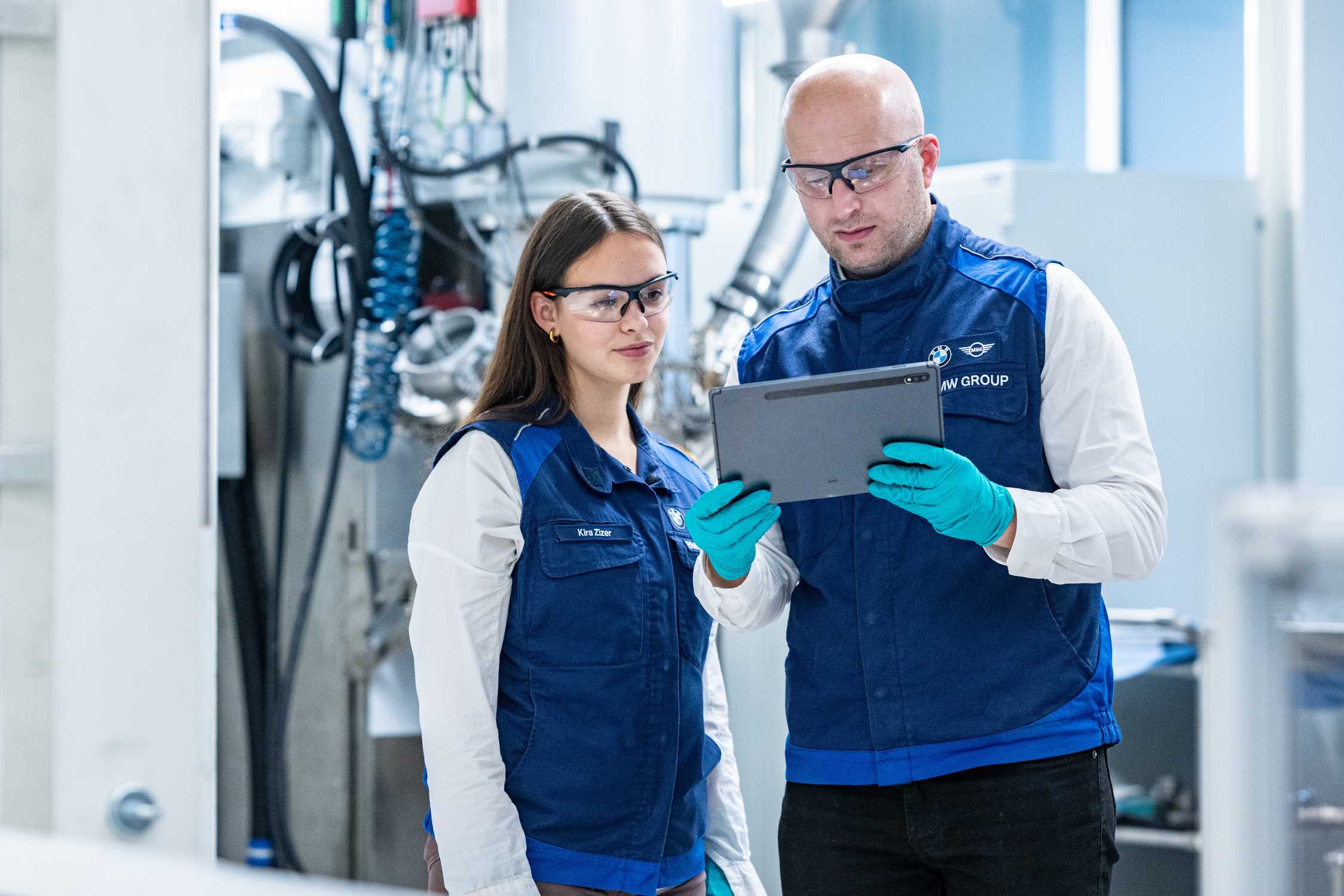
Munich/Zagreb. The BMW Group and the University of Zagreb’s Regional Centre of Excellence for Robotic Technology (CRTA) are collaborating on a significant research initiative aimed at enhancing battery cell production. The “Insight” project focuses on integrating artificial intelligence (AI) to optimize the entire battery cell value chain, from electrode manufacturing to testing and recycling. This partnership underscores the commitment of both entities to drive innovation in the automotive battery sector.
At the BMW Group’s Battery Cell Competence Centre (BCCC) in Munich, researchers are dedicated to developing advanced battery cells for future high-voltage applications. This entails conducting extensive test series that typically consume considerable time and resources, while also occupying essential manufacturing and laboratory facilities. The “Insight” project seeks to address these challenges by employing an AI network that leverages existing test data alongside real-time production data to predict critical process parameters and performance metrics. This predictive capability is expected to reduce the duration and frequency of testing by over 50%, all while maintaining or even enhancing quality levels.
In addition to streamlining testing processes, the AI systems developed through this research are set to transform the final approval phase of battery cells. Newly produced cells undergo a mandatory storage period, referred to as “quarantine,” where they are kept at specific temperatures before installation in a battery housing. The AI’s analytical capabilities may allow for a more thorough assessment of the battery cells, potentially eliminating the need for this storage step in the future, thereby further enhancing efficiency.
Since its launch in 2024, the collaboration has been focused on creating practical AI solutions to refine battery cell production. Doctoral candidates and students from the University of Zagreb play a pivotal role in this initiative, working to compile and analyze production data to develop AI models capable of identifying performance-enhancing patterns. “We are working on scaling the newly developed AI models from the prototype environment,” stated Christian Siedelhofer, head of Technology Development Lithium-Ion Battery Cells at the BMW Group. This collaboration also evaluates the applicability of these models to other use cases within BMW’s production network.
The partnership is mutually beneficial, with the University of Zagreb providing expertise in mechanical and electrical engineering, as well as computer science. This synergy not only enriches BMW’s technological advancements but also offers its students invaluable hands-on experience in a cutting-edge industry. Stefan Kerscher, head of Technology Development Battery Cells at BMW, expressed enthusiasm about attracting young talents to the field, highlighting that the project cultivates interest in AI and battery technology among students and graduates.
BMW’s strategy also encompasses the consolidation of its battery cell expertise across multiple Competence Centres located in Munich, Parsdorf, and Salching. The BCCC focuses on research and development for future battery technologies, while the Cell Manufacturing Competence Centre (CMCC) in Parsdorf aims to produce near-series battery cell concepts. This integrated approach fosters collaboration among development, purchasing, and production teams, ensuring that product and process innovations are effectively aligned. Furthermore, BMW is committed to sustainability, with efforts directed toward recycling materials through its Cell Recycling Competence Centre (CRCC) in Salching, in partnership with Encory GmbH. The BMW Group holds the intellectual property for its innovative direct recycling method.
As the automotive industry continues to evolve, the partnership between the BMW Group and the University of Zagreb exemplifies a proactive approach to developing the next generation of battery technologies. By harnessing AI to optimize production processes, the collaboration not only aims to increase efficiency and reduce costs but also focuses on nurturing the next wave of talent in a rapidly advancing field. This initiative highlights the significance of academic and corporate partnerships in driving technological innovation and enhancing competitiveness in the global market.
See also AI Will Redefine Legal Education, Says University of Sydney’s Law School Leadership
 NPL Integrates NVIDIA Ising AI to Automate Quantum Calibration and Enhance Stability
 Microsoft Executive Predicts AI Will Fuel Software Growth Despite Job Concerns
 Google Partners with Marvell for New AI Chip Design Focusing on Inferencing Solutions















