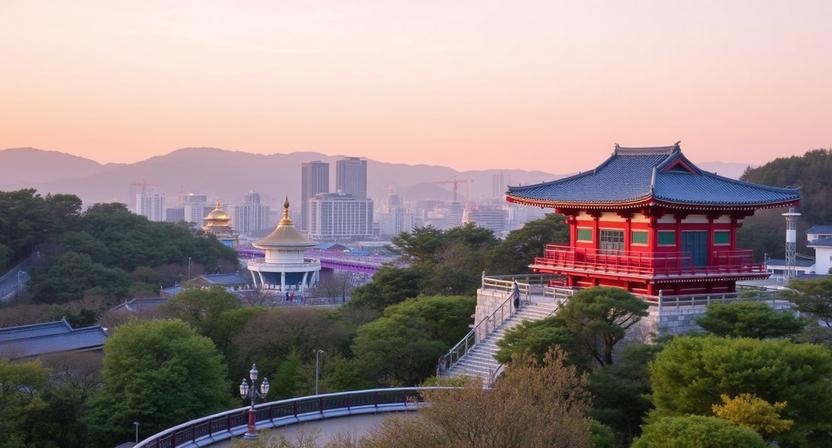
South Korea has announced an ambitious strategy to boost its tourism industry, aiming to attract 30 million international visitors by 2028. This goal, set by the Korea Tourism Organization, comes two years ahead of previous government forecasts and marks a significant shift from recovery-focused tourism policies to proactive expansion. The strategy emphasizes attracting higher-value travelers rather than merely increasing visitor numbers, leveraging technology and market diversification as key components.
2026 has been designated as the “action year” for this initiative, marking the start of a comprehensive transformation in how South Korea engages with international tourism. The roadmap consists of three core pillars: increasing visitor arrivals, extending visitor stays, and integrating artificial intelligence across the tourism ecosystem. This marks a significant departure from traditional marketing and air connectivity, with digital capabilities and experience quality taking center stage.
The confidence in achieving these targets is bolstered by a strong post-pandemic recovery, as South Korea recorded 18.9 million international visitors last year, representing a 15.7 percent annual growth and exceeding pre-pandemic levels by 8.2 percent. To meet the 2028 target, the country must sustain an annual growth rate exceeding 16 percent, which tourism officials acknowledge is ambitious yet essential for cementing South Korea’s position among Asia’s leading tourism economies.
A critical aspect of this strategy is closing the gap with Japan, which currently attracts approximately double the number of international visitors. South Korea’s approach reframes this gap as a growth opportunity, with officials seeking to enhance regional competitiveness through expanded market reach and improved visitor value. This shift from volume to value represents a new paradigm in tourism growth, focusing on key performance indicators such as length of stay, per-capita spending, and repeat visitation.
The strategy highlights segments with high growth potential, including medical and wellness tourism, beauty and lifestyle travel, and large-scale international conferences. These areas are prioritized to enhance economic impact while bolstering South Korea’s global tourism brand.
Market-specific strategies will also be employed, particularly in regions such as China, Japan, and Taiwan, where the focus will be on secondary cities and repeat travelers to alleviate congestion and extend geographic reach. In Southeast Asia and the Middle East, campaigns will center on K-culture, entertainment, and lifestyle products aimed at younger, experience-driven audiences. Meanwhile, North America and Europe will see enhanced digital and offline engagement to capture new long-haul demand, reflecting a transition towards precision tourism growth.
At the heart of South Korea’s tourism growth strategy is the integration of artificial intelligence. One flagship initiative involves the development of a unified Visit Korea platform by 2028, which will consolidate 13 current tourism websites into a single system. This platform is expected to feature a multilingual AI travel assistant, real-time recommendations, and integrated tourism and transportation passes, facilitating easier travel experiences and encouraging longer stays with higher spending.
In addition to domestic initiatives, South Korean tourism authorities plan to forge high-level partnerships with major hotel groups and online travel agencies. This corporate-level engagement aims to create global distribution effects, embedding South Korea deeper into international booking systems and travel campaigns, which could accelerate inbound tourism growth.
Domestically, the tourism growth strategy is also seen as a tool for regional revitalization. Pilot programs offering 50 percent travel refunds to visitors in 20 designated rural and depopulating regions are designed to promote travel outside major urban centers. This approach ties tourism growth to balanced national development, ensuring that increased visitor numbers yield broader economic benefits.
With this revised strategy, South Korea is signaling a transition from recovery to a more ambitious framework for tourism expansion. By integrating AI, focusing on high-value travel, and setting aggressive growth targets, South Korea seeks to become a leader in technology-driven tourism. Success in this initiative could not only bring the targeted 30 million visitors by 2028 but also establish a new standard for optimizing scale, value, and sustainability in the tourism industry.
For more information on South Korea’s tourism initiatives, visit the Korea.net.
See also Grok AI Restricted from Editing Revealing Images Amid Legal Scrutiny and User Safety Concerns
 U.S. Air Force Awards $15M to Matrix Research for AI-Powered Combat Identification System
 Singapore Unveils Global First Agentic AI Governance Framework; Armor Launches ASEAN Initiative to Ensure Compliance
 China Approves DeepSeek’s Conditional Purchase of Nvidia H200 Chips Amid Geopolitical Tensions